Cima and Pops’s Box Canyon Ranch
The Dog StarsCima and Pops’s Box Canyon Ranch is a hidden settlement where water, shelter, and cultivated land briefly sustain a life apart from the exposed country beyond. Hig discovers it from the air: a stone hut, a bridge over a creek, livestock on watered grass, and a garden fed from an oxbow. The ranch’s apparent abundance depends on a narrow local water source, and its eventual departure makes clear that even a place made habitable through labor cannot escape the worsening conditions around it.
Discovery and Physical Setting
Hig encounters the ranch while flying over a route he had previously traveled by truck. The old road has become overgrown, and from above he follows the creek rather than the track. A glimpse of red rock draws him toward a canyon he had never seen because his earlier journeys kept him on the road. The revelation is therefore also a change in perspective: the landscape contains a sheltered place that the familiar ground-level route had concealed.
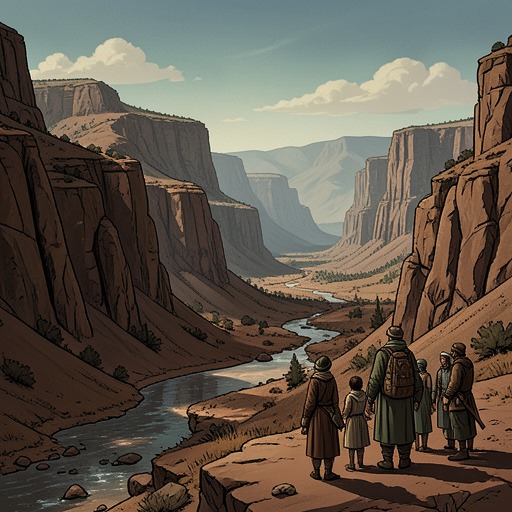
The canyon is enclosed by high walls, with a creek winding through a widening green interior and a meadow along one bank. Hig circles close enough to see the settlement’s features: a stone hut against the cliff, smoke rising from it, and a stone bridge crossing the creek to the field. Livestock are scattered across the watered grass. These details distinguish the ranch from an unoccupied refuge; the smoke, bridge, and managed field show a place being used and maintained.
The garden makes that work especially visible. It is larger than the garden Hig knows elsewhere, and a ditch carries water to it from an oxbow in the creek. The ranch is not simply adjacent to water: its residents have altered the flow to make cultivation possible. The creek, bridge, meadow, and irrigation ditch form a small system in which access to water connects shelter, food production, and animal care.
A Working Refuge
The ranch’s buildings and land are presented through practical signs of habitation rather than through an account of how the settlement began. A stone structure rests against the canyon wall; a bridge links it to the field; the garden is irrigated; and livestock graze on watered ground. Together these features establish a household landscape organized around subsistence. The canyon offers concealment and a usable patch of land, while the creek supplies the water on which the garden and pasture depend.
That visible self-sufficiency has limits. The place is green and productive at the moment Hig finds it, but the garden’s irrigation depends on the creek, and the pasture is explicitly described as watered grass. Elsewhere, Hig fears that the old seasonal patterns have become unreliable: recent winters have left mountain peaks dry, and he regards the loss of water as more alarming than attacks or disease. The ranch’s apparent plenty must be understood against that larger environmental uncertainty. Its waterworks show adaptation, not immunity.
The canyon also marks a contrast with Hig’s own experience of the surrounding mountains. He continues to seek streams and surviving green woods, even as warming water has driven trout away and altered what can be caught. Fishing offers him a reason to enter the mountains beyond immediate survival, but it also exposes him to the ecological losses taking place there. Against those diminished streams, the ranch’s irrigated garden and watered meadow appear as a concentrated pocket of life, dependent on the same vulnerable resource.
Drought and Departure
The ranch’s security is temporary. Hig considers the prospect that, if rain does not come within a few weeks, it will be time to leave. The statement gives the landscape a deadline: the canyon may shelter a household, but it cannot manufacture the rain on which its water supply ultimately depends. The decision to go is shaped not by a single attack or sudden destruction, but by the expected failure of the conditions that make staying possible.
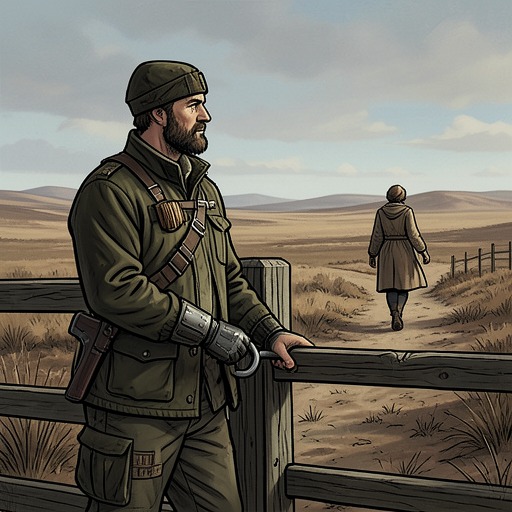
Pops leaves before full light. His departure is quiet and practical: he looks over the remaining cows and calves, sheep and lambs, takes a light pack and his rifle, and walks downstream through the brush fence. He latches the gate behind him. The gesture closes the ranch’s boundary as he exits it, while the animals and familiar ground remain on the other side. The departure carries the weight of a break with inherited continuity; the life he leaves is described as bound to his family line across generations, and as something lodged in his blood.
The contrast between the ranch’s careful cultivation and Pops’s departure gives the location its decisive significance. The stone bridge, irrigation ditch, garden, and managed animals record sustained effort to make a home in the canyon. Yet the threat of a dry season narrows that effort’s horizon, and leaving becomes a response to conditions no amount of local construction can control. The ranch is both refuge and threshold: a place capable of sustaining life for a time, and the place from which Pops must walk out when that life is no longer viable.
Ecological Memory and Meaning
The ranch’s green interior belongs to a book in which ecological loss is not an abstract backdrop. Hig grieves the disappearance of trout and other animals, and he fears the drying of creeks and mountains. In the surviving woods, fishing is also a way of attending to what remains: water, trees, and the possibility of recovery. That attention makes the canyon’s cultivated abundance meaningful without making it permanent. The garden and pasture represent life supported by water, while the threatened creek reminds the reader that their survival is conditional.
Hig’s first view of the ranch from the air also gives the place a particular narrative role. It is hidden not because it lies beyond the known world, but because ordinary movement along the overgrown road has kept it out of sight. The flight reveals an alternative landscape tucked into the larger one: inhabited, worked, and provisioned, yet still vulnerable to the same drought that has changed the streams elsewhere. When Pops leaves, the ranch’s story turns from discovery of a possible refuge toward recognition of its limits.