Cimarron
The Dog StarsCimarron, who introduces herself by the name Cima, is a physician whose memories and medical knowledge give the catastrophe a human and public-health dimension. In conversation with Hig, she recalls a future she once planned, describes the loss of her twin brother, and considers both the lingering disease that followed the pandemic and the unverified stories about how the outbreak began. Her presence in the canyon is also marked by ordinary acts of hospitality, which make the possibility of leaving that refuge a question about more than survival.
Identity and Earlier Plans
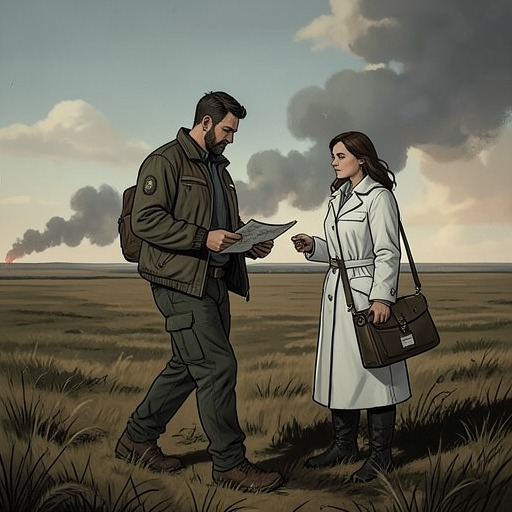
Cimarron first gives Hig her full name, then pauses, looks around the canyon, and settles on the name Cima. The small act of renaming herself is immediate and situated: she is standing in a place that has become home, and the name she chooses belongs to the life she is living there. The evidence does not explain whether she had used Cima before, but it presents the choice as a personal introduction rather than a formal change of identity.
Cima remembers having strong grades and test scores and expecting to become a veterinarian. Her plan was to attend Colorado State, return home, and establish a large-animal practice. That future had been settled in her mind from childhood. A college counselor controlled students’ placements closely enough that classmates gave him an insulting nickname; Cima recalls being summoned from an English class discussion of The Love Song of J. Alfred Prufrock to meet him. The recollection preserves the texture of her former life and its institutional routines, even though the available account does not complete the story of that meeting or explain how her career plans changed.
Her family history includes the death of her twin brother in a motorcycle accident when they were fifteen. Cima reports the loss plainly, without elaborating on its circumstances or aftermath. Its concise place in her conversation nonetheless establishes an early bereavement distinct from the later mass losses around her: the catastrophe did not begin her experience of grief.
Medicine and the Epidemic
In the canyon, Cima identifies her medical specialties as internal medicine and public health. These credentials shape her discussion of the illnesses that followed the flu, but her explanations remain careful about what is known and what is conjecture. The community of roughly thirty Mennonites living south of Hig and Bangley’s perimeter has a blood disease that appeared after the flu; children were born with it, many were weak and sick, and some died each year. The disease is compared to AIDS, but the comparison is an attempt to make an unfamiliar illness intelligible, not a confirmed identity between the conditions.
Cima also discusses a proposed mechanism for the autoimmune disease affecting survivors: its onset may have been accelerated when the body’s ability to produce vitamin D broke down. She likens the condition to AIDS through its effect on T cells, while qualifying the comparison as an analogy rather than a known equivalent. Her professional vocabulary offers Hig a framework for thinking about the epidemic’s aftermath, but it does not turn incomplete evidence into certainty.
The outbreak’s origin is similarly unresolved. When Hig asks whether it began in New Delhi, Cima does not confirm that attribution. The account recalls press reports linking the Africanized bird flu to a mutation of a superbug that researchers had monitored for two decades, and rumors that the pathogen originated at Livermore. One version of the rumor describes a military flight carrying a sample to England and crashing in Brampton. Cima acknowledges the rumor, but the conversation leaves its truth unestablished; the possibility that no one will ever know is part of the exchange. Her medical and public-health perspective therefore coexists with the limits imposed by the collapse of reliable reporting and investigation.
Life in the Canyon
Cima’s hospitality is conveyed through an extended meal with Hig. She serves shepherd’s pie, continues bringing him food as he eats, and offers milk that has been chilled in the creek. The scene gives practical care a domestic form: food is prepared and shared at the plank table, while the canyon household’s resources sustain a visitor. It also shows Hig becoming absorbed in the meal, a brief reprieve from the danger and deprivation outside the refuge.
The possibility of departure brings that refuge into focus. In a conversation about flying the three of them out, Cima is included in a prospective journey with Hig and Pops. Hig’s response emphasizes the contrast between the exposed world beyond the canyon and the relative peace of the place where Pops and the remains of his family can live. The exchange does not establish that Cima herself decides to leave, or what she wants from the plan; it shows instead that her future is implicated in a choice between the canyon’s shelter and the risks beyond it.
Character and Narrative Significance
Cima’s characterization rests on the joining of capacities that the narrative does not reduce to one another. She is a physician who can discuss population health and disease mechanisms, a daughter embedded in a family refuge, and a host who attends to a guest’s immediate needs. Her account of her twin’s death and her recollection of an abandoned professional plan give her a past beyond the epidemic, while her medical reasoning makes the epidemic more than a distant disaster: its effects continue in illness, vulnerability, and recurring deaths.
The uncertainty surrounding the pandemic’s origin sharpens this role. Cima can explain what was reported, distinguish a rumor from established fact, and offer a plausible account of post-pandemic disease, but neither expertise nor memory can restore the institutions needed to settle every question. Her conversations with Hig thus place knowledge beside its limits. The result is not a definitive medical history, but a portrait of care and inquiry continuing in a world where even the cause of its defining catastrophe may remain unknowable.