Coke Truck Confrontation
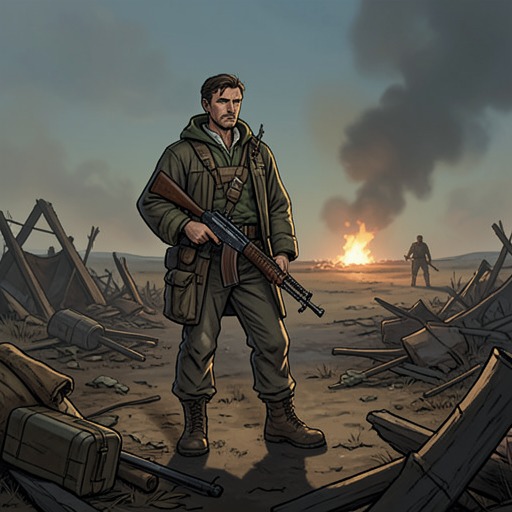
The Dog StarsThe Coke Truck Confrontation is a violent encounter over supplies that exposes the fault line in Hig and Bangley’s survival partnership. Hig’s first response is to try to control the danger without killing everyone involved; when the encounter escalates, he does kill one man, and another runs. The spilled cases and the requested cargo matter, but the deeper consequence is the disagreement that follows: whether a stranger should be granted time to prove himself harmless, or treated as a threat from the outset.
Discovery at the Trailer
Hig and his companion approach the Coca-Cola semi-trailer after noticing signs of someone inside. The dog’s short growl becomes continuous, and his raised hackles and fixed gaze direct Hig toward the trailer’s rear doors. One door is slightly ajar, and the odor coming from it confirms that something is drawing attention. The warning comes not from a visible lookout but from the dog’s behavior, which gives Hig time to watch the opening.
A man pushes the door wider and steps down from the bumper. He carries a bow and is described as a large, heavily dressed figure, with a ski jacket, camouflage hat, and tangled beard. He does not turn his back as he comes down. Hig fires twice; the man is knocked backward, and the bow clatters to the ground. A front wall of drink cases topples, scattering cans and bottles onto the road. The sudden crash is followed by silence, broken only when a Dr Pepper rolls out and hits the road. The cargo that might have been a practical prize has become part of the confrontation’s disorder.
Attempted Bargain and Escalation
Hig tells one of the men to get up and says he will not kill him. He then sets out a specific arrangement: the man is to drag his companion to the ditch and load the plane with twenty cases, fifteen of Coke and five of Sprite, plus two extra cases of Dr Pepper. Hig says he will take that cargo and leave the rest. He acknowledges that once the plane is airborne he cannot prevent what happens to the men, but says he will not kill the man in front of him because he has already done too much killing.
The arrangement is practical, but it is also a brief attempt to make room for restraint within an encounter governed by danger. Hig does not promise lasting protection or offer an open-ended alliance; he proposes an exchange with a defined load and a clear departure. The men are being given an opportunity to comply, not an assurance that the surrounding world is safe. That distinction matters: even while trying to avoid another death, Hig frames the bargain around the limits of what he can control once he leaves.
The man answers by invoking a feared outside group and warning that they will kill Hig’s opponents. Rather than calming the scene, the warning contributes to its escalation. An insulting remark follows. Hig then fires, killing the man. The other man drops the cases he is carrying and runs south through the fields. The outcome reverses the terms of the attempted bargain: the promised loading does not become a completed exchange, and Hig leaves with the encounter resolved by violence and flight rather than cooperation.
A Fracture in the Partnership
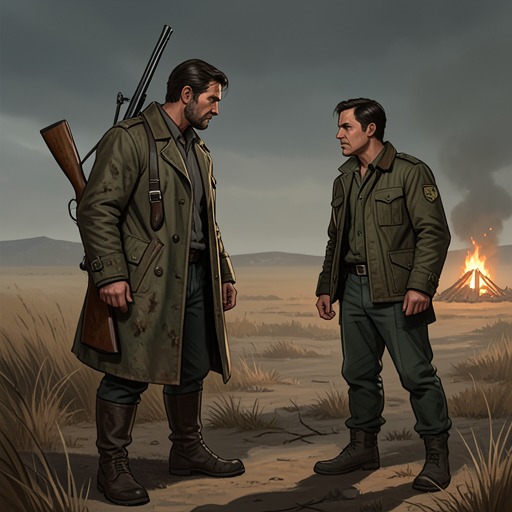
The confrontation is an instance of the bargain Hig and Bangley struck without negotiation, but it also reveals that their shared arrangement does not mean agreement on every decision. Bangley’s position is to shoot first and treat visitors as guilty unless they prove otherwise; his rule is never to negotiate, because negotiation risks death. Hig’s competing principle is to let a visitor live a little longer, on the expectation that a person may yet demonstrate his humanity. The truck encounter gives that principle a difficult, concrete test: Hig makes an offer, but the chance to accept it does not prevent the encounter from ending in a killing.
The disagreement is not simply about tactics. Bangley’s rule makes safety depend on decisive private force, while Hig’s approach leaves a narrow opening for judgment and response. Their protected perimeter, supplies, power, and firepower give them reasons to keep the arrangement simple and avoid internal conflict. Yet the confrontation shows that simplicity cannot eliminate moral choices; it can only postpone them until someone arrives at the boundary. The men at the truck make that boundary literal, while Hig and Bangley’s opposing responses reveal a crack in the union they depend on.
Consequences and Significance
The encounter leaves Hig with a limited supply of drinks as its immediate practical stake, but its more lasting consequence is the renewed awareness that he and Bangley remain divided over how to treat strangers. The episode does not settle the argument. Hig’s initial effort to spare a man coexists with the fact that he later shoots him; Bangley’s absolute rule remains in tension with Hig’s willingness to wait for proof. The scene therefore makes neither restraint nor force a simple solution.
Its structure turns on a failed exchange. Hig begins by watching for danger, answers the apparent threat, and then tries to convert the encounter into a controlled transaction. The cargo list makes that proposed control exact, down to the extra Dr Pepper; the fleeing man’s dropped cases make clear that the plan has collapsed. What remains is the unresolved question of what kind of order two isolated survivors can maintain: one founded on immediate lethal suspicion, or one that risks a short interval of trust. For Hig and Bangley, the truck is not merely a source of supplies but another point where their shared security and their differing principles meet.