DMZ (Quarantine Zone)
The Dog StarsThe DMZ (Quarantine Zone) is a fifteen-foot separation Hig and the Mennonite community preserve when they meet, turning uncertainty about disease into a rule for how aid and conversation can continue. It is neither a medically established safe distance nor a sealed boundary: the families and Hig rely on it because they feel more secure with the gap, while their dealings repeatedly test how firm it needs to be.
Origin and Purpose
Hig describes roughly thirty Mennonites living south of his position, affected by a blood disease that appeared after the flu. The illness has made many of them weak, and children were born with it; some people die each year. Hig compares it uncertainly to AIDS and wonders whether it may be more contagious, but the account offers no confirmed transmission mechanism. The community’s separation is therefore a response to fear under conditions of limited knowledge, not a measure grounded in a known medical threshold.
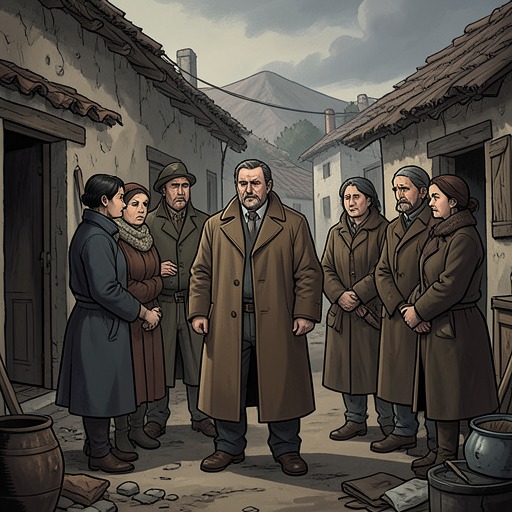
During one meeting, Hig and the families gather in the muddy yard and stop about fifteen feet apart. Hig understands the interval as a mutually respected demilitarized zone: a space across which they can speak and negotiate without closing the distance. They had settled on the practice without discussion or medical evidence. They believed infection was unlikely across that span, perhaps even at shorter distances or through casual touch, yet the gap made those present feel safer. Its force lies less in scientific certainty than in the shared willingness to observe it.
How the Boundary Works
The DMZ organizes ordinary contact as well as risk. Words pass across it, and when an exchange requires an object, the parties can place it between them for the other to retrieve. In this way, the separation allows assistance to continue without requiring either side to treat uncertainty as resolved. It is a negotiated practice, maintained through repeated encounters rather than enforced by a formal authority.
Hig’s relationship with the families includes practical help. After their solar water pump failed because of a fuse they did not have, he brought them a replacement the next morning. That history of mutual aid gives the protocol a double character: the same distance that limits contact also creates a workable arrangement through which help can reach the household. The DMZ protects a boundary, but it does not make the people on either side strangers to one another.
Encounters and Changes
The separation becomes especially charged when the family asks whether Hig will bring Jasper down. Hig cannot answer immediately; the question makes him stop. A girl has brought flowers as a present, and he breaks down in front of the family, grieving Jasper as well as everything else the loss represents. He accepts the flowers while still standing close to them, describing the emotional ordeal of loving and grieving across a distance that feels uncrossable. The protocol remains in place, but the scene shows that physical separation cannot prevent intimacy or shared feeling.
At a later meeting, the exchange becomes more direct. Reba, one of the women in the community, offers Hig a cracked plastic bucket full of early baby lettuce. He takes it hand to hand—the first time they have ever made that kind of contact. The moment marks a concrete change in their practice, though it does not establish that the disease risk has been medically settled or that the DMZ is abandoned. Instead, trust and need have permitted a particular crossing of the boundary.
Significance
The DMZ gives form to the tension between self-protection and care. Its measured distance makes cooperation possible while preserving the fear that contact may carry danger; the objects passed across it, the flowers offered in grief, and finally the bucket exchanged directly register different degrees of connection. The protocol’s meaning consequently changes with the encounters themselves. It begins as a shared precaution in the absence of reliable medical knowledge and becomes a flexible limit, capable of holding both caution and an emerging willingness to trust.