Deer
The Dog StarsDeer occupy a double place in Hig’s life after the collapse: they are dependable game that helps keep him fed, and living inhabitants of a damaged landscape he enters for more than food. Hunting them draws on his patience, field knowledge, and partnership with Bangley, while each trip also exposes him to the open ground and uncertain woods. The practical necessity of killing Deer never erases Hig’s awareness of what has disappeared around them—or his longing for a world in which the mountain streams still held Trout.
Food and Survival
Hig says plainly that killing Deer is something he can do without hesitation, and he connects the hunt to the work of dressing, butchering, and eating. When rabbits and sunfish grow tiresome, he goes after Deer; a successful trip can bring back substantial food. This is not a purely recreational pursuit in a world where each journey has a cost. Bangley evaluates a hunt in terms of the protein it provides against the danger of reaching the hunting ground, while Hig also values the time away from the airport and the chance to enter the woods.
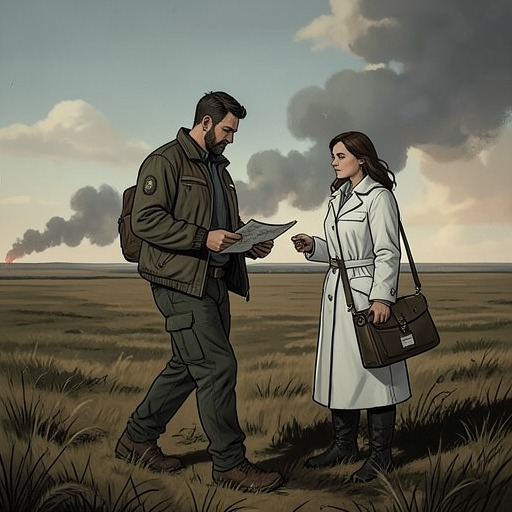
The terrain shapes the method. Deer roam the plains, but Hig observes that they seem to keep away from the airport, and he has little success stalking them in the open. He considers himself a mountain hunter. For one trip he cuts the deck off a kayak hull to make a green sled, which lets him drag a Deer back across the open country. The eight miles between the airport and the mountain front form both a working boundary and a hazardous stretch: Hig can reach cover on foot, but bringing game home means hauling it across exposed ground.
His return with two small female Deer shows how much effort can go into a modest harvest. On the tenth day away, Hig contacts Bangley by radio and reports the two animals in the sled. He does not consider the time away justified only by their size or the amount of food. When he later starts hauling the quartered animals toward the tower, Bangley warns him by radio that company is approaching. The hunt and its return are therefore part of the same precarious routine: food must be brought home through a perimeter that can quickly become a point of danger.
Hunting Knowledge and Risk
Hig’s hunting skill begins in childhood. At twelve, on his first Elk hunt with Uncle Pete, he proved attentive to terrain, habitat, wind, and sound. He learned to move quietly and to stalk carefully, abilities that remain useful in his later hunts. Yet the early experience also established a distinction that persists: Hig can perform the work of hunting, but the suffering of an animal is not what he loves about it. His competence does not make him indifferent.
As an adult, he prepares before walking into the woods. He flies over the area twice, once by day and once at night with Night-vision goggles, then makes a broad loop before returning from the north. He checks for people and tells Bangley what he has seen. On the ground, Hig covers the eight miles to the first trees with an empty sled before entering cover; on the way back, the load makes the journey slower and harder. Bangley watches over him from partway out, using their Handheld radio to maintain contact. Their division of labor is clear: Hig scouts and hunts, while Bangley provides armed protection.
That protection is not theoretical. During one return, Bangley waits with a clear view of the first trees and alerts Hig to approaching company as Hig struggles with the loaded sled. The warning interrupts a moment in which Hig has been thinking about the warmth of the dawn and the new grass and flowers. Such contrasts make the woods neither a refuge beyond danger nor simply a larder. They offer Hig a way into a world he values, but getting food from them means carrying the risks of that world back across open ground.
Deer and the Mountain Woods
Hig’s attraction to the mountains exceeds the usefulness of any one hunt. He describes going into the greener woods as a way to breathe, despite the danger. He watches for signs of Elk, sees Deer, and carries a rifle; but the forest is not merely a place to collect game. Its living patches matter to him against the expanses of beetle-killed and drought-stricken trees. He roots for the green woods to spread, and the landscape becomes a measure of what remains capable of recovering.
A planned spring outing brings together the different purposes of his journeys. Hig expects to take Jasper, the sled, and a fly rod into the mountains to look for a spring buck. He prefers mountain hunting partly because Deer on the plains are difficult to stalk, but he also wants to reach the high country before the creeks rise. The plan places a hunt alongside fishing and companionship rather than treating them as separate activities. Even when Hig goes in search of Deer, his attention remains on the season, the water, and the condition of the woods.
A later journey takes him through a wooded canyon where a stream runs below steep banks and open glades. The setting offers concealment and shelter, but it is also hunting country that Hig reads through his close attention to signs and movement. He eventually brings a large buck back from there, dragging it down the creek and lowering it by rope over the waterfall’s rim. He shares the meal with a man staying in the canyon. The passage shows Hig’s knowledge serving both subsistence and contact: the Deer he hunts supplies food, while the work around the hunt becomes one of the practical ways he and another person live alongside one another.
Ecological Loss and Grief
Hig’s respect for Deer sits within a broader grief for animal life that has vanished. He recalls the loss of species including the tiger, elephant, apes, and several birds, but identifies the disappearance of every Trout as the loss that brought him closest to tears. The distinction does not mean Deer are untouched by ecological change; rather, the surviving game exists amid evidence that the natural world he remembers is contracting. Deer are present enough to hunt, while other familiar forms of life are gone.
The changing water makes that loss concrete. Hig fears the disappearance of the creeks as well as the Trout, noting that mountain streams have become too warm for them. He still fishes for suckers and Carp, adapting his practice to the altered waters, and sometimes catches Carp where he once sought Trout. This altered fishing gives the Deer hunt a larger context: survival requires adapting to the species and conditions that remain, but adaptation does not restore what has been lost. Hig continues to enter green woods and hunt there even as he measures them against an earlier abundance.
The pattern returns in his later reflection that even the Carp might disappear. Deer remain part of his means of survival, but they are not proof that the ecological crisis has passed. The slow changes in temperature, water, and forest condition unfold alongside immediate needs for food and security. Hig’s hunting thus holds together two truths the narrative does not resolve: taking Deer is necessary and familiar work, while the landscapes that make the hunt possible are fragile and changing.
Narrative Significance
Deer reveal the practical and emotional complexity of Hig’s survival. He can hunt and butcher them, and he plans trips with the efficiency demanded by scarcity; at the same time, he seeks the mountain woods for breathing space and notices the signs of environmental decline. The contrast is not between a person who cares and one who does not. It is between care for the living world and the continuing need to draw food from it.
The hunts also connect Hig’s separate forms of knowledge. His childhood training, attention to animal sign, knowledge of the terrain, and reliance on Bangley’s protection all become part of the same routine. A sled, a radio, and a loaded journey across the plains turn an animal encounter into a sustained undertaking. Deer therefore matter not only as game but as a point where subsistence, risk, companionship, and ecological grief meet. Their continued presence sustains Hig, even as the vanished Trout and the changing woods keep that survival from feeling like restoration.