Ecological collapse and species extinction
The Dog StarsEcological collapse and species extinction are a continuing condition of Hig’s world, not a calamity confined to the past. As he travels between the plains and the mountains, missing animals, warming streams, falling water levels, and dead forests show how environmental change has narrowed both the living world and his sense of home. The few signs of recovery matter precisely because they coexist with losses that may already be irreversible.
Disappearance and Ecological Grief
Hig understands the disappearance of Trout as a defining loss. He remembers that Brookies, rainbows, browns, cutthroats, and other forms of Trout have vanished from the waters he knew. Their absence belongs to a larger register of disappearance: Hig also names the tiger, elephant, apes, baboon, cheetah, titmouse, frigate bird, gray pelican, gray whale, and collared dove among the animals no longer present in his account of the world. These are not abstract statistics for him. The loss of species registers as grief in its own right, alongside the death of Melissa, rather than merely serving as a metaphor for personal bereavement.
The dwindling Geese offer a more local, countable measure of decline. Hig recalls seeing five in October, and expects that none may return the following April. His estimate is not presented as a scientific census; its force lies in the way a rare sighting becomes a record of how little remains. The uncertainty itself is part of the loss: each season offers fewer grounds for assuming that familiar animals will still be there.
Warming Water and the Changing Mountains
The streams make environmental change tangible. Hig connects the disappearance of Trout to water that has grown too warm, and worries that the creek itself may be next. He continues fishing in the mountains, but the catch has changed: he takes suckers and Carp where Trout once defined the experience. Carp have moved into the ecological niche left by Trout and increasingly feed near the surface. The change alters not only which fish can be caught, but the fishing practice Hig has carried with him since before the collapse.
Even those replacement fish are vulnerable. In one episode, Hig catches several thin Carp and recognizes that they are starving, perhaps because warmer water has affected their food supply. He releases them carefully and stops fishing. Later, he frames the possibility of losing even Carp as another step in an accumulating sequence of disappearances. The sequence resists any comforting idea that less familiar species can simply substitute for those already gone.
Water loss is also visible in the canyon. After spending time near the stream, Hig sees its level dropping early and rapidly: the creek bed is increasingly exposed, and fish, crawfish, and frogs face the prospect of dying if the water disappears. Flowers have mostly faded after an unusually fast spring. Past seasonal cycles once seemed to promise that drought would break and life would return, but Hig can no longer rely on that pattern. In the wider region, he notes that the mountain peaks had held almost no snow for two consecutive years, a change that frightens him more than attacks or disease. The creek is both a source of life and a warning that the familiar seasonal order may not recover.
Forest Dieback and Uneven Renewal
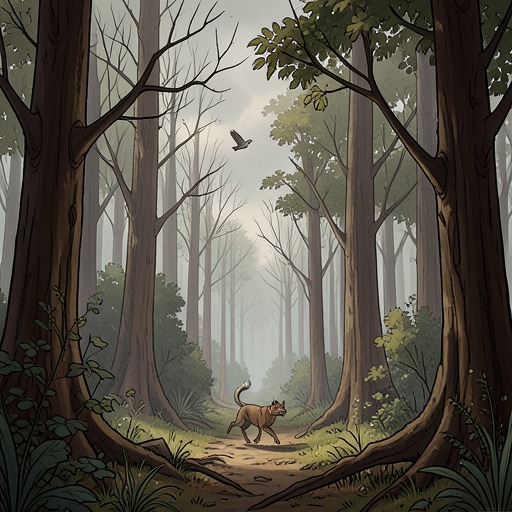
The forests likewise hold decline and persistence together. Much of the woodland near Hig’s home has been killed by beetles and drought; standing dead trees make the damage visible across the mountain skirt. Yet green patches remain, and Hig observes that they are spreading from year to year. He also goes into healthier or recovering woods to fish, choosing places that have not died or are beginning to return. Those surviving areas are not evidence that the forest has recovered as a whole. They are limited pockets within a landscape still marked by extensive dieback.
A sighting of a nighthawk, the first Hig has seen in years, provides another small sign that absence is not always permanent. Later observations from the air disclose a more mixed pattern: Bison are moving back toward their old range, and Wolves and Bighorn sheep are also returning to the surrounding region. Hig has seen Osprey and Bald eagles, while mice, hawks, and crows remain numerous. Spruce and fir, along with aspen, are coming back in some places even as miles of forest remain dead. These returns count as real ecological persistence, but they do not bring back the Trout, Elk, or other losses Hig names. Renewal is partial and uneven, not a restoration of the former world.
Human Life Within Environmental Decline
The changes affect human survival as well as Hig’s memories and routines. His household depends on food gathered or hunted in a landscape where animal populations have altered: when rabbits and sunfish become tiresome, he hunts Deer, and the Mennonite families to the south live with recurring scarcity amid a worsening drought. Their immediate illness is described as a blood disease following the pandemic, not as an effect of ecological collapse; the account nevertheless places vulnerable human communities within the same increasingly precarious environment.
In the canyon, drought has direct consequences for the family there. The creek nearly dried up the previous summer, forcing them to dig in its bed to collect enough water to drink, and half their cattle died. The stream’s decline therefore threatens drinking water, livestock, and the wider network of life at once. Such pressures unfold gradually, from season to season, rather than as one cleanly bounded disaster. Hig’s observations make that slow accumulation legible: diminished snow, faster springs, lower water, disappearing fish, and stressed animals each signal a world continuing to change.
Memory, Place, and the Limits of Recovery
For Hig, ecological loss is inseparable from place. The mountains matter not only as terrain but as the setting for fishing, breathing, and remembering a world in which many species still lived. He carries a fishing rod given to him by his father and continues to visit the streams, adapting to unfamiliar catches as their conditions change. The act preserves a connection to the landscape, but it cannot restore the Trout or the water temperatures that supported them.
The account grants nonhuman life its own stakes: Carp starve, streams diminish, and forests die or return in patches, whether or not those changes serve human needs. At the same time, Hig’s attention shows how environmental damage enters human feeling and daily practice. The surviving green woods and returning animals prevent the landscape from becoming a story of total disappearance, while the lost species and threatened waters prevent renewal from being mistaken for reversal. The ecological future remains unsettled, and every sign of life is measured against what has already gone.