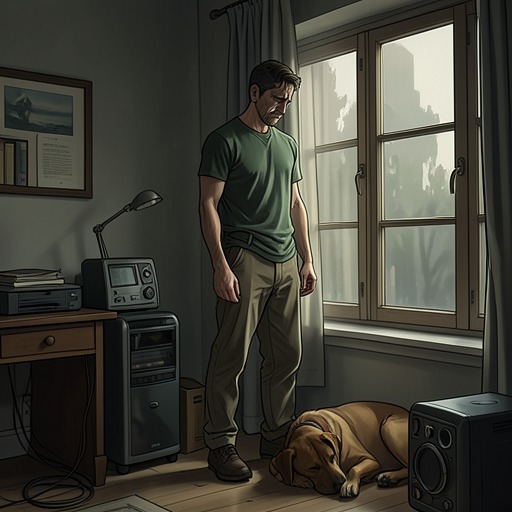
Hig Buries Jasper
The Dog StarsHig’s burial of Jasper turns the dog’s death into a deliberate act of farewell, and gives grief a place in the landscape the two had shared. At a familiar camp beside a changing creek, Hig buries his companion beneath the trees, marks the grave with stones, and leaves his sweater there. The ritual cannot reverse the loss; it makes the bond visible in the only way still available to him.
The Discovery at Camp
Hig wakes after a night spent outdoors to find frost covering the sleeping bag, his wool hat, and Jasper’s quilt. At first he expects to start a fire and warm them both. When Jasper does not respond, Hig tries to draw the quilt over him and touches his ear. The coldness makes the truth unmistakable: Jasper has died while Hig slept beside him.
The recognition is immediate, but the grief breaks through in a rush. Hig pulls Jasper’s stiff, curled body closer and lays the quilt over him. He remembers that the hike had been difficult for the dog and reproaches himself for not understanding how much trouble Jasper was having. The scene gives the death a painful human circumstance: Hig was close enough to share the cold night, yet did not realize that Jasper would not wake.
Hig’s first response is to remain beside Jasper rather than hurry into practical tasks. He tells himself that a fire can wait, and calls Jasper his little brother and his heart. The language marks a relationship that had long exceeded that of a man and a useful animal. Jasper had been Hig’s companion and alarm; now Hig faces the silence left by the one who had shared his routines and kept him company.
The Burial
On the third day, Hig wakes with a brief expectation that Jasper will stir. For a moment he has forgotten the death; then memory returns, along with the impossible hope that Jasper might somehow rise again. Hig sobs before gathering himself to carry Jasper beneath the trees. The delay and renewed shock show grief as something that does not resolve simply because the loss is already known.
Hig digs with whatever the ground and camp provide: a stick, a flat rock, and his fingers. He spends most of the morning making the grave deep enough to discourage a bear. The labor is slow and physical, but its purpose is care. Jasper is laid in the quilt, and Hig marks the farewell by telling him that their bond will not be undone by separation or place.
The site is one of their favorite camps, a place they had returned to year after year. Hig imagines Jasper’s spirit looking out over the creek as it changes with the seasons. That thought ties the burial to a particular landscape rather than to an abstract memorial: the grave belongs beside water and trees that had accompanied their repeated visits. The creek is changing, but it remains part of the place Hig and Jasper knew together.
A Memorial Made from the Place
After covering the grave, Hig spends the rest of the day gathering cobbles, rounded stones, and heavier rocks smoothed by the stream. He piles them into a mound that reaches his chest. The effort turns scattered materials from the campsite into a marker, and the stones’ shaping by moving water connects the memorial to the creek that defines the camp.
Hig is uncertain what to place at the top. He chooses his old wool sweater, which carries Jasper’s smell as well as his own, lays it over the mound, and adds more stones. The shared scent makes the object more than a marker: it preserves a trace of their closeness, even as Hig acknowledges that the seasons will eventually dissolve it. His imagined prayer-flag image holds both impulses together—the wish to cover and protect Jasper, and the knowledge that neither cloth nor stone can keep time from acting on the grave.
When the burial and mound are finished, Hig loads the sled and walks upstream. The departure is another part of the farewell, but it does not happen cleanly. He stops and turns repeatedly, almost as if to call Jasper to keep up, then shoulders himself back toward the trail. At one point he faces the sun with his eyes closed and lets its light meet his tears. His grief remains in motion: the walk continues, while his habits still expect Jasper beside him.
Loss Within a Changing World
Jasper’s burial occurs within a broader pattern of ecological loss that shapes Hig’s life. He once loved fishing for trout, but the trout have disappeared from the streams as the water has grown too warm. In the mountains, Hig still seeks out places that remain green or are beginning to recover, and he finds comfort in the smell of running water and cold stone. The camp’s creek is therefore both a companion to the burial and a reminder that the natural world around Hig is changing.
The book places Hig’s sorrow for Jasper alongside his grief for vanished species and altered seasons without reducing either loss to the other. The death is personal and particular: this is the dog who stayed with Hig, shared the camps, and was expected to rise from beneath the quilt. The stones, sweater, and repeated backward glances give that attachment its own ritual form. By burying Jasper in a place they loved, Hig honors a relationship that had helped make an isolated life bearable, even as he has to leave the grave and continue alone.