Hig Makes an Emergency Landing in Box Canyon and Confronts Pops
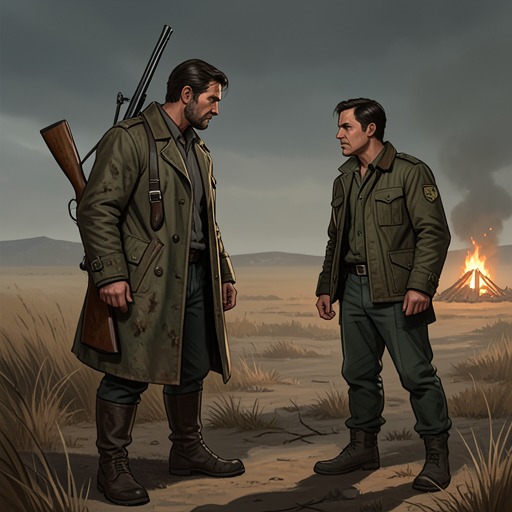
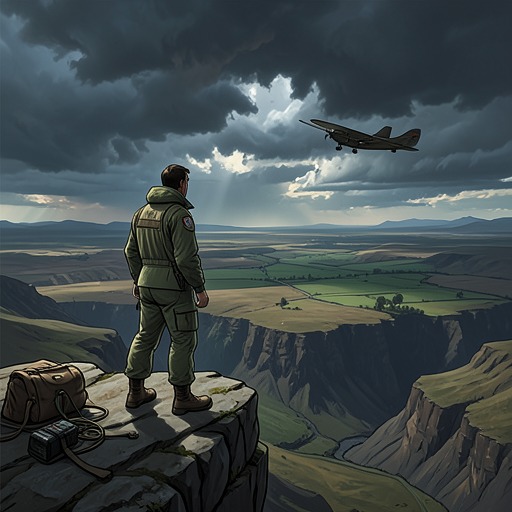
The Dog StarsHig Makes an Emergency Landing in Box Canyon and Confronts Pops turns a dangerous landing into a test of how much room a survivor can afford to give another armed person. After the Beast is hit while Hig is flying over the canyon, he brings it down on rough ground, secures the aircraft, and moves toward the people below with weapons close at hand. He does not surrender his caution; instead, he tries to make contact without making violence inevitable. The scene gives physical form to the conflict between Bangley’s uncompromising security rules and Hig’s belief that a stranger may yet prove to be human.
Causes and Stakes
Hig and Bangley’s partnership rests on a hard bargain: they rely on the airport’s perimeter, water, power, food, and firepower, while keeping their shared life deliberately simple. Bangley sees security as a matter of acting before a potential threat can act. Hig recognizes the logic of that approach but resists making suspicion the only rule. Their disagreement is not abstract. In Hig’s view, visitors might demonstrate that they are not enemies if they are given time; in Bangley’s, hesitation is a negotiation that may cost a life. The canyon encounter carries that unresolved difference into a situation where the person below is armed and Hig is exposed.
The immediate danger comes during the flight. Birdshot strikes the Beast, damaging the aircraft and forcing Hig to climb away over the canyon rim. He checks that the plane remains controllable and that the engine and flight controls still function, then turns to the next problem: finding somewhere to land. The attack makes the landing more than a technical necessity. Hig must put the aircraft down in unfamiliar, broken country while knowing that someone below has already tried to stop him.
The Landing
Hig rejects a sage meadow because rocks hidden in the brush might damage the landing gear. Instead, he chooses a rutted track, a known hazard that he can inspect, and studies the wind because the landing will require close control. With no tundra tires to soften the risks of rough terrain, he aims to keep one wheel on the center hump and the other along the brush at the track’s edge. The choice is practical rather than comfortable: he accepts a visible difficulty over a concealed one.
The Beast comes down through gusts and thick sage. Hig works to keep the nose from entering the ditch and the right main wheel from dropping into a rut. The brush batters the aircraft as it slows, but it reaches a patch of low rocks and shortened grass and stops before the piñons. The successful landing is a narrow reprieve, not safety. Hig has brought the plane down in a place where he must still confront the people who fired at it.
Before walking away, he drives three stakes into the ground and ties the Beast down facing its takeoff direction. He pours the remaining fuel from the jugs into the wing tanks, takes the key, and puts two of Bangley’s grenades in his jacket. He also takes the AR-15. These preparations preserve a route back to the aircraft and give him options if the encounter turns against him; they show that approaching Pops does not mean approaching unarmed.
Contact Across the Canyon
Hig has used written messages before to control distance. He keeps paper and crayons in the aircraft and has dropped short, graphic warnings, wrapped around stones, to people camped too close to the airport. He has also used such messages to persuade a band of pirates to leave. In the canyon, he again uses a message rather than immediately closing the distance: from behind a rock, he writes words and holds them over the edge on a stick. The person on the other end does not answer at once. The silence makes the exchange a negotiation, though Hig and Pops have not met face to face.
When the pause continues, Hig pulls the pin on a grenade and tosses it over the edge. The gesture escalates the danger and demonstrates that he can use force, but the following demand is for the person below to stand up. Hig rises only to one knee, keeps his aim, and calls down that the other side can keep its guns while he comes down. The sequence is deliberately mixed: a grenade and a weapon establish the seriousness of the threat, while his offer not to disarm Pops leaves open the possibility of meeting without an immediate surrender or attack.
The Approach and Its Significance
Hig then prepares to descend. He puts a second grenade in his jacket, takes venison jerky as a peace offering, slings the AR-15 over his shoulder, and crosses the sage meadow toward the canyon. He works up through the piñons until the cleft becomes shallower, then finds a game trail leading down to the creek. The jerky does not erase the danger, and the weapons do not disappear; the approach holds both facts together. Hig offers something that can be shared while keeping himself ready to defend against a threat.
The scene therefore stops short of presenting trust as a simple alternative to self-protection. Hig has just experienced the cost of being targeted, and he responds with precautions, a grenade, and an armed descent. Yet he does not treat the first sign of hostility as proof that killing is the only possible outcome. His earlier willingness to let a visitor live long enough to show who he is now becomes a concrete action. Against Bangley’s rule never to negotiate, Hig accepts the risk of contact and tries to make an encounter possible on terms that leave both men armed. The landing secures the Beast; the measured, uncertain approach toward Pops is the more consequential decision.