Hig and Jasper’s bond
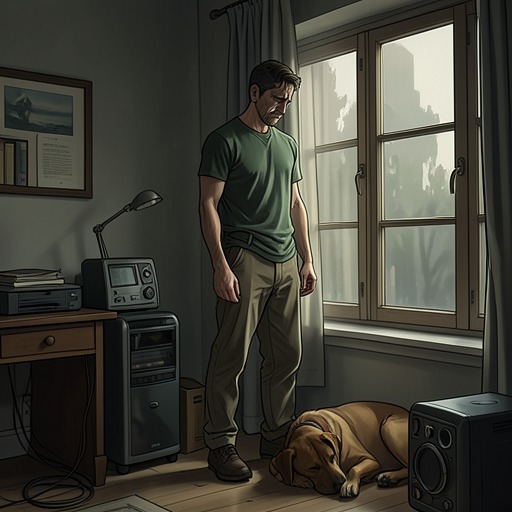
The Dog StarsHig and Jasper’s bond is both a survival partnership and a deeply personal attachment: Jasper helps keep watch, accompanies Hig through ordinary routines, and becomes the companion whose absence makes loss impossible to keep abstract. When the old dog dies on a mountain, Hig’s grief enters the same landscape where he seeks refuge and remembers the life they shared.
Companionship and the Work of Survival
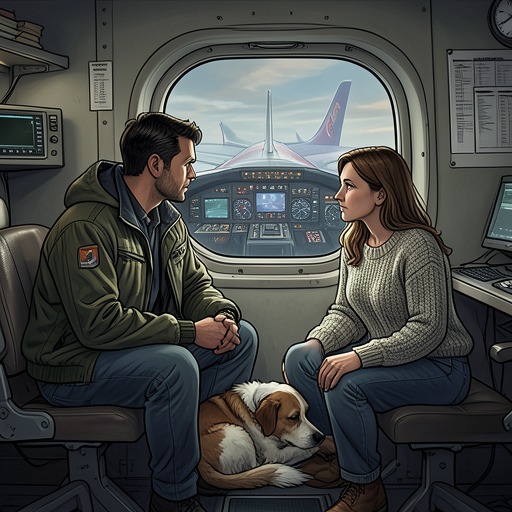
Jasper has a defined place in the fragile security Hig and Bangley maintain. Hig calls him his best remaining line of alarm, a role that makes the dog part of their warning system rather than simply a pet kept for company. The arrangement mirrors the larger partnership: Bangley supplies armed defense, Hig watches from the air, and Jasper contributes vigilance on the ground. The narrative gives this practical function weight without reducing their bond to usefulness. Jasper is also the familiar companion who occupies the seat beside Hig and accompanies him through the routines of survival.
That double role matters because Hig’s world has narrowed around vigilance. The open ground between the airport and the mountains forms a safety perimeter, and the possibility of attack is a constant concern. Jasper’s place within that perimeter gives their companionship a material consequence: he belongs to the daily business of staying alive. Yet Hig’s recollections show that their closeness exceeds this task. The dog is present in memories of travel, play, and shared places that have no immediate survival value.
Shared Places and Repeated Rituals
Jasper is tied to Hig’s memories of Paonia, a town where Hig once bought groceries, ammunition, and dog food. On the route past the town, Hig looks toward the seat Jasper used to occupy and recalls walking down to the river below the town park to throw a stick into the current. Jasper was not good at fetching or swimming, but he loved the game anyway. The recollection is affectionate precisely because it preserves the mismatch between the activity and the dog’s imperfect skill: enjoyment, rather than competence, defines the memory.
The memory also gives the landscape a personal history. Paonia is not just a place Hig recognizes from the air; it is a setting where his routines with Jasper once unfolded. As the Beast passes over the valley, the remembered river outing interrupts the practical journey and brings Jasper into the present through absence. Hig’s response connects the dog’s uncomplicated pleasure in play with a broader wish that life might be met in the same spirit. The scene does not turn Jasper into a symbol detached from his individual habits: the detail that he was poor at both stick and swimming keeps the bond grounded in the particular dog Hig knew.
Jasper’s Death and Hig’s Grief
Jasper dies on a mountain, in his sleep, at an old age. Hig later tells the Mennonite community what happened. Their response is sincere, and the moment reveals how far Jasper’s presence had extended beyond the two companions: the community remembers him, including Ben, a young boy who had been especially excited when Hig landed the plane and brought Jasper down. Ben would sometimes forget the rules of the separation zone and rush toward the dog, only to be gently held back by an adult. The encounter shows Jasper as a focus of the child’s delight while also marking the limits people maintained around contact.
The community’s sympathy does not lessen Hig’s sense that the loss belongs to his own family. He wipes away a tear and resolves not to cry again in front of them. His restraint is a response to being witnessed, not evidence that the grief has passed. Later, alone at the base of the berm, he lies with Jasper’s remembered weight on his leg as an aching absence. The image makes the loss physical without confusing memory with presence: the dog is no longer there, and Hig feels the difference where the companionship used to be.
Bangley’s response offers another measure of the bond. After Hig’s loss, Bangley says that Hig must keep moving and do what he has to do. Hig thinks about this through the night and understands it as Bangley’s way of giving permission to continue. The permission is not needed, but it still matters to Hig. In this exchange, the dog’s death affects the relationship between the two men as well: Bangley recognizes Hig’s need to go on, even if he expresses it in the practical language of survival.
Absence, Memory, and the Living World
Jasper’s absence follows Hig into the cockpit. During a flight, Hig looks at the empty right-hand seat, where the dog’s quilt lies crumpled against the door. The image combines an ordinary object with the vacant place of a companion. The quilt depicts a hunter aiming at a pheasant in a scene that never changes; against that fixed image, Hig recalls that even a deaf and stiff Jasper was a better copilot than most men. The airplane still carries the materials associated with companionship, but it cannot restore the presence that gave them meaning.
The bond also sits within Hig’s wider grief for the natural world. He remembers that trout once mattered to him more than almost anything, and he describes their disappearance as a loss severe enough to surface in dreams. In the mountains, fishing had been a reason to enter the surviving forest, breathe, and spend time beside running water. By the time he continues fishing after the trout are gone, streams have become too warm for them; he catches suckers and carp instead. His attachment to Jasper and his mourning for vanished species are not the same loss, but the narrative places them in a shared pattern: beloved presences disappear, and familiar places retain traces that sharpen the absence.
Later, Hig releases several thin carp carefully back into the creek and admits to himself that even they may be disappearing. He remembers Jasper alongside the trout, elk, and other vanished animals. This does not make Jasper interchangeable with wildlife or reduce the dog to an emblem of ecological decline. Rather, the recollection shows how Hig’s losses accumulate in the same consciousness: intimate bereavement and environmental change both alter what he expects to find in the world. Jasper’s bond with Hig remains distinct in its daily history—the alarm, the shared journeys, the failed games of fetch—but his death becomes part of the wider reckoning through which Hig measures how much has already vanished.