Hig and the Mennonite family’s mutual aid
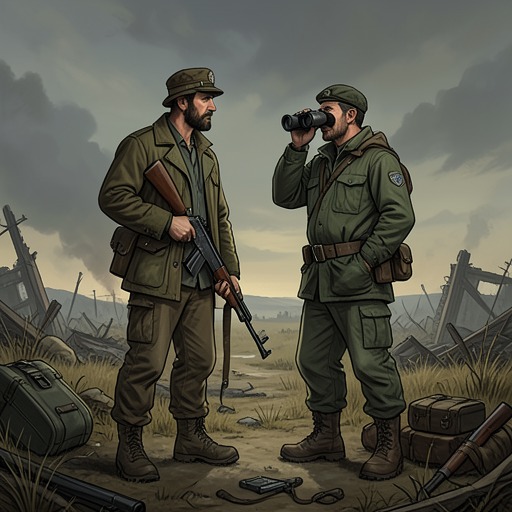
The Dog StarsHig and the Mennonite community’s mutual aid is a repeated act of assistance across a landscape organized around distance and danger. The community’s members are weakened by a disease that appeared after the flu, and some die every year; Hig nevertheless answers their requests, helps with practical needs, and quietly shares food. For him, this connection makes survival more than the defense of a perimeter: it preserves the possibility of human connection that Bangley’s harsher rules would exclude.
The community and the terms of contact
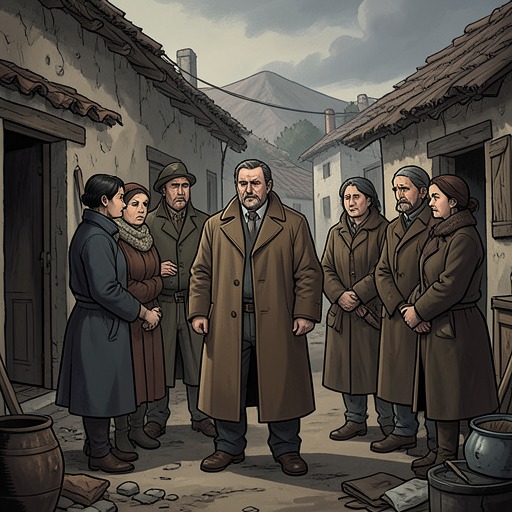
Hig describes roughly thirty Mennonites living with a slow-burning blood disease that followed the flu. The illness affects adults and children; children were born with it, and its consequences include weakness and recurring deaths. Rumors of survivors leave open the possibility that not everyone will succumb, though no certainty is offered. Hig recognizes the community’s vulnerability, while Bangley focuses on the cost and risk of helping people who may have little time left.
Their contact takes place under an explicit boundary. The Mennonite community knows to remain fifteen feet away, a distance Hig says he has trained its members to observe. He reports that they have never shown aggression toward him. Instead, they express gratitude when he repairs a pump or demonstrates how to make a fish trap for the creek. That gratitude can embarrass him, but he does not treat it as a reason to withdraw. He says that helping is partly for his own sake: it loosens something in him that had nearly frozen. The exchange is therefore practical, but its effect on Hig is emotional and ethical as well.
Repeated assistance in a working landscape
Hig’s aid is not a single rescue but a continuing routine. When the community needs help, its members hoist a ripped red union suit on a thirty-foot flagpole. The garment serves as a signal and a wind indicator, its limbs extended by strong wind. The improvised signal belongs to the same landscape as the settlement’s cultivated plots and uneven landing strip: a means of making need visible despite limited resources and the community’s physical weakness.
The settlement occupies an old turkey farm beside a creek. Eight metal sheds stand in two rows, with a brick farmhouse, two ponds, solar panels, and windmills, including a mechanical windmill used to draw water. The Mennonite community keeps the dirt landing strip clean even though maintaining the rest of the place is difficult for members often weakened by illness. At the entrance, a metal warning sign identifies the blood disease. Hig lands there in the Beast, sometimes in a strong crosswind, and the children jump and laugh when he arrives. The landing is more than a route for supplies: it is a recurring point of contact between his guarded world and a community that asks for help without crossing the boundary he established.
Food is another part of the relationship. Hig plants string beans, potatoes, corn, spinach, and tomatoes, and preserves more vegetables and potatoes than he and Bangley can use. Without telling Bangley, he leaves fresh vegetables in summer and jars later in the year for the Mennonite community. Its own garden is less successful because illness hampers the work. Hig also anticipates bringing Sprite for the families on a planned flight, alongside drinks intended for Bangley. These details show assistance incorporated into ordinary planning: the aid is discreet, seasonal, and repeatedly renewed rather than announced as a grand gesture.
Conflict with Bangley
Bangley regards the community’s illness as proof that help is futile. He asks what assistance could accomplish when some members may have only a few years, and Hig understands that his response will not produce sympathy. In one exchange, Hig argues that the Mennonites are people trying to stay alive day by day, that they pose no threat, and that reports of survivors exist. Bangley dismisses the possibility that they will matter to the two men except perhaps at a funeral. His view has already consigned the community to death; Hig’s continued visits contradict that judgment through action rather than persuasion.
The disagreement exposes a division inside Hig and Bangley’s survival partnership. Bangley’s rule is to treat a visitor as guilty until proven otherwise and to avoid negotiation because it can lead to death. Hig’s opposing instinct is to let a visitor live long enough to demonstrate whether he is human. The Mennonite community gives that difference a concrete form: it stays at the required distance, has shown no aggression, and responds to Hig’s assistance with gratitude. To Hig, those repeated encounters make the community a poor fit for Bangley’s assumption that everyone outside their partnership is an imminent threat.
What the relationship means to Hig
Hig admits that he and Bangley cannot know whether they will need the Mennonite community one day. Bangley answers that such a need will never arise, but Hig continues to go when asked. The uncertainty matters: Hig does not claim that the community will repay him or guarantee his safety. His conduct instead refuses to make usefulness or predicted survival the sole measure of whether people merit help.
He understands the contrast in terms of connection and solitude. Following Bangley’s belief to its end would leave each person alone with the universe; Hig associates another possibility with the community’s signal, help given and requested, and a smile or wave across the yard. The image of the red garment flying from the flagpole condenses the relationship: a modest, visible call for assistance, answered across a boundary that remains in place. Hig’s care does not erase the disease, the danger, or the disagreement with Bangley. It establishes that even in a world narrowed to patrols and supplies, he continues to choose contact.