Hig–Bangley relationship
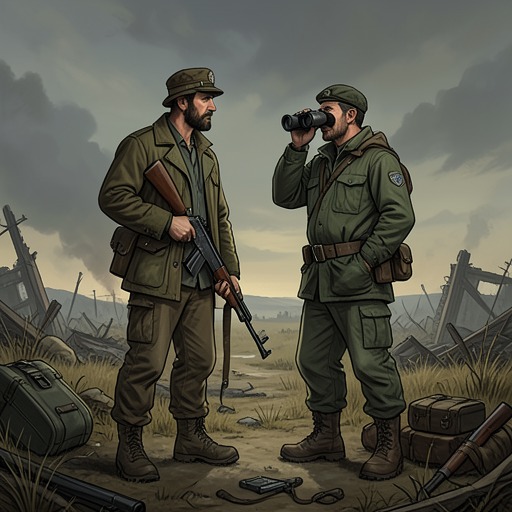
The Dog StarsHig and Bangley’s relationship begins as a practical alliance between two very different survivors and becomes, almost without either naming it, a chosen family bond. At an abandoned airport, they depend on each other to stay alive: Bangley supplies vigilance and overwhelming firepower, while Hig flies, hunts, grows food, and helps maintain the perimeter. Their partnership is often abrasive, but its decisive measure is not easy affection. It is the accumulated fact that each trusts the other with risks neither could manage alone—and that, when separated, Hig recognizes the airport as home because Bangley is there.
A Partnership Built for Survival
In the post-pandemic world, the pair’s arrangement has a clear division of labor. Bangley needs Hig to secure the perimeter, grow vegetables, and hunt deer; Hig relies on Bangley to cover him and bring out heavy weapons when danger escalates. Their skills complement one another, even though they do not wholly trust or like each other. The alliance is less a meeting of temperaments than a workable system: one man watches and plans for threats, while the other ranges farther afield and brings back what the settlement needs.
That practical interdependence does not make them interchangeable. Bangley is exceptionally capable in the narrow field of defense, while Hig’s abilities include flying and seeking food beyond the airport. The distinction matters because each man’s contribution leaves the other exposed in a different way. Bangley’s protection lets Hig travel; Hig’s work and warning help make their home defensible. Their survival is therefore joint, even when their habits and judgments pull them apart.
Friction Over What Counts as Living
The sharpest recurring tension is Bangley’s contempt for activity that does not directly serve survival. He regards recreation as wasted effort, and hunting earns his approval chiefly because it provides protein. Hig, by contrast, fishes not only to obtain food but because he needs the time and distance from the airport: the mountain air and hours beside a stream matter to him in themselves. After the trout disappear as streams warm, he continues fishing for suckers and carp, adapting the practice rather than abandoning it. Bangley would not have understood that change as recreation with emotional value; Hig keeps it to himself.
Flying carries the same divide, but Bangley understands more than he admits. Hig experiences flight as a vital part of being alive, and Bangley knows this, even though he cannot reduce it to a calculation of direct usefulness. In practice, the patrols have sometimes provided intelligence that helped save them. That result does not erase the difference between them: Bangley evaluates action through its survival value, while Hig also needs movement, attention, and contact with a world beyond the perimeter. The partnership holds because Bangley can recognize the importance of Hig’s pursuits without sharing them, and because Hig continues to value Bangley’s protection despite its hard limits.
Trust Expressed Through Risk
Bangley’s care is most legible in what he permits and what he does without announcing. Hig’s fishing and hunting trips take him away from the defenses and put Bangley at additional risk, yet Bangley does not forbid them. He appears to understand that these excursions serve Hig psychologically, not merely as a source of food. His tolerance is significant precisely because it goes against his own survival-first standards.
The airport’s defenses also show how much Bangley carries without making visible. When Hig later enters Bangley’s room, he realizes that its vantage point covered nearly the whole encampment: the runway, the decoy house, the dumpster, the line of aircraft, and the hangar entrance. Bangley could assess an intrusion before coming out to meet it, explaining the composure that had often seemed inexplicable to Hig. From this position, Bangley could have taken long shots across roughly three hundred yards. Hig feels admiration and revulsion together, then recognizes love in the mixture. The discovery changes the meaning of Bangley’s competence: it was not merely a personal talent but an unseen service that had helped keep them both alive.
Separation and the Meaning of Home
When Hig leaves, Bangley knows that the threat will increase. He understands the loss of Hig—and of Jasper as an early warning—as a concrete danger to the airport, yet his resistance to the departure is brief. He gives Hig a basket of grenades and makes clear that Hig is family. The gift is characteristic of their bond: care arrives not as a softened change of personality, but through equipment, warning, and an insistence on staying safe. Bangley does not ask Hig to become someone else or pretend to share his reasons for leaving.
After more than six weeks away, Hig approaches the airport with mixed anticipation and fear of Bangley’s anger. The sight of the perimeter and the tower they built together leads him to realize that Bangley has become family. His return is not simply to a defensible site. Hig compares its emotional pull to returning to his mother’s home years earlier, while recognizing that this time Bangley is the person waiting at the other end of that feeling. The recognition does not erase his losses; it marks the unlikely formation of another attachment amid them.
Recognition and Mutual Dependence
The reunion makes the partnership’s practical and emotional dimensions inseparable. Hig rushes into the hangar when he understands that Bangley is inside, injuring himself in his haste. Bangley is critically ill and remains close to death for more than two weeks. Cima stays to care for him, while Hig is present as Bangley gradually recognizes him again. On the sixth day, Bangley looks at Hig as he is being given water. The recovery is slow, but the reunion confirms that their separation has not undone their bond.
The relationship’s central irony is that Bangley, who organizes life around self-protection, has repeatedly accepted danger for Hig: he lets him take trips, supports his return journeys, and has quietly managed the defenses that made those journeys possible. Hig, who wants more than mere survival, nevertheless returns to the man who embodies its harshest discipline. Neither transforms into the other. Instead, their loyalty makes room for their differences, and the alliance acquires the force of family through repeated acts of backing one another without hesitation.