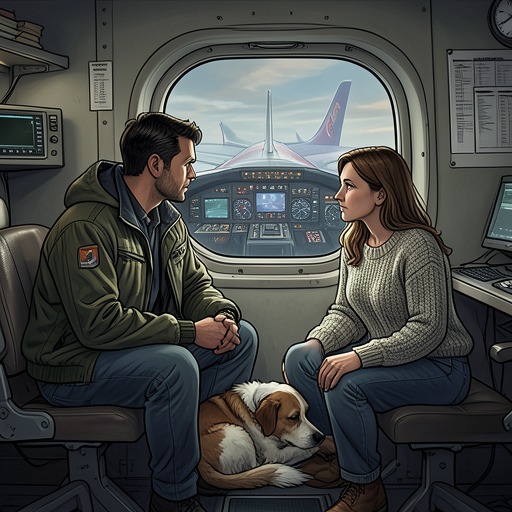
Hig–Jasper relationship
The Dog StarsHig–Jasper relationship joins practical companionship to deep attachment in a world where both human lives and the natural world have been radically diminished. Jasper is Hig’s beloved dog and copilot, present in the routines of travel, watchfulness, fishing, and sleep; after Jasper’s death, the bond persists as a grief Hig cannot simply leave behind.
Companionship and Daily Life
Jasper is part of the small household Hig maintains in the post-collapse world. Hig identifies him as the son of Daisy and counts him as a particularly valuable line of alarm. That practical role belongs to a life shaped by vigilance, but it does not define the relationship: the novel presents Jasper as Hig’s beloved dog, a companion whose presence accompanies the work of staying alive.
The two share repeated journeys into the high country. Hig goes there with Jasper to fish and spend time away from the demands of the airport. Jasper is therefore not merely left behind while Hig pursues an individual refuge; he accompanies Hig into one of the few settings where survival gives way, for a time, to attention and restoration. Their trips bind companionship to a landscape Hig continues to visit even as it changes.
Jasper is also part of Hig’s sleeping routine. Hig remembers sleeping outside with him, and later continues the practice of sleeping outdoors with Jasper among the quilts. This ordinary closeness gives the relationship a domestic dimension amid a life otherwise organized around danger and scarcity. The open-air routine is not presented as an isolated gesture of affection: it is one of the repeated forms through which the dog belongs to Hig’s daily world.
A Companion in a Diminishing World
The mountain trips take place against ecological losses that Hig experiences as grief in their own right. The trout he once loved to fish for have disappeared as streams have grown too warm; changing seasons and dry mountain peaks further unsettle the environmental patterns he remembers. Hig still fishes, but the altered streams make the activity a reminder of absence as well as a source of solace.
Jasper’s presence on these journeys connects the human scale of companionship with that larger, ongoing loss without making one a substitute for the other. Hig mourns vanished species and a changing landscape, while Jasper remains a living companion within the world that is still available to him. The novel’s attention to both losses gives the relationship particular weight: attachment is experienced amid a setting in which familiar forms of life cannot be assumed to endure.
Fishing also offers Hig time away from the defensive outlook shared with his neighbor, Bangley. Jasper accompanies him on these excursions, making the high country a shared space rather than simply a private escape. Their companionship thus belongs to a broader contrast in Hig’s life between the demands of protection and the desire for connection with living beings and places.
Death and Continuing Attachment
Jasper’s death is a turning point for Hig. The evidence establishes its emotional force without making the circumstances of the death the focus here: its consequence is clear in Hig’s continuing grief and in the difficulty he has moving beyond it. Jasper’s importance is measured not only by the loss itself but by the ordinary life the loss removes—the journeys, shared nights outdoors, and constant presence woven into Hig’s habits.
That attachment continues in Hig’s dreams. He still dreams that Jasper is alive, and says that his heart cannot move on before that changes. The recurring dream does not undo the death; instead, it shows how the relationship persists in memory even when its daily forms have ended. Hig’s grief remains unresolved, and the bond is carried forward as an absence that continues to shape his emotional life.
Narrative Significance
The relationship gives the novel a sustained measure of what survival means to Hig. Jasper has a concrete place in the routines that protect Hig, but the story also makes clear that companionship cannot be reduced to usefulness. Travel, outdoor sleep, and the repeated remembrance of Jasper all register an attachment that survives as more than a practical arrangement.
Jasper’s death also sharpens the distinction between merely continuing to live and being connected to a particular life. Hig’s dreams keep the relationship present after its shared routines have stopped, just as his memories of fishing preserve the value of a natural world that is disappearing. The novel does not treat these losses as interchangeable; together, they show the range of what Hig mourns and why survival alone cannot resolve that grief.