Jasper’s bird-hunting quilt
The Dog StarsJasper’s bird-hunting quilt serves as more than a keepsake: Hig carries it from the empty passenger seat of The Beast into a canyon standoff, where its familiar hunting scene becomes a makeshift flag and a way to communicate without approaching the people below. Across these uses, the quilt holds together the practical demands of survival, Hig’s attachment to Jasper, and his awareness of a natural world that is no longer stable.
Appearance and Place in Hig’s Life
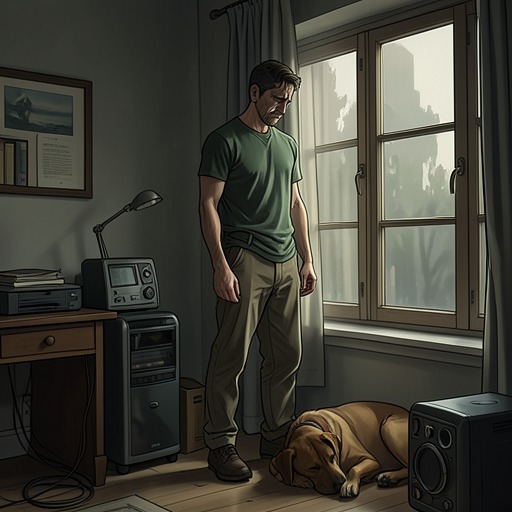
The quilt depicts a hunter aiming at a rising pheasant, a scene repeated across its surface. Hig keeps it on the passenger seat of The Beast, alongside the secured weapons at the front of the cabin. When he looks across at the empty seat, the quilt and its pattern make Jasper’s absence tangible: the pictured shot will never miss, the bird will never fall, and the dog will never die. The unchanging image offers an untroubled counterpart to the losses Hig has experienced, without making those losses reversible.
The object also has an immediate practical value. Before flying toward Grand Junction, Hig leaves it on the passenger seat; later, while stranded in a canyon, he gathers it with paper and a crayon. That change of setting does not change what the quilt depicts, but it changes what Hig can make it do. A keepsake associated with his companion becomes a visible signal that might help him reach people at a distance.
A Signal Across the Canyon
Hig has prepared simple tools for communicating from the air: paper, crayons, stones, and rubber bands. He has used notes dropped from The Beast to warn people away from the airport, and brings paper and a black crayon with him when he returns to the canyon edge. For the first attempt at contact, however, he chooses the quilt. He moves carefully to a sandstone lip and pushes the fabric over so that the hunter, pheasant, and dog appear right side up to anyone looking from below. He keeps his hands behind the edge while the quilt unfurls like a flag.
A shot follows almost as soon as the quilt reaches open air. Hig withdraws, then uses stones to hold the quilt in place and lets it hang where it can be examined. He understands that the person watching through a scope can see its repeated hunting scene, but the sudden quiet leaves the response uncertain. The cloth has drawn attention without requiring Hig to expose himself in the same way. He then raises a paper message on a broken limb; another shot misses it. The exchange makes the quilt part of a cautious, improvised conversation, in which distance and interpretation matter as much as the message itself.
Connection, Risk, and Restraint
Hig finds the episode unexpectedly absorbing. The quilt on the far side of the canyon becomes, in his comparison, like a fishing line: there are people at the other end, and their response offers a clue to their state of mind. The analogy links a dangerous negotiation to an activity he values for its attention and uncertainty. Yet the encounter is not safe or playful in its consequences. The shot directed toward the quilt is followed by another aimed near Hig’s exposed position, and the possibility of further violence remains present. The quilt lets him test for a response while he stays back from the edge; it does not make the people below harmless or guarantee agreement.
That use also contrasts with the methods associated with Bangley’s defense of the airport. Hig recalls that Bangley’s rule there was never to negotiate and that people were shot before they understood what was happening. At the canyon, Hig instead attempts communication through a conspicuous object and a written message. The quilt is not a substitute for protection, but it gives him a way to act without immediately turning the encounter into an attack.
Ecological Loss and the Fixed Image
The quilt’s pheasant and dog belong to an image that remains intact, while Hig’s real encounters with animals increasingly register loss and environmental change. He remembers waking from dreams about trout disappearing from every stream, and he fears that warmer water and diminished creeks will mean more than the loss of a favored fish. In the mountains, he continues to fish, adapting to carp and suckers after trout have vanished; the practice also takes him into stretches of forest that have survived or begun to recover. His attention to these changes is not merely a symbol for private grief: species and places are themselves what he mourns.
Against that experience, the quilt’s repeated scene has an uneasy permanence. The hunter remains poised, the pheasant remains in flight, and the dog remains alive within the pattern. Hig uses this stable image in a landscape where neither wildlife nor familiar seasonal conditions can be counted on to persist. The final fear that even carp may disappear extends the losses beyond the trout that first haunted him. The quilt cannot restore the living world or Jasper, but its passage from passenger-seat reminder to canyon signal gives it a continuing place in Hig’s efforts to remember, communicate, and stay alive.