Mennonite Farm Settlement
The Dog StarsThe Mennonite Farm Settlement is an old turkey farm where roughly thirty people live with a blood disease that emerged after the flu pandemic. It is both a vulnerable home and a recurring point of contact between Hig and the families he chooses to help, despite Bangley’s objections. The farm’s warning signs, improvised signal, and unusually well-kept landing strip make its precariousness visible: this is a place that cannot easily protect itself, yet continues to make room for aid.
Setting and Layout
The settlement lies about ten miles south of Hig and Bangley’s position, on a creek. Hig encounters it along a patrol route that heads west to the mountain front, turns south along the river’s line of trees, and then swings northwest near the power plant stacks and reservoir. The farm is set among tall, century-old trees: eight metal sheds stand in two rows of four, angled like diagonally parked cars, while a large brick farmhouse with an asphalt roof sits in a central grove. Two ponds are fed by the creek. To the south of the sheds are solar panels and two windmills, one of them mechanical and used to draw water.
The grounds show both the effort required to keep the place functioning and the limits of that effort. A straight dirt drive branches from the old county road to the west. Water floods it and cuts ruts into the surface, which residents fill with shovels. They are often too weak to keep up with maintenance, but they preserve the landing strip. For Hig, whose aircraft is called The Beast, that strip provides a practical way to reach the settlement; for the residents, keeping it clear helps keep the possibility of outside assistance open.
Warning and Signal
At the entrance, a metal sign wired to two posts bears a red skull and crossbones and warns that the settlement has the blood. The warning marks the danger of approaching, but it also communicates the residents’ condition before anyone reaches the farmhouse. Their signal for help is just as improvised. When they need assistance, they raise a ripped red union suit on a thirty-foot flagpole whose flag is long gone, perhaps taken for a baby blanket. In a strong wind, the garment spreads its arms and legs like a headless figure; it functions as both signal and windsock.
The airstrip gives that signal a practical counterpart. Hig approaches in a strong crosswind, often from roughly 330 degrees, and brings The Beast down almost sideways to the drive, left wing low and nose turned south before straightening at the last moment. Children in the yard jump up and down as he lands. From two hundred feet, he can see them laughing; it is the only time he sees them do so. The landing is a brief arrival scene, but it also shows how a difficult place to reach has established a fragile channel to someone able to come.
Residents and Need for Help
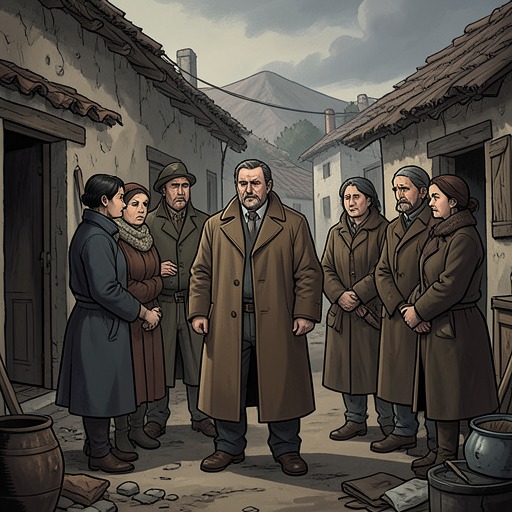
The residents are Mennonites, not the Druids Bangley suspects when he sees children waving from a turkey shed. Hig confirms that he knows them and helps them. Their illness is described as something like AIDS and possibly more contagious, though Hig’s comparison is uncertain. Children are born with the disease; it leaves them sick and weak, and some die each year. The settlement is not simply isolated from the wider catastrophe: its residents face a continuing illness that makes ordinary survival and upkeep harder.
The help they request is occasional, but Hig’s decision to answer those requests becomes a point of disagreement. Bangley counts the community’s losses and questions the value of intervening when the sick may have only a few years, while Hig insists that they are people trying to stay alive day by day. He recognizes the risks and does not claim that everyone can survive; he also knows there have been rumors of survivors. The dispute is not resolved by certainty about the disease. Instead, Hig continues to go when asked, treating their immediate need as sufficient reason to help.
Narrative Significance
The settlement gives Hig’s role beyond the perimeter a concrete destination. He is the pilot who can carry help across the open country, while the farm’s landing strip and signal make the residents’ need legible to him. That connection unsettles the arrangement with Bangley, whose attention is fixed on threats and the boundary they defend. The community does not attack them, but its presence tests whether survival can mean only guarding one’s own position.
The farm also sits within a landscape changing beyond the settlement’s own illness. Hig mourns the disappearance of trout, and later recognizes that even carp are affected as water temperatures shift. He fears the loss of creeks and the drying of mountain peaks, describing two winters in which the peaks held almost no snow as more frightening than attacks or disease. Against this ecological decline, the settlement’s creek, ponds, water-drawing windmill, and maintained strip are not proof of safety; they are practical features people continue to depend on. The place matters because it brings those dependencies, and Hig’s choice to answer them, into the same view.