Mennonite community
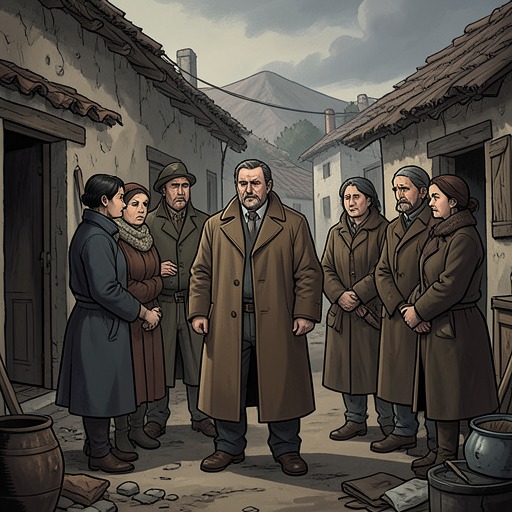
The Dog StarsThe Mennonite community is a settlement of roughly thirty people living with a debilitating blood disease that emerged after the flu pandemic. Children are born with the illness, some residents die each year, and the families’ visible frailty helps keep outsiders away. The community’s survival depends on a careful balance: maintaining separation from potential infection and attack while accepting occasional help from Hig and, eventually, medical care from Cima.
Identity and Circumstances
Hig describes the residents as Mennonites and distinguishes them from the people he and Bangley fear might threaten their defended territory. The families live about ten miles south of Hig and Bangley’s position, on a creek, and have not shown aggression toward them. Their illness leaves them weak, and their numbers face a steady attrition: children are born with the disease, and someone dies every few months. Hig compares its spread to a slow-burning plague, while recognizing that the nature and transmission of the condition are not initially clear to him.
The disease shapes the settlement’s relation to the surrounding world. Warnings bearing the THE BLOOD message stand along the edges of the families’ fields, and visitors are expected to keep fifteen feet away. These precautions express genuine fear of contagion, but also make the community seem dangerous to outsiders. The same separation that protects the families from attackers also limits ordinary contact and risks leaving them without assistance.
The Settlement and Its Defenses
The community occupies an old turkey farm. Eight metal sheds stand in two angled rows, with a large brick farmhouse among old trees. Two ponds are fed by the creek; solar panels provide power, and two windmills include a mechanical one for drawing water. The site’s arrangement reflects the practical work of sustaining a settlement with limited resources, though the residents are often too ill or weak to maintain everything around them.
A flagpole remains in the yard, but its flag is gone. When the families need help, they raise a ripped red union suit as a signal. It serves as both a marker and a windsock, making the call for assistance visible from the air. Their landing strip is a straight dirt drive branching from the old county road. Floodwater cuts ruts into it, and the families fill the holes with shovels; despite their difficulty keeping up with other maintenance, they make a particular effort to keep the strip usable.
Hig lands there in the Beast, managing the strong crosswind and bringing the aircraft down nearly sideways before straightening it along the drive. Children come out to watch. The landing connects the settlement to a visitor who can deliver supplies and practical help, but it also depends on the families’ continuing labor to keep the rough strip clear.
Mutual Aid and Boundaries
Hig’s relationship with the Mennonite community develops through repeated visits rather than a single rescue. When the families ask for help, he goes. He has repaired a pump and shown them how to make a fish trap for the creek, and he brings supplies. The residents follow the distance rule he has taught them and respond to his help with conspicuous gratitude. For Hig, these visits are not only useful to the families: helping them loosens something in him that has nearly closed up. Their needs draw him toward human connection, even as Bangley measures life primarily in terms of survival and security.
That difference creates tension between Hig and Bangley. Bangley worries about risk and questions why Hig should expose himself to a community whose illness may be contagious and whose members, in his estimation, have little time left. Hig insists that they are people trying to stay alive day by day, and that they pose no threat. His continued visits are therefore both material aid and a refusal to treat the families as disposable simply because they are ill or vulnerable.
Cima’s Visit and Medical Care
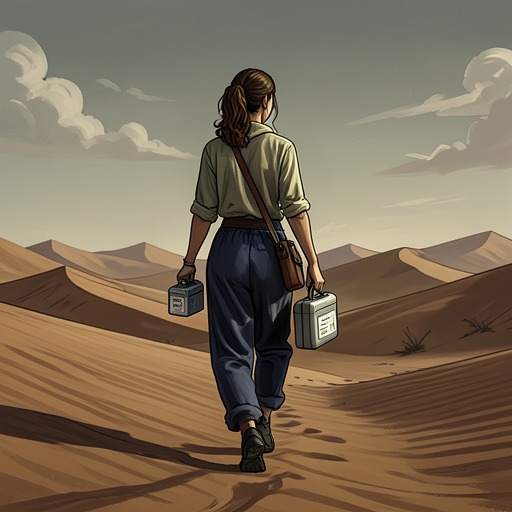
The community’s quarantine boundary becomes especially significant when Hig takes Cima there. She carries a medical bag, and the families gather along their quarantine line as she approaches. At first, they recoil when she steps across the boundary, opening space around her. Cima raises a hand to reassure them, and the initial fear gives way to welcome: the gathered residents close around her, and children reach for her and hold on to her skirt.
Cima sets up in a room in the farmhouse and examines the residents one by one. Wearing latex gloves, she treats cuts and wounds, asks for warm water, counsels a pregnant young woman, and comforts an older man. Her care makes the boundary negotiable in a way it had not been during Hig’s visits: the families accept close contact with someone able to treat them, and Cima allows Hig to come across as well. The scene does not remove the community’s vulnerability, but it briefly replaces the social isolation of quarantine with medical attention and ordinary human touch.
Cima also explains that the danger of casual contact has been misunderstood. She compares the blood disease’s transmission to Hepatitis C or HIV, describing transfer through bodily fluids and blood rather than treating simple proximity as the threat. The warning signs and the fear they evoke have helped keep attackers away, preserving the families’ lives even as the disease continues to diminish them. Protection and isolation are thus bound together: the same message that deters violence also reinforces the distance that makes care difficult.
Illness, Environment, and Significance
The origin and mechanism of the post-pandemic illness remain uncertain. In a later discussion, Cima recalls reports suggesting that the onset of the autoimmune disease was accelerated by the body’s reduced ability to make vitamin D. She presents this as a proposed mechanism, not a settled explanation. The community’s condition is therefore part of a wider landscape of unresolved consequences after the pandemic, where observation, medical knowledge, and rumor do not always yield certainty.
Environmental loss forms another part of Hig’s outlook as he visits the families. He mourns the disappearance of trout as mountain streams grow warmer, and he fears the loss of creeks as drought intensifies. Those changes are not presented as the cause of the Mennonites’ illness, but they sharpen the sense that human and ecological survival are both precarious. Against this background, the community’s ponds, creek, windmills, and carefully maintained landing strip are not a promise of safety; they are the means by which the families keep going under difficult conditions.
The Mennonite community gives the novel a sustained test of the boundary between self-protection and compassion. Its quarantine is real, its need for help is practical, and its members are neither a menace to be eliminated nor an abstract emblem of suffering. Through Hig’s recurring assistance and Cima’s arrival as a caregiver, the settlement becomes a place where survival requires more than defending a perimeter: it also requires recognizing when fear has mistaken distance for safety and when aid must cross the line.