Point of no return (aviation threshold)
The Dog StarsThe Point of no return (aviation threshold) is the point in a flight at which the remaining fuel is no longer sufficient to return. For Hig, it turns a journey toward Grand Junction from a matter of distance into a commitment with consequences: once he has gone beyond the threshold, reaching safety depends on finding fuel and on the people he encounters.
Definition and calculation
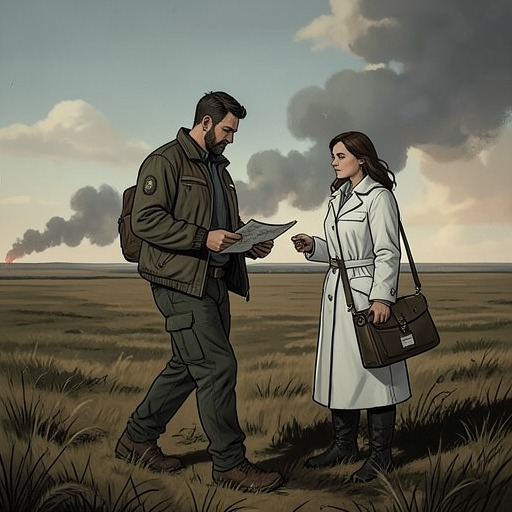
The boundary is defined in practical terms, not as a universal distance. When Bangley asks Hig about his Point of no return, he clarifies that he means the point at which Hig would lack enough fuel to get back. The relevant measure is therefore the return journey, rather than simply how far the destination lies ahead. Hig answers with the figure 260, in an exchange that has just established the control tower as three hundred miles away. The number gives their discussion an immediate, concrete edge, even though the passage does not specify a unit for Hig’s answer.
Later, Bangley explains how he assessed the flight. He knew that a Cessna 182 of The Beast’s vintage usually carried fifty-five usable gallons and burned about thirteen gallons per hour. He had also worked out the approximate distances and allowed for Hig carrying a couple of extra cans. The threshold is thus not presented as a fixed property of the aircraft alone: it depends on the plane’s fuel, its rate of consumption, the route, and any reserve fuel Hig has brought along. These particulars make the calculation an estimate of whether a return remains possible under the conditions of this particular flight.
Hig crosses the boundary
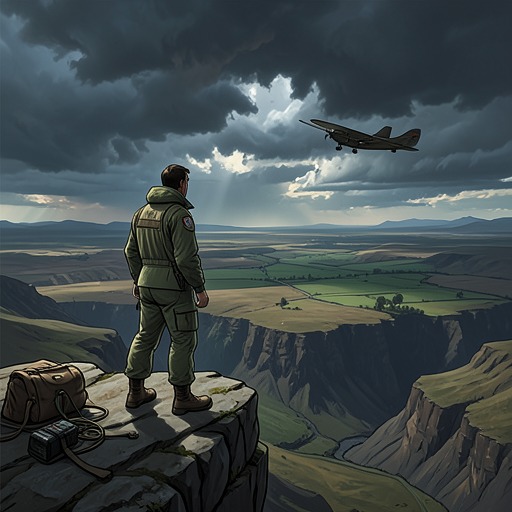
Hig later tells Bangley that he did not merely approach the threshold: he flew past it, around Colbran. His admission reframes the journey that brought him to this point. The flight was no longer safely reversible; he had continued into a region where the fuel remaining could not guarantee a return. The Point of no return marks the moment when continuing forward and retreating cease to be equivalent choices.
The risk is sharpened by the world the flight crosses. Bangley recalls that Hig left a working partnership and a safe haven to travel through a country where people might attack him or expose him to disease, in a period when good fuel might no longer be available. Fuel arithmetic, physical danger, and the loss of a dependable base therefore converge at the same boundary. The plane may still be flying, but the option of simply turning around has become uncertain or unavailable.
Bangley’s reassessment
At first, Bangley treats Hig’s journey as a danger to both of them. He asks whether Hig is chasing shadows and risking both their lives. After Hig confirms that he passed the threshold, Bangley studies him and visibly reassesses what he has done. His response changes as the calculation becomes clearer: he recognizes that Hig did not make a casual excursion within a comfortable return range.
Bangley had correctly calculated the aircraft’s likely usable fuel, its burn rate, the distances, and Hig’s extra cans. What he had misjudged was Hig’s own grasp of the situation. In Bangley’s account, Hig was right at the Point of no return, but did not understand what that meant. The concept therefore distinguishes technical possibility from informed decision-making: carrying enough fuel to reach farther does not itself mean the pilot has understood the danger of leaving too little to come back.
Consequences and narrative significance
Crossing the threshold does not end Hig’s journey, but it changes what a safe outcome requires. Bangley proposes that they go to Grand Junction, inspect the tower and airport, obtain aviation gasoline, and then fly back to Bangley. This plan treats the fuel shortage as something that may be addressed at the destination, rather than as a risk that can be erased by turning back. Bangley also takes responsibility for obtaining fuel, while leaving Hig responsible for flying the aircraft.
The Point of no return consequently links a technical calculation to a shift in dependence between the two men. Hig’s decision to continue has brought him beyond the protection of his established home and partnership; Bangley’s response is to join the attempt to make a return possible. The threshold is both a limit and a turning point: it closes off an easy retreat, exposes the cost of Hig’s misjudgment, and forces the next plan to be made together.