The Airport's First Major Firefight
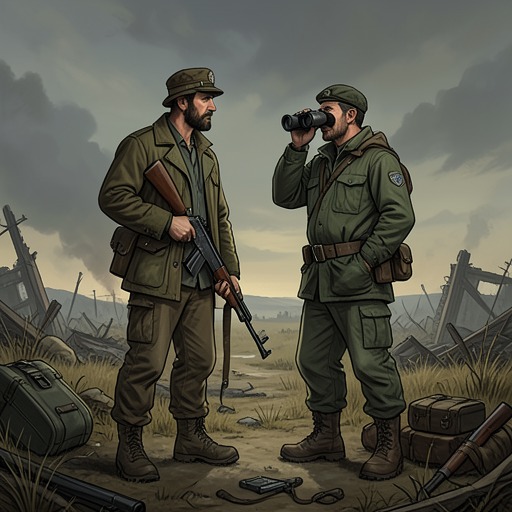
The Dog StarsThe Airport's First Major Firefight is the turning point at which Hig becomes an active participant in the armed defense he and Bangley have built around the airport. The largest group they have faced numbers seven; three attackers survive the opening volley, and a brief, consequential firefight follows. The scene makes survival a matter not only of Bangley’s preparations but of Hig’s willingness to use them, while the danger also shapes where Hig will sleep and how he lives afterward.
Build-up and Stakes
The account places the firefight within a continuing pattern of armed visitors and defensive vigilance. Seven is the biggest group the two have faced, and Bangley counts them under his breath while lying beside Hig. His muttered response and unhappy chuckle register the scale of the threat without turning the moment into a speech: the number itself is enough to make clear that their usual perimeter is being tested.
Until this point, Bangley has been the more practiced and decisive combatant. His instruction to Hig is direct: Hig will have to participate. Hig has an AR-15, and Bangley has fitted him with a night scope, so the scene’s pressure is not simply a shortage of equipment. It is the transition from being protected by a system to accepting responsibility within it. The weapon and scope make that responsibility concrete, but they do not make Hig’s response automatic; the narration marks hesitation before recording that he does act.
The stakes are therefore both immediate and enduring. The attackers threaten the pair’s survival, but the confrontation also changes the terms of their partnership. Hig’s earlier position near Bangley’s defenses cannot remain wholly passive when the group they face has grown to seven. Bangley’s demand turns defense into a shared task, whether or not Hig is ready for the emotional weight of taking part.
The Firefight
Hig participates after Bangley equips him with the AR-15 and night scope. The account gives no detailed sequence of Hig’s shots, nor does it name the attackers or identify their individual fates. It does establish the crucial fact that Hig crosses from preparation to action: after his hesitation, he does what Bangley has told him he must do.
Three attackers survive the first volley. Their survival makes the encounter a bona fide firefight rather than a single exchange that ends with the opening shots. Yet the attackers are disadvantaged: they have no night goggles and do not know the terrain. The combination matters. The defenders’ familiarity with the ground and advantage in seeing at night shape the unequal duration of the struggle; it does not last long after the initial volley and the survivors’ resistance.
The account’s compressed treatment of the fighting keeps attention on its threshold rather than on a blow-by-blow spectacle. The largest group yet encountered produces a real exchange of fire, and Hig is inside it. The enemy’s numerical presence is answered by the defenders’ equipment and knowledge of the terrain, while Hig’s reluctant participation becomes part of the means by which the pair holds out.
From the Perimeter to the Open Ground
The firefight belongs to a wider change in Hig’s habits of defense. He says this is how sleeping outside began: he was not going to be trapped in the house. His image is of a dragon sleeping on a pile of treasure, but he distinguishes himself from that creature by staying back. The comparison conveys the logic of the arrangement: the house and its contents must be guarded, yet being enclosed would make Hig vulnerable if danger reached the building.
That pattern persists even after the pair becomes more confident in its system. Hig continues to sleep behind the berm rather than inside, and the porch light remains on. In winter, he sleeps beneath a pile of blankets weighing about twenty pounds. These details show how the firefight’s defensive world extends beyond the moment of shooting: security is organized through distance, barriers, watchfulness, and an outdoor sleeping place that trades the shelter of the house for freedom from being boxed in.
Jasper still curls against Hig’s legs and trembles beneath his own blanket. Hig suspects the dog is mostly deaf and no longer useful as an alarm, but he does not let Bangley know. The small concealment sits beside the larger precautions as part of their fragile domestic routine. Bangley sees usefulness in everything, Hig thinks, and Jasper’s diminishing ability to warn them could become a point of judgment. The household that emerges from the violence is not simply a fortified position; it is also a place where companionship is protected from that hard calculus.
Aftermath and Significance
The fighting does not end the threat. After the second summer, visits taper off like a faucet, first to perhaps one visitor in a season and then to none for almost a year. The lull is interrupted by a band of four desperados who nearly defeat them. In response, Hig begins flying regularly, as though it were a job. The later danger gives the first major firefight a place in a longer sequence of adaptation: each reprieve can be temporary, and surviving one encounter does not guarantee that the next will be manageable.
The event’s decisive change is Hig’s participation, not a newfound ease with violence. Bangley’s demand, Hig’s hesitation, and his eventual action make the firefight a test of the partnership as well as of the airport defenses. Its aftermath is visible in the way Hig chooses to sleep and in the routines the pair sustains through seasons of danger and quiet. The perimeter may become more familiar, and visitors may disappear for a time, but Hig remains outside the house, still keeping distance between himself and the possibility of being trapped.