The Flu Pandemic and Societal Collapse
The Dog StarsThe Flu Pandemic and Societal Collapse is the disaster that ends the world Hig knew, killing nearly everyone and replacing ordinary institutions with scattered survival, illness, and flight. The narrative offers no settled account of the pathogen’s origin. Instead, it shows the collapse through uncertain reports, overwhelmed medical care, interrupted communications, abandoned cities, and the choices survivors made as familiar systems failed.
Outbreak and Uncertain Origins
Hig recalls that the flu had already passed through his own body before the narrative’s later survival routine took shape. He had two straight weeks of fever, including three days at temperatures between 104 and 105 degrees. He believed the illness might have affected his thinking, though he also recognizes that the strain of life after the pandemic could account for his unsettled thoughts. His recollection makes the catastrophe both historical and intimate: the mass event is registered in the altered conditions of a survivor’s mind.
When Hig asks Cima whether she knows how the outbreak began, she cannot confirm a cause. Reports had attributed it to the mutation of a superbug that researchers had monitored for years, combined with a bird flu. The illness was called the Africanized bird flu, and the first cases were said to have appeared in London, with New Delhi blamed as their source. Hig and Cima also discuss a rumor that the origin might instead have been Livermore, the national weapons laboratory. In that account, a military flight carrying a sample to England supposedly crashed in Brampton. The possibility remains hearsay; neither the characters nor the narrative resolve it. The uncertainty persists as part of the disaster’s legacy: survivors know what happened to their society, but not exactly where the catastrophe began.
Death, Medical Care, and the Second Disease
The flu killed almost everybody. Hig’s account places that first wave alongside a second, distinct catastrophe: a blood disease that struck after the flu and killed additional survivors. The families living south of Hig’s airport are described as roughly thirty Mennonites affected by this illness. Children were born with it, remained sick and weak, and some died each year. The epidemic therefore did not end with the first mass outbreak; its aftermath continued to expose survivors to illness and loss.
Medical facilities became overwhelmed as the flu spread. Hig remembers St. Vincent’s Hospital across the lake, where helicopters brought patients and buildings were taken over and filled with the dead. In another recollection, Melissa died of the flu in an Elks Hall converted into a hospital, less than five hundred yards from their house. Hig was not allowed to bury her; she was cremated with the others. His repeated return to fishing through the illness and after her death marks the personal duration of the crisis: public emergency and private bereavement become inseparable, while the ordinary acts of mourning are no longer available to him.
The Breakdown of Public Life
The collapse unfolded through successive failures rather than a single moment. Hig recalls dwindling supplies, lengthening fuel lines, and riots as daily life became harder to sustain. News broadcasts charted the same deterioration. Cima and Pops watched presenters grow exhausted and frightened as colleagues disappeared into hospitals or makeshift flu wards, or simply stopped reporting. Field reports became more frantic before broadcasts were cut short by mayhem. The breakdown of communication left those outside the immediate crisis with diminishing access to reliable information even as the situation worsened.
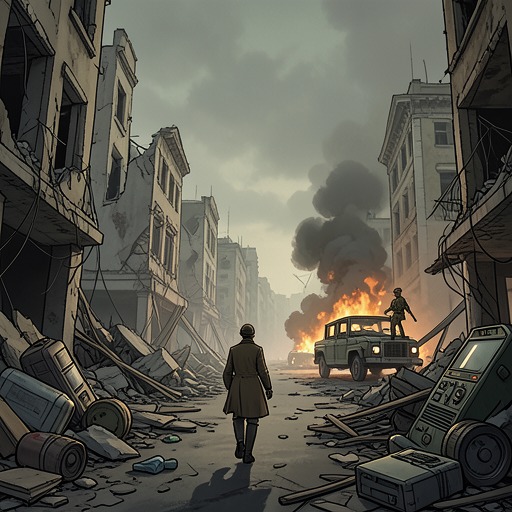
Grand Junction offers a later, visible record of the disaster. Nine years after the flu, Hig flies over a city scarred by fires: cars were burned, whole neighborhoods had been destroyed, and human remains lay scattered across the ruins. Cottonwoods still shaded the river parks, although some of the oldest trees were only partly alive amid drought. Cima recognizes the city as the place where she and Pops had once gone for shopping, farm equipment, and entertainment. Its ruined streets make the collapse legible not as an abstract account of deaths but as the loss of a functioning place and the routines that connected it to nearby communities.
As public order failed, movement itself became dangerous. During the worsening crisis, Cima and Pops loaded a cattle trailer and a smaller trailer with livestock and provisions, then left their ranch at night for the canyon. On the fifteen miles toward the creek road, Pops had to get through three barricaded ambushes; farther on, he shot three attackers. They lost one horse and two sheep to gunfire. The next morning, Pops destroyed the ford with dynamite, making the crossing impassable to vehicles. Their departure shows how survival increasingly depended on armed defense, mobility, and the ability to make a refuge harder to reach.
The Long Aftermath
Hig’s account distinguishes the human disaster from environmental changes that form part of the same damaged world. He recalls the disappearance of trout, which he connects to streams becoming too warm, and describes years in which mountain peaks held little or no snow. By mid-April, old seasonal expectations had become unreliable. These conditions deepen the sense of loss without making the pandemic their direct cause: the flu and the changing environment are related features of the survivors’ world, not a single explained chain of events.
Nine years after the outbreak, Hig and Bangley live at an airport that once had solar panels and wind-powered operations. Hig patrols the surrounding plain because he considers many remaining survivors dangerous; attacks have made even a light left on at night a calculated risk. The airport’s infrastructure remains useful, but it no longer belongs to a functioning public system. When two 747s pass overhead, Hig hears Arabic on a radio frequency and tries repeatedly to contact them. The planes continue west without responding. Their passage suggests a world beyond the local ruins may still exist, but offers no proof of rescue or restored connection. The collapse’s decisive consequence is therefore not only mass death: it is a durable separation from the institutions, communities, and shared knowledge that once made ordinary life possible.