
The Birthday Party’s Social Machinery
The DoubleThis flow examines how a formal celebration establishes a hierarchy that Golyadkin cannot enter or control.
increasing Bearing strength in each event
 decreasing
Bearing strength in each eventdecreasingCeremonial Toasts

The Ceremony of Belonging
A Public Order
The birthday dinner gathers officials, relatives, and prospective young men around Klara Olsufyevna. Toasts and carefully staged emotion reaffirm the family’s status and the guests’ place within its social circle.
Exclusion by Contrast
The narrator’s extravagant praise of the occasion makes its conventions conspicuous. Golyadkin’s later intrusion matters because the gathering has already defined who may speak, celebrate, and be seen as respectable.
The Dance Begins
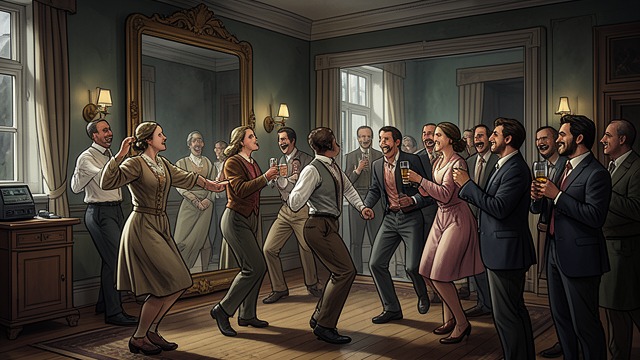
Respectability in Motion
Ordered Festivity
After the meal, officials move to card tables and the younger guests dance. Polite conversation, fashionable movement, and mutual recognition turn the party into a display of social fluency.
A Stage for Misreading
Golyadkin watches from a concealed corner and treats patience as a strategy. To the dancers, the room is a shared celebration; to him, it becomes a stage on which he hopes to force a different verdict.
A Dance Interrupted

The Rupture
An Uninvited Partner
Golyadkin suddenly asks Klara Olsufyevna to dance. His stumbling imitation of the polka transforms his desire to participate into a spectacle the guests can neither ignore nor interpret kindly.
Removal and Flight
The crowd separates him from Klara and guides him toward the door. When he escapes into the storm, the party’s renewed music becomes a sharp contrast to his private collapse.
the opening dinner on Klara Olsufyevna’s birthday
later that evening, after dinner
near the height of the birthday celebration
