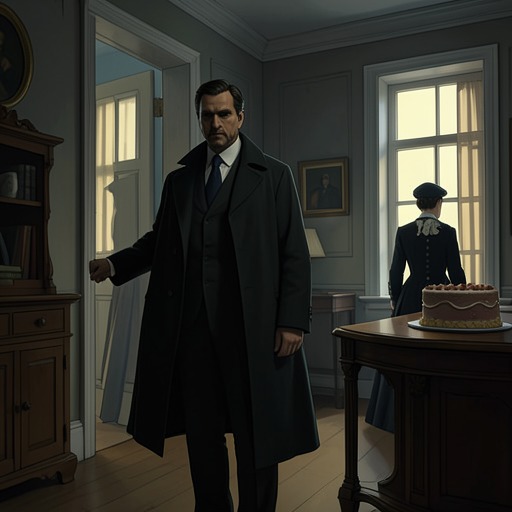
“I’m all right”
The Double“I’m all right” is Yakov Petrovitch Golyadkin’s recurrent formula for asserting that he is sound, composed, and still in control of himself. Its force lies in the widening distance between the reassurance he tries to give and the scenes in which he gives it: what begins as a private check becomes a public explanation, then a refrain that cannot make his circumstances appear ordinary. The phrase is both a claim of identity and evidence of how urgently that identity needs defending.
Identity and Introduction
The expression first appears in the morning, as Golyadkin inspects himself in a little round looking-glass. He has woken in his Petersburg flat after a long sleep and briefly hesitated over whether he was awake or still caught in a confused dream. Looking at his sleepy, short-sighted face and rather bald head, he finds nothing amiss. He imagines the possibility that a pimple or some other unpleasant change might have appeared, then reassures himself that so far everything is all right. The mirror makes the phrase a verdict delivered by Golyadkin to himself: he tests his appearance, finds it acceptable, and seeks relief in the result.
That opening assurance belongs to a morning organized around checking. Golyadkin looks into the courtyard, makes sure Petrushka is absent from his room, and carefully retrieves a shabby green pocket-book hidden beneath old papers and rubbish. He counts its banknotes again, smoothing each one between finger and thumb. The episode does not establish a direct connection between the money and the phrase, but it places his self-certification amid repeated acts of inspection and reassurance. He wants to establish that his face, circumstances, and resources are in order before the day can challenge that conclusion.
A Public Defense
The phrase changes register when Golyadkin encounters Andrey Filippovitch in a carriage. Two young clerks from the same department have already noticed him, and he has concealed himself rather than answer them. When Andrey Filippovitch recognizes him from a fashionable droshky, Golyadkin cannot hide. He blushes and anxiously weighs whether to bow, call out, or pretend that he is somebody else who merely looks like him. He takes off his hat, fixes his eyes on his superior, and whispers that he is all right.
Here the reassurance is no longer simply a private judgment about his appearance. It is addressed to the person whose recognition makes concealment impossible, and it accompanies Golyadkin’s attempt to deny the significance of being seen. His words insist on normality even as his behavior—hiding in the carriage and speaking under his breath—shows how exposed he feels. After the droshky passes, he reproaches himself for not having spoken more openly and imagined telling Andrey Filippovitch that he, too, had been invited to dinner. The episode gives the formula its characteristic tension: Golyadkin asserts that nothing is wrong while rehearsing the explanation that might have made his situation seem ordinary.
Claims Before an Authority
Golyadkin carries the same defense into his visit to Krestyan Ivanovitch Rutenspitz. The doctor’s unexpected, apparently displeased reaction unsettles him. Golyadkin has not prepared an opening sentence; he mutters, sits without being invited, rises to correct that breach, then becomes confused by his own attempt to repair it and sits again. He tries to shield himself with a defiant look, one that he understands as displaying his independence and proving that he is quite himself, like everyone else, with nothing wrong in his upper storey.
That self-assurance is presented through a sequence of awkward reversals rather than calm authority. Golyadkin’s effort to demonstrate good sense produces successive breaches of etiquette, and his emphatic inner defense cannot control the doctor’s gaze. When he begins speaking, he says that he has come to trouble Krestyan Ivanovitch a second time and asks for indulgence, but he is plainly at a loss for words. The visit thus places “I’m all right” within a broader pattern: the more Golyadkin tries to establish his composure before an authority figure, the more visibly his words and gestures fail to cohere.
Repetition Under Pressure
At Olsufy Ivanovitch’s gathering, the language of being all right accompanies a more extreme separation between Golyadkin’s self-description and his actual position. He is not in the dance but on the back-stair landing, where he has hidden in a dark corner between a huge cupboard and an old screen, among litter and odds and ends. He has waited there for nearly three hours, watching the proceedings while telling himself that he can take care of himself and that he might enter whenever he chooses. To justify waiting, he recalls the maxim that all things come in time to him who has the strength to wait; he also thinks of the Jesuits and the idea that any means may be justified if the end is attained.
The narrator’s repeated insistence that Golyadkin is all right, even while describing him as lost, hidden, cold, and apart from the gathering, turns the assurance into irony. It cannot erase the difference between the role he claims for himself and the scene that encloses him. The phrase sounds like self-protection, but its repetition also exposes the strain of maintaining that protection. Golyadkin imagines himself as a spectator who remains free to enter; the circumstances show a man who has spent hours concealed on a staircase, waiting for an opening.
The contradiction sharpens at the department, where Golyadkin finds himself confronted with another Mr. Golyadkin. He pinches himself and tries to screw up the courage to pinch someone else, seeking proof that the encounter is not a dream. Sweat runs down him; he doubts his own existence and loses the power to think and remember. When he comes to himself, he notices that he has been moving his pen mechanically over the paper and cannot make sense of what he has written. The other Mr. Golyadkin rises from the table and disappears into another room, leaving the first Golyadkin among the ordinary office sounds of scratching pens, rustling pages, and distant conversation.
When Anton Antonovitch asks after his health, Golyadkin answers that he is very well, perfectly well, and all right now. The final qualification—“now”—makes the formula sound less like a stable fact than an effort to regain one. He repeats Anton Antonovitch’s name, stammers, and remains uncertain whether to trust his colleague before trying to approach the matter troubling him. Against the earlier mirror scene, this is a crucial change: the assurance is no longer based on a face that appears acceptable, but is spoken amid an experience that has shaken his sense of existence and interrupted his work.
Narrative and Thematic Significance
Across these scenes, the expression moves through distinct uses: Golyadkin privately evaluates his appearance, addresses a superior who has recognized him, asserts his soundness before a doctor, and reassures a colleague after losing confidence in what he sees and writes. The recurring wording makes these moments answer one another. Each assertion attempts to hold together a self-image—ordinary, independent, and fully himself—that the surrounding action places under pressure.
The phrase is therefore more than a repeated declaration of health. It is a small verbal ritual through which Golyadkin tries to determine what is real and how he will be judged. Its repetition produces an effect opposite to the one he seeks: rather than settling the question, it draws attention to the need to keep settling it. The contrast between the calm verdict he wants and the embarrassed, concealed, or disoriented person shown in each scene makes “I’m all right” a compact marker of his worsening difficulty in reconciling self-perception with experience.