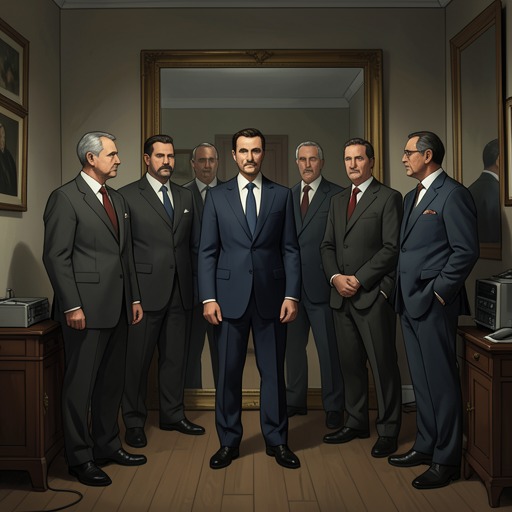
“I’m not one to intrigue”
The Double“I’m not one to intrigue” is Yakov Petrovitch Golyadkin’s recurring declaration of plain dealing and resistance to covert maneuver. He presents it as a point of pride—to a doctor, to his office colleagues, and finally to himself—so that a claim of moral openness becomes a refrain through which he tries to secure his identity. Its repetition is also a measure of his unease: the more insistently he announces that he is free of duplicity, the more sharply the narrative shows him watching for judgment, ridicule, and threat.
A Rule of Self-Description
Golyadkin first places the expression within a formal account of his character to Krestyan Ivanovitch Rutenspitz. He has already apologized, and now emphasizes that he is an unimportant man who does not regret his position; he is, he says, proud not to be a great man. He extends that modesty into a moral defense: although he could do harm and knows how it might be done, he will not sully himself. His insistence on clean hands links his refusal to intrigue with a refusal to use concealed power.
He develops the same contrast by distinguishing direct action from “devious ways.” Golyadkin claims to disdain such methods, to dislike insinuation, and to be disgusted by slander and calumny. The image of the mask makes his principle memorable: he says that he wears one only at a masquerade, not before people every day. In his account, the mask belongs to an acknowledged occasion and is therefore not a disguise in ordinary life; everyday concealment, by contrast, is the duplicity he repudiates. He even warns that he does not seek to degrade people who may be purer than himself, then falters in addressing the doctor, correcting himself as he tries to keep the speech from sounding like a personal accusation.
The declaration is thus more than a denial of scheming. It is Golyadkin’s proposed standard for how a person should act and be judged: openly, without insinuation, and without trying to advance through humiliation of others. Yet he delivers this code as a defense in a conversation whose real subject he cannot bring into direct focus. He asks how the doctor would take revenge on a most malignant enemy, while anxiously studying the doctor’s response. The profession of candor is already shadowed by what remains unspoken.
Before the Doctor
Golyadkin’s performance combines measured formality with visible apprehension. He speaks in a solemn style, emphasizing each point and pausing expressively; he presents his words with confidence, apparently calculating their effect. At the same time, he watches Krestyan Ivanovitch with mounting anxiety and waits irritably for an answer. The bodily detail unsettles the composure of the declaration: he is “all eyes,” alert to the very judgment his appeal to openness is meant to overcome.
The doctor does not respond to the moral appeal as Golyadkin hopes. He says, in effect, that his time is precious and that he does not understand, while remaining willing to attend to him within limits. He turns to paper and prepares to prescribe what is necessary. Golyadkin rejects that course, rising and clutching the doctor’s right hand to insist that a prescription is not what is wanted. The mismatch is consequential: Golyadkin has offered a declaration of character and an oblique account of an enemy, but the doctor answers as a practitioner rather than entering the moral drama Golyadkin is trying to establish.
A Public Challenge at the Office
At the government office, the declaration becomes part of Golyadkin’s attempt to remake his standing among the clerks. He tells them they have known him only on one side, acknowledges that he bears some responsibility for that, and promises to explain himself only lightly. His examples sketch the conduct he rejects: roundabout behavior, treating the polishing of one’s boots as life’s highest calling, claiming happiness because one’s trousers fit properly, aimless bustle, fawning, and meddling where one is not wanted. The list converts his private code into a public indictment of habits he associates with false advancement.
The register clerks do not receive the speech as a solemn disclosure. They exchange winks, then burst into laughter before Golyadkin has finished saying what he wants to say. He flares up, takes his hat, and withdraws toward the door, telling them that time will show them. Turning back, he makes the principle explicit: if he fails, he does not lose heart; if he succeeds, he perseveres; in either case, he says, he is never underhand. He again claims pride in not intriguing and disavows diplomacy.
His closing image of a bird flying to the hunter complicates the confidence of the speech. He accepts the saying but immediately asks who, in this case, is the hunter and who the bird. Rather than resolving the image, he leaves the roles uncertain, then falls silent, raises his eyebrows, bows, and walks out. The clerks remain amazed. The expression has served as an assertion of dignity, but it has not secured recognition: it ends in an unresolved question and an audience whose laughter has already made Golyadkin’s appeal precarious.
Reassurance Beside His Double
Later, the refrain turns inward. Golyadkin tries to reason through the appearance of a man exactly like himself, arguing that the likeness need not matter and that the newcomer can simply work in the office. He invokes the Siamese twins, then considers and dismisses the comparison; he even recalls that the general Suvorov used to crow like a cock, before setting that behavior aside as politically motivated. These loose analogies register an effort to make an extraordinary resemblance manageable by placing it among things he can name and explain.
From there he returns to his familiar self-description: he keeps himself to himself, cares about no one else, and, secure in his innocence, scorns his enemies. He repeats that he is not one to intrigue and is proud of it, rounding out the reassurance with a string of self-approving qualities: gentle, straightforward, neat, meek, and mild. The repeated language no longer addresses an audience that can confirm or reject it; it is part of an attempt to steady himself.
That attempt breaks off when Golyadkin trembles and closes his eyes. Hoping the source of his terror is an illusion, he opens them and sees his acquaintance from earlier that morning walking beside him, smiling and peering into his face. They continue together for about fifty paces without speaking. Golyadkin muffles himself in his coat and pulls his hat down over his eyes; the companion’s coat and hat appear to have been taken from Golyadkin himself. At last, without looking at the other man, he says that they are going different ways and insists that the companion understands him. Against this encounter, the claim of being straightforward sounds less like a settled fact than a defense repeatedly summoned against an identity he cannot comfortably face.
Repetition and Irony
The expression’s force comes from its return in changing circumstances. Before the doctor, it belongs to a carefully staged plea for understanding; at the office, it becomes a public challenge to laughter and professional convention; beside the double, it is folded into private self-reassurance. Across those scenes, Golyadkin keeps the principle of openness intact in words even as his speech grows indirect, self-conscious, and preoccupied with hostile observers.
The pattern does not prove that his claim is simply false. Rather, it shows how hard he works to make the claim count. “I’m not one to intrigue” is both a moral assertion and a device for protecting a fragile self-image: Golyadkin names the sort of man he means to be whenever circumstances make his position feel uncertain. Its very recurrence turns sincerity into a tension. He rejects masks and covert methods, yet must repeatedly address an audience—real or imagined—to establish that he is not the deceiver he fears others may take him for.