Andrey Filippovitch
The DoubleAndrey Filippovitch, head of the government office where Yakov Petrovitch Golyadkin serves as assistant to the chief clerk, is a recurring representative of institutional authority and social judgment. His encounters with Golyadkin chart the latter’s increasing difficulty in controlling how others see him: a carriage ride becomes a public embarrassment, a gathering ends in rebuke, and a workplace grievance is repeatedly displaced by official business. Andrey does not resolve the mystery of Golyadkin’s double; instead, his authority gives the protagonist’s attempts to be recognized an increasingly consequential audience and barrier.
Position and First Encounters
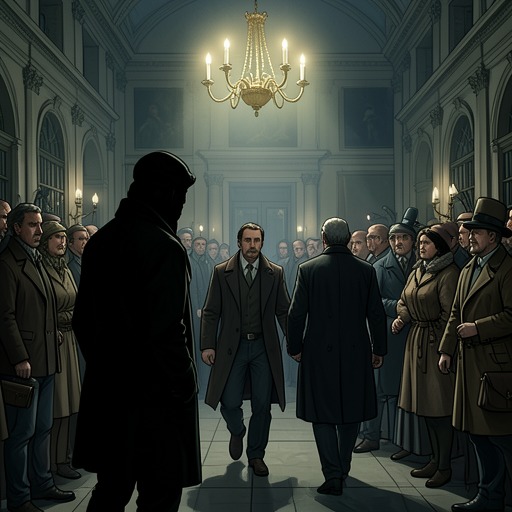
Andrey is introduced through a chance street encounter. As Golyadkin travels in a hired carriage along Nevsky Prospect, he watches passers-by and tries to appear decorous whenever he thinks someone is looking. At the turn from Liteyny Street, two young clerks from his department notice him; soon after, a fashionable droshky passes, carrying Andrey, who recognizes his subordinate and stares into the carriage. Golyadkin blushes, wonders whether to bow or pretend to be someone else, and mutters that he is all right. Andrey’s look is brief, but it makes the carriage—a display of Golyadkin’s newly arranged appearance—feel like a public stage on which he cannot control the impression he makes.
The encounter establishes Andrey as both a specific superior and a representative of the office’s social order. Golyadkin’s thoughts about the junior clerks are contemptuous, but the sight of Andrey unsettles him more sharply: the recognition of his own chief makes concealment seem necessary and impossible at once. Andrey need not accuse him or intervene. His gaze alone is enough to turn Golyadkin’s anxious performance of composure into visible embarrassment.
Rebuke at Olsufy Ivanovitch’s Gathering
At Olsufy Ivanovitch’s gathering, Andrey enters the house with his nephew, Vladimir Semyonovitch, as Golyadkin is trying to explain himself to the servant Gerasimitch. Andrey and Vladimir look at him in amazement. Andrey seems about to speak, but Golyadkin has already started out of the entry, blushing, smiling, and looking down. He promises that he will return and explain himself later; Andrey calls after him, and Golyadkin turns on the landing. The exchange makes Andrey’s presence a point of pressure even before he delivers any judgment: Golyadkin flees first, then must face the voice of his superior behind him.
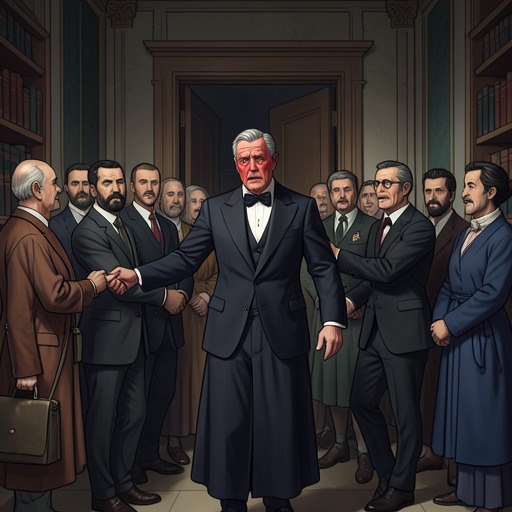
Later, Golyadkin pushes through the guests until he finds himself before Klara Olsufyevna. He offers congratulations, falters in his good wishes, blushes, and looks up to find the room silent, with laughter nearby. He appeals to Andrey with a humble, imploring look, then insists that the matter concerns his domestic circumstances and private life, not an official incident. Andrey answers in a half-whisper, “For shame, sir, for shame!” and turns away with Klara on his arm. The rebuke makes the distinction Golyadkin tries to assert—private trouble rather than public misconduct—ineffective in the eyes of the company. Golyadkin says he has nothing to be ashamed of, then tries to reassure the surrounding guests and withdraw into a corner, but the effort cannot restore his position.
The Office and the Stolen Document
The conflict takes a practical form in the government office when Golyadkin junior takes the document required by the authorities. Golyadkin senior is left holding a penknife, still apparently about to scratch something out, while his double rolls up the document, carries it to Andrey, and enters the Director’s room with him. Andrey has not noticed the manoeuvre. The work is completed punctually and exceeds His Excellency’s expectations; Golyadkin learns that the official was pleased and had thanked the junior warmly. The contrast is decisive: Golyadkin senior’s labor and protest are displaced by the double’s successful presentation of the work, while Andrey accompanies the person who receives the recognition.
When Golyadkin rushes to protest, Andrey refuses to listen, saying that he has no time for the subordinate’s private affairs. This answer does not adjudicate who performed the work or explain the double’s conduct; it classifies Golyadkin’s complaint as a private matter and gives precedence to official business. The refusal thus compounds the appropriation of the document: Golyadkin has lost both the object and the opportunity to make his account heard by the superior who might have recognized what happened.
Appeal and Institutional Exclusion
Later, at dusk, Golyadkin returns to the office while Andrey and Anton Antonovitch are in the Director’s room handing in reports. The clerks greet him coolly: some walk away, others barely nod, and the younger men gather around him with insulting curiosity. Golyadkin tries to approach colleagues with whom he once got on best, but no one shakes his hand. Andrey is not present for this initial snub, yet it prepares the scene for Golyadkin’s attempt to use the institution’s chain of command to counter the exclusion.
When Golyadkin junior appears among the clerks and mocks him, Golyadkin breaks away and heads for His Excellency’s room. In the adjoining room he accosts Andrey, who has just come out from seeing the superior and is surprised by the sudden approach. Golyadkin asks resolutely for a private conversation with His Excellency. Andrey scans him from head to foot and refuses: “What next! of course not.” Golyadkin then says that he is surprised no one has unmasked the impostor and scoundrel. Andrey asks whom he means. Golyadkin speaks vaguely of a certain person, describes exposing him as an honorable act of loyalty, and begins to weep. His appeal shifts between accusation and deference, but it does not give Andrey a clear, actionable case; nor does Andrey grant the private audience that Golyadkin seeks.
Andrey steps back in astonishment and looks uneasily about him. Before the exchange can proceed, His Excellency comes out with several officials and calls Andrey to discuss business details. The group moves away, and Golyadkin is left to turn to Anton Antonovitch instead. Andrey’s departure is not presented as a direct ruling on the charge; the interruption nevertheless leaves Golyadkin without the hearing he hoped to secure. The scene repeats the office’s governing pattern: official movement continues, while his distress remains outside its business.
Final Confrontation and Narrative Role
In the final confrontation with His Excellency, Golyadkin points to his twin and calls him vile and vicious, insisting that he is referring to a well-known person. Andrey is among those present, alongside a gentleman with a cigar. They nod as His Excellency impatiently rings for the servants, and Golyadkin junior steps forward to ask permission to speak. Andrey’s nod belongs to the room’s collective response; the passage does not establish what he believes about the double or whether he understands Golyadkin’s accusation.
Across these episodes, Andrey’s role is less that of a personal adversary than that of a gatekeeper whose official rank makes recognition matter. He sees Golyadkin at moments when the latter is intensely concerned with his appearance and standing, but the encounters produce no sustaining acknowledgment: a look in the street, a rebuke at the gathering, a refusal to hear a complaint, and the interrupted appeal at the office. His authority therefore sharpens the novel’s contrast between Golyadkin’s need to explain himself and the institution’s capacity to treat that need as irrelevant or private. At the final crisis, Andrey remains part of the watching official world, while Golyadkin’s claim against his double is left to compete with the double’s confident speech.