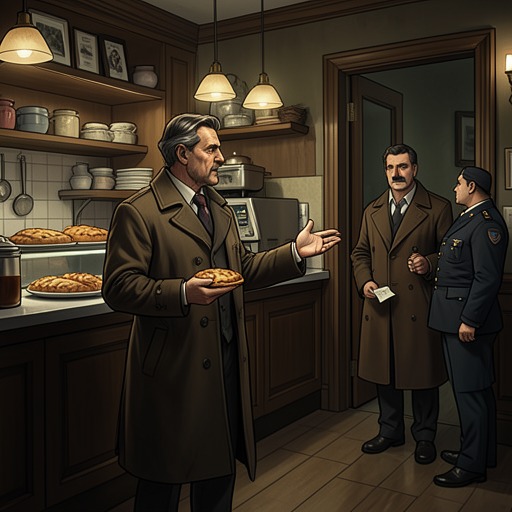
Goliadkin took in a duplicate overnight
The DoubleYakov Petrovitch Golyadkin takes his exact double into his home for dinner and the night, transforming an encounter that has left him trembling into an act of hospitality. The invitation begins in bewilderment and pity, then swells into brotherly alliance: Golyadkin offers shelter, shares private affairs, and imagines that the two men can work together against their enemies. The scene’s warmth is real, but so is its unease. The newcomer’s poverty and deference let Golyadkin interpret an impossible resemblance as a manageable bond, while the intimacy of the evening gives that bond a place in his ordinary life.
From the street to the back street
The encounter begins as Golyadkin walks beside the man he met that morning. He trembles, shuts his eyes, and opens them again in the hope that his companion is an illusion. The stranger remains beside him, smiling and apparently seeking a chance to speak. Their coats and hats appear to have come from Golyadkin himself, making the resemblance a material affront as well as a visual one. Golyadkin tries to hide inside his coat and pull his hat over his eyes; at last he tells the stranger, in a near-whisper, that they are going different ways. The stranger responds with an apology and a plea for an indulgent hearing, explaining that he had taken Golyadkin’s earlier compassion as an offer of interest.
Instead of ending the encounter, Golyadkin invites him home. He proposes crossing the Nevsky Prospect and taking a small back street, a route he says will be more convenient. The stranger readily accepts, speaking as if the choice belongs entirely to his host. Golyadkin, however, cannot comprehend what is happening. His invitation turns flight into accommodation without resolving the fear that prompted his attempted separation: he brings the unsettling figure closer while still trying to manage where and how their meeting takes place.
Hospitality and the visitor’s appeal
At home, the visitor sits humbly and watches Golyadkin’s movements, as though trying to read his thoughts from his glance. Golyadkin drops his hat from the window; the visitor immediately retrieves it, brushes off the dust, and carefully replaces it. The small gesture helps Golyadkin understand him as a man in distress, and Golyadkin ceases to exert himself to make his guest comfortable, leaving the visitor to manage his own needs. The narrator leaves the stranger’s reserve ambiguous: it may come from shyness, shame, or politeness. When Petrushka appears in the doorway and asks whether dinner should be brought for two, Golyadkin hesitates before agreeing. The visitor blushes, and Golyadkin’s kindness begins to shape a more generous interpretation of the situation.
The stranger asks for Golyadkin’s acquaintance and protection, presenting himself as poor, newly arrived, and desperate. He says he has been drawn to Golyadkin from the first moment and appeals to his generosity, but struggles to choose words that will not sound either servile or presumptuous. His posture is that of a gentleman reduced to begging while trying to preserve his dignity. The appeal gives Golyadkin a social explanation for the visitor’s presence: he can treat him not simply as a duplicate, but as a vulnerable namesake who needs assistance.
A shared meal and a borrowed history
Petrushka brings dinner for two, and the men eat together. Their meal is brief and uncomfortable. Golyadkin feels ill at ease and is ashamed of the poor food, both because he wants to give his guest a good dinner and because he wants to show that he does not live like a beggar. The visitor, too, is embarrassed: he hesitates to take a second piece of bread or help himself to the best morsels, insists that he is not hungry, and says he will remember the excellent meal all his life. Afterward Golyadkin lights his pipe and offers his guest a second one; facing each other, they begin a conversation that lasts for hours.
The visitor’s account is a catalogue of minor hardships and workplace grievances. He describes provincial law-court service, departmental intrigue, corrupt registration clerks, a new chief, and the loss of his position through enemies’ machinations. He says that he came to Petersburg on foot, failed for a long time to find work, spent his money, and was left almost living in the street. He recounts subsisting on a crust of bread, sleeping on a bare floor, and eventually receiving help from a Christian benefactor who secured him a new post. In tears, wiping his eyes with a blue-check handkerchief, he confesses that he lacks money for a decent lodging and proper clothes: he has managed to obtain only a pair of poor boots and has had to hire a uniform.
The details are ordinary, but their effect on Golyadkin is extraordinary. He is genuinely moved, and the tale acts like balm to his heart. His last misgivings begin to fade; he tells himself that he had been foolish to feel so distressed. The double’s apparent helplessness allows him to regard their likeness as an oddity of nature rather than a threat to his honour or career. Golyadkin’s welcome therefore depends not on solving the uncanny circumstance but on recasting it: if the stranger is innocent, pitiful, and in need of protection, then the resemblance need not be a disgrace.
Brotherhood, conspiracy, and the night together
Overcome with feeling, Golyadkin embraces his companion and begins disclosing private affairs, including matters involving Andrey Filippovitch and Klara Olsufyevna. He promises that they will get on together like brothers, work together, and even devise an intrigue to pay their enemies back. At the same time, he warns the visitor not to trust anyone and describes him as guileless, someone who might tell other people everything. His welcome thus joins tenderness to suspicion: he offers solidarity while imagining a common struggle against the people he distrusts.
Golyadkin then asks the visitor to stay with him, either for a while or forever. He calls their strange resemblance a matter of nature and urges his new brother not to grieve over it. The visitor agrees and becomes tearful too. Their emotional agreement does not erase the strangeness between them; instead, Golyadkin gives it a fraternal name and tries to make it the basis of a shared plan. The language of brotherhood promises closeness, while the talk of intrigue keeps the outside world cast as an enemy.
After they reach their third and fourth glasses of punch, Golyadkin feels both exceptionally happy and unable to stand. He invites the visitor to spend the night. A bed is improvised on two chairs, and the guest says that under a friend’s roof even the bare floor would be soft, that he can sleep anywhere, and that he is now in paradise after all the trouble he has endured. Golyadkin urges him to put his faith in God; their conversation wanders from religious belief to Turks, learned professors, and an Algerian barber’s shop Golyadkin has read about. The guest undresses, and Golyadkin goes behind a screen, partly to spare him embarrassment and partly to sound out Petrushka and reassure himself about the servant.
Before settling down, Golyadkin takes a candle and tiptoes over to look at the sleeping guest. He calls the sight an unpleasant picture and a burlesque. The image registers a doubt that the evening’s tenderness has not entirely subdued: the visitor is at once a person to pity and an uncanny repetition of his host. Golyadkin eventually falls asleep with a humming and ringing in his head, after trying unsuccessfully to concentrate on an important, delicate question. The chapter closes the night with the bodily consequences of five glasses of punch, leaving his attempted understanding unfinished.
Significance of the welcome
This episode establishes the double not through open conflict, but through domestic admission. Golyadkin first tries to evade his companion, then brings him across the city, feeds him, listens to his history, shares confidences, and gives him a place to sleep. Each act makes the stranger more intimate and more difficult to dismiss. Hospitality offers Golyadkin a temporary way to master the encounter: he can be the generous host to a needy namesake, the elder brother to a meek dependent, and a partner in a scheme against common enemies.
Yet the episode keeps that reassuring account unstable. The visitor’s matching clothes, Golyadkin’s trembling, the awkwardness at dinner, and the late-night description of the sleeping man as a burlesque all persist beside the declarations of brotherhood. Even the guest’s story, which moves Golyadkin so deeply, is made of the mundane humiliations of work, poverty, and lodging rather than a revelation that could explain the resemblance. The night’s reconciliation is therefore provisional: Golyadkin welcomes the stranger by folding him into a story of innocence and need, while the scene’s repeated signs of likeness and discomfort keep the original disturbance alive.