Golyadkin's government office
The DoubleGolyadkin's government office is both a workplace and a public arena in which the protagonist’s precarious standing is tested before supervisors and clerks. Its routines—sitting at an assigned desk, copying papers, carrying a manuscript to a superior, and receiving official instructions—give social judgments institutional consequences. The office’s most decisive reversal comes when Golyadkin junior takes a document prepared by the senior Golyadkin and delivers it to the authorities, winning credit for work the protagonist had done.
Setting and Routine
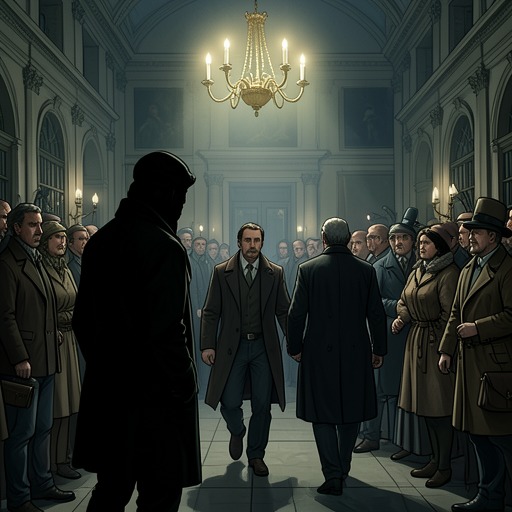
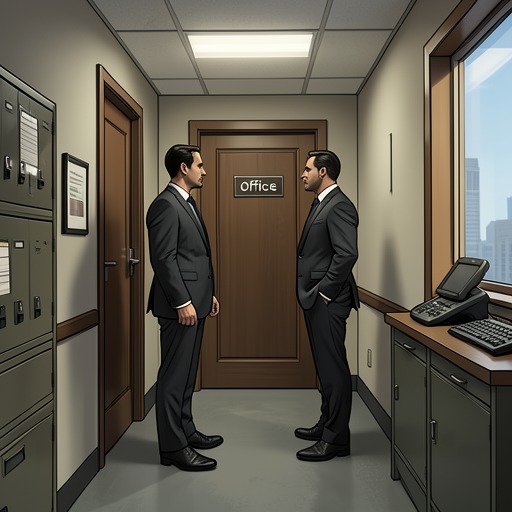
Golyadkin enters the department in a state of anxious expectation after the previous evening. He takes his usual place beside the head clerk, Anton Antonovitch Syetotchkin, and tries to lose himself in the papers before him. To avoid drawing attention, he resolves not to ask questions, make jokes, allude to recent events, or even exchange the ordinary courtesies with his colleagues. Yet he keeps stealing glances at their faces, searching them for signs that they know something about him. The office is thus introduced not simply as a site of labor but as a room of possible witnesses, where even routine attention feels charged with judgment.
His attempt to take refuge in work becomes harder when a familiar figure appears at the desk opposite. Andrey Filippovitch, the head of the office, directs the newcomer to sit at Anton Antonovitch’s table, opposite Golyadkin, and says that they will soon find something for him to do. Golyadkin recognizes the newcomer as his double, but the other clerks show no visible astonishment. Their silence unsettles him as much as the double’s presence: the office behaves as though this extraordinary arrival were an ordinary administrative matter.
The Double in the Workplace
The newcomer is incorporated into the department through the same practical gestures that govern any appointment: a place is assigned, work is promised, and the newcomer is treated as a colleague. Meanwhile, Golyadkin tries to keep his mind on the papers in front of him. In his distress he moves his pen mechanically, then discovers that he cannot make sense of what he has written. The contrast is sharp: the office’s familiar sounds and procedures continue, while his ability to perform his own work falters.
The double’s authority becomes tangible when Andrey Filippovitch needs a manuscript for His Excellency. Golyadkin is preparing to follow the head of the office with the required papers when the junior double darts past him and approaches him in an official bustle. He asks whether the papers are ready, then offers to remove what he calls a blot with a penknife. In the momentary struggle that follows, he takes possession of the document against Golyadkin’s will, rolls it up, tucks it under his arm, and hurries away with Andrey Filippovitch into the Director’s room. Golyadkin is left holding the penknife, still poised to perform the small service the other had pretended to offer.
Credit, Exposure, and Humiliation
The document’s delivery turns the office’s apparent normality into a contest over credit. Golyadkin follows and sees Andrey Filippovitch speaking amiably with his namesake, who smiles, ingratiates himself, and whispers to him. Golyadkin learns that the work has exceeded His Excellency’s expectations and was completed punctually. The junior is thanked warmly; Golyadkin, who prepared the work, is not recognized as its author. When he attempts to protest, Andrey Filippovitch refuses to listen, saying that he has no time for private affairs.
Golyadkin later catches the junior as he is leaving among the clerks and holds him by the sleeve. The witnesses step back to watch. Instead of answering the accusation, the junior pats and tickles Golyadkin’s cheek, then pokes him in the stomach, making a spectacle of his helpless anger. He addresses him as a mischievous brother and says they will be sly together, then abruptly resumes an official manner and slips away on a special commission. The humiliation is therefore both intimate and public: the man Golyadkin had regarded the previous day as a trusted friend now turns their resemblance into an instrument of ridicule in front of the department.
Colleagues and Official Authority
The office’s social response changes alongside the struggle over the document. When Golyadkin returns at dusk, he approaches colleagues with whom he used to get on well, hoping to greet them and restore ordinary relations. Some answer briefly and walk away; others barely nod, turn their backs, or pretend not to notice him. Younger clerks gather around him with insulting curiosity and nearly block his way. The room’s informal audience has become a visible measure of his isolation.
Golyadkin tries to enlist Andrey Filippovitch’s attention by presenting his appeal as a matter of loyalty to a superior whom he regards as a father. His voice trembles and tears gather, but the conversation is interrupted when His Excellency comes out with other officials and walks off with Andrey Filippovitch to discuss business. Golyadkin is left to seek understanding from Anton Antonovitch. The reply is stern and procedural: he will be officially informed that day. The phrase makes clear that the office can end a personal appeal not by resolving it in conversation but by converting it into an administrative notice.
Consequences and Significance
That notice arrives in an envelope at Golyadkin’s flat. Signed by Andrey Filippovitch, it instructs him to hand over the business in his charge to Ivan Semyonovitch. The office’s decision consequently reaches beyond the workplace: Golyadkin’s duties are transferred, while at home he finds Petrushka gathering his belongings, apparently preparing to leave for Karolina Ivanovna’s flat. The official order and the threatened loss of his servant deepen a night already dominated by sleeplessness, confused memories, and visions of his reputation being trampled and his place in the service taken over.
Across these scenes the department’s ordinary procedures acquire an unsettling double meaning. Assigned seats, written work, reports, and formal instructions continue to function, but they also determine who is accepted, credited, and heard. Golyadkin’s efforts to appear composed and to keep to his papers cannot protect him once his double has been admitted into the same institutional space and recognized by its hierarchy. The office turns an uncanny rivalry into concrete professional displacement: a document changes hands, praise goes to the wrong man, colleagues close ranks, and Golyadkin is formally required to surrender his work.