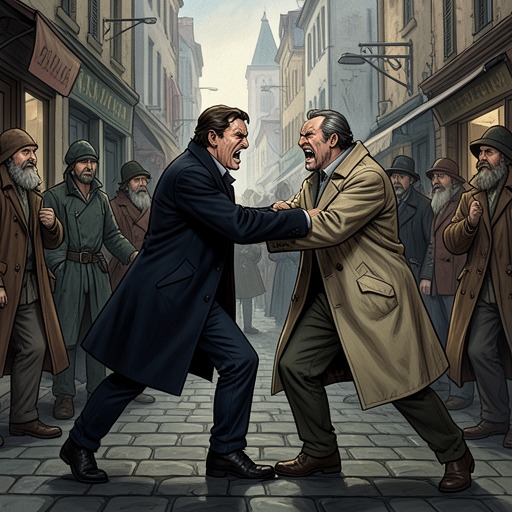
Golyadkin’s confrontation with his double at the department
The DoubleGolyadkin’s confrontation with his double at the department is a public struggle over who may claim the name, work, and standing of Yakov Petrovitch Golyadkin. Before a room of clerks, the younger namesake turns a cordial gesture into an act of humiliation; the senior Golyadkin then seeks an audience with his superiors, only to be told that an official decision will speak for itself. The scene brings the story’s personal crisis into the workplace, where colleagues’ reactions and administrative procedure combine to leave him without a credible platform from which to defend himself.
Setting and Immediate Context
The confrontation takes place late in the working day, as dusk falls and office hours near their end. Andrey Filippovitch and Anton Antonovitch are in the Director’s room delivering reports, while the clerks have gathered in groups to talk and laugh. Some of the youngest employees are playing pitch-farthing by a window. Golyadkin enters aware that he needs to conciliate his colleagues, approaching those with whom he had previously got on best to offer his greetings.
The reception is cold. Some clerks answer briefly and walk away; others barely nod, turn aside, or pretend not to see him. Younger clerks gradually form a group around him, looking at him with insulting curiosity and nearly blocking his way. The growing audience matters: before Golyadkin can make his case, the room has become a social stage on which others’ attention and judgment shape what he can do.
The Double Takes the Floor
The younger Golyadkin appears among the clerks as the senior man is already surrounded. Gay, nimble, and smiling, he moves easily through the group, shaking hands, slapping one man on the shoulder, putting an arm around another, and explaining how he came to be employed by His Excellency and what he had done. He wins over the room with the same fluent sociability that has repeatedly set him apart from his namesake.
After making the rounds, the younger man offers his hand to the senior Golyadkin, apparently without noticing whom he is greeting. The senior accepts it warmly, with an emotion that the narration leaves uncertain: he may be taken by surprise, misled by the gesture, or conscious of his own helplessness. In front of witnesses, he willingly shakes hands with the person he regards as his mortal enemy. The younger Golyadkin then withdraws his hand with conspicuous contempt, shakes it as though soiled, spits aside, and wipes his fingers with a handkerchief while looking around to ensure that the clerks see the insult.
The gesture reverses the apparent promise of reconciliation. The assembled clerks seem at first to disapprove, and even the frivolous younger employees murmur in protest. But the younger man follows the insult with a joke that alludes to an incident familiar to the group, calling his namesake their Russian Faublas and inviting him to kiss him. The allusion gives the crowd a shared frame for the mockery; the senior Golyadkin recognizes that his rival’s performance is working on the audience, and his last hopes of winning them over collapse.
Appeal to Authority
Rather than remain inside the gathering, the senior Golyadkin breaks out of the crowd and heads toward His Excellency’s private room. He meets Andrey Filippovitch in the adjoining room and, despite his hesitation, asks firmly for an immediate private conversation with His Excellency. He explains that he is surprised no one has unmasked the impostor and scoundrel. His appeal makes the dispute explicit: he wants the institution to recognize the younger man as an impostor and hear his own account.
Andrey Filippovitch refuses the request. When the senior Golyadkin tries to press the issue, His Excellency comes out with several officials and moves away with Andrey Filippovitch to discuss business. The procession passes on without hearing him. Golyadkin then turns to Anton Antonovitch, appealing to him as someone who might understand his position and asking what Andrey Filippovitch’s words mean. Anton answers that everything will be explained in due time and that Golyadkin will be officially informed that day. When Golyadkin asks why the matter must be official, Anton tells him that decisions made by their superiors are not for the two of them to discuss.
The exchange replaces a personal hearing with a promised notification. Golyadkin has named the double and demanded intervention, but no superior investigates the accusation in his presence. The language of office procedure closes the conversation without resolving the question of identity as he understands it.
Documents, Recognition, and Consequences
The scene belongs to a wider conflict in which written messages and official papers carry power, but do not necessarily secure Golyadkin’s version of events. Earlier, after the evening’s humiliations, he has written a letter to the young Golyadkin, addressing him as a man bound to him by their circumstances. A letter from Vahramyev, a former friend and fellow clerk, also reports that the person whose name he will not mention has taken Vahramyev’s place as a friend and lives at Karolina Ivanovna’s. The letter says Vahramyev intends to break off their connection and demands repayment of two roubles for a razor. Golyadkin reads the message as evidence of slander and intrigue and answers with a letter of his own, insisting on his honour and good name.
The battle over recognition also has a concrete administrative dimension. At the department, the younger Golyadkin takes possession of the document required by the authorities and carries it into the Director’s room with Andrey Filippovitch. The work is reported to have exceeded His Excellency’s expectations and been finished on time; the younger man receives thanks, while the senior Golyadkin protests and is told that Andrey Filippovitch has no time for his private affairs. In this setting, a document’s successful delivery and the superior’s approval count more institutionally than the senior man’s claim that another person has appropriated his place.
The promised official communication soon takes material form. An attendant brings Golyadkin an envelope containing instructions, signed by Andrey Filippovitch, to hand over the business in his charge to Ivan Semyonovitch. Back at his flat, Golyadkin sees Petrushka gathering his belongings, apparently preparing to leave for Karolina Ivanovna’s lodging. These consequences extend the department’s rejection beyond the office: work is reassigned, and the servant on whom Golyadkin depends appears ready to depart. The official notice does not settle the personal truth of the double, but it changes Golyadkin’s practical position.
Public Exposure and Narrative Significance
The department scene echoes an earlier public humiliation at Olsufy Ivanovitch’s gathering. There, after forcing his way through the crowd and stumbling into a confrontation with Klara Olsufyevna, Golyadkin stammers through his congratulations and good wishes. The assembled guests fall silent; laughter comes from nearby, and Andrey Filippovitch’s response leaves him crushed. He retreats to a corner, trying to appear decorous, unobtrusive, and like everyone else. At work, the same need to manage appearances returns in a different form: he approaches colleagues politely, accepts a handshake, and finally attempts a direct appeal to authority. Each strategy fails before witnesses.
The opening of the wider episode supplies another contrast. On his way through Petersburg in a hired carriage, Golyadkin first chuckles as though pleased with a successful performance, then grows anxious and searches the streets for anyone watching. When he sees colleagues, he hides in the carriage; when Andrey Filippovitch recognizes him from a droshky, he cannot conceal himself and blushes. The shifting performance of confidence, concealment, and exposure anticipates the department’s more severe public test. His concern with how he appears is not separate from the action: it governs his efforts to approach others and sharpens the force of each rejection.
The younger Golyadkin’s ease among the clerks contrasts with the senior man’s dependence on formal greetings and appeals. The double does not merely contradict his claim in private; he stages an alternative identity before the very colleagues whose recognition the senior man needs. The latter’s attempt to secure an official audience fails at the threshold, while the administrative world continues to act through reports, documents, and orders. The confrontation therefore marks a decisive narrowing of his recourse: he can accuse, protest, and seek explanation, but the workplace’s public judgment and official machinery proceed without granting him the hearing he asks for.