Golyadkin’s removal by Krestyan Ivanovich
The DoubleGolyadkin’s removal by Krestyan Ivanovich turns the protagonist’s imagined exposure into a public departure under medical authority. At the end of the novel, the doctor arrives amid the humiliation orchestrated by Golyadkin’s double; Golyadkin entrusts himself to him, is carried away in a four-horse carriage before a watching crowd, and then recognizes that the familiar physician has become a figure of terror. The scene closes not with reassurance or reconciliation, but with the grim announcement that Golyadkin will receive free quarters, wood, light, and service—provisions he is told he does not deserve.
The Doctor’s Arrival
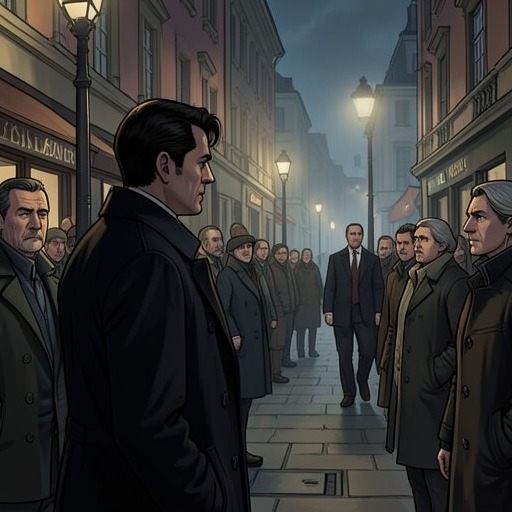
The removal begins at the moment when Golyadkin’s double has completed the Judas kiss and Golyadkin imagines an endless multitude of identical versions of himself flooding the room. A new arrival interrupts that vision: a tall, thick-set man in a black dress-coat, wearing a large cross and marked by thick black whiskers. Golyadkin recognizes him as someone he has seen repeatedly, including that day, and the sight sends a chill through him. The narration also says that he had long had a presentiment of something like this arrival, making the encounter feel both unexpected in its timing and anticipated in its dread.
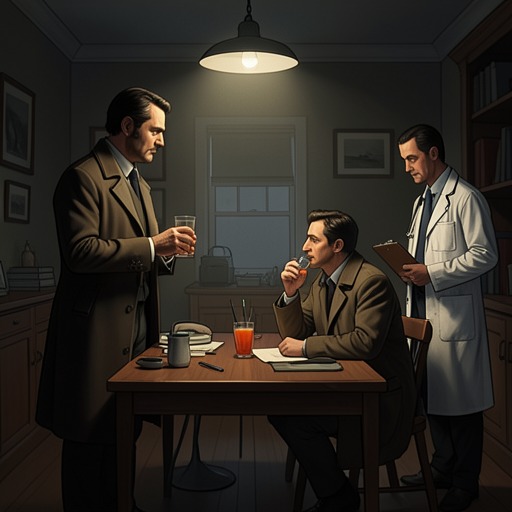
The newcomer is Krestyan Ivanovitch Rutenspitz, identified as Golyadkin’s old acquaintance and a doctor of medicine and surgery. The identification reaches Golyadkin in the double’s whispered voice. Instead of explaining the doctor’s purpose in ordinary terms, the scene gives the announcement an ominous, ceremonial weight: Krestyan approaches gravely, takes Golyadkin by the hand, and draws him away. The man who once belonged to Golyadkin’s familiar world now appears as an agent of an outcome he fears but cannot prevent.
A Public Departure
The movement from the room to the carriage unfolds under the gaze of a crowd. The party reaches brightly lit stairs already filled with onlookers, and the front door opens onto a carriage waiting with four impatiently snorting horses. Golyadkin’s junior double bounds down the stairs and opens the carriage door himself. Krestyan gestures for Golyadkin to get in, although the crowd is ready to help him. The orderly form of an escort is thus surrounded by pressure: Golyadkin is not simply departing privately with a physician but is being watched and physically assisted out before the assembled company.
From the steps, Golyadkin looks back at the staircase, where faces fill the lighted space and inquisitive eyes follow him. Olsufy Ivanovitch sits in his easy chair on the top landing, observing events with deep interest. The crowd’s impatience becomes audible when Golyadkin pauses to look back. Faced with so many witnesses, he tries to defend himself in terms of official conduct, desperately asking whether he has done anything reprehensible or anything that should attract severity or general attention in his official relations. The surrounding people answer not with a clear explanation but with a clamour and shaking heads; tears come to Golyadkin’s eyes.
His response to this pressure is to declare that he is ready, expresses full confidence, and entrusts his fate to Krestyan. The declaration produces a deafening shout of joy from those around him, echoed through the waiting crowd. The moment reverses the language of trust: Golyadkin presents his surrender as confidence in an old acquaintance, while the crowd’s jubilant response makes the surrender sound like a public victory over him. Andrey Filippovitch helps Krestyan put him into the carriage, while the double assists from behind in his characteristic nasty manner. Golyadkin gives a last look at everyone and everything, shivering as he climbs in; Krestyan follows, and the carriage door slams.
The Double’s Farewell
The crowd pursues the departing carriage, sending shrill, furious shouts after Golyadkin under the guise of good wishes for his journey. Several people run alongside for a time, but they gradually fall away. The double keeps pace longer than anyone, hands in the pockets of his green uniform, skipping from side to side, at moments gripping the window-frame and leaning his head inside to throw farewell kisses. His cheerful persistence makes the departure an extension of the earlier public mockery: even after Golyadkin has been placed under the doctor’s care, his double remains close enough to turn the carriage window into a stage for one last taunt.
The procession eventually recedes until the double, too, disappears. Golyadkin is left with a dull ache in his heart, a rush of blood making his head throb, and a feeling of suffocation so intense that he longs to unbutton his clothes, bare his breast, cover it with snow, and pour cold water over it. He then sinks into forgetfulness. The ending develops the scene’s pressure through bodily effects rather than a composed account of what the crowd has decided: noise, exposure, physical distress, and finally a lapse in consciousness mark how little control he retains over his departure.
An Unfamiliar Road and a Changed Physician
When Golyadkin comes to himself, the horses are carrying him along an unfamiliar, deserted road bordered by dark patches of copse. The change from the brightly lit stairs and crowded entrance to the empty road removes the public witnesses, but it does not restore safety. Instead, two fiery eyes stare at him in the darkness, glittering with malignant glee. Golyadkin tries to identify their owner by comparing the figure with the Krestyan he knows: at first he questions whether this is the doctor, then concludes that it is Krestyan, but not the old Krestyan—another, terrible Krestyan Ivanovitch.
The recognition makes the physician’s identity unstable at the very point when Golyadkin has entrusted his fate to him. During the departure, Krestyan was an old acquaintance whose presence could be invoked as reassurance; on the road, Golyadkin experiences him as transformed into a menacing stranger. Golyadkin begins timidly to say that he believes he is all right, hoping that meekness and submission will soften him. The appeal does not produce comfort. Krestyan answers that Golyadkin is to receive free quarters, wood, light, and service, which he does not deserve, delivering the words with the stern force of a judge’s sentence.
The Sentence and the Ending
The provisions named in Krestyan’s reply give the journey a definite, institutional consequence, but the passage does not specify a destination by name. Instead, its last emphasis falls on the authority and severity of the pronouncement. The offer of quarters and service is made conditional and punitive at once: even while naming what Golyadkin will receive, Krestyan declares that he has not earned it. The language transforms an apparent act of care into a judgment, leaving no space for Golyadkin’s hope that submission might change the outcome.
Golyadkin shrieks and clutches his head. The narrator closes by recalling that he had long been haunted by a presentiment of this fate. That return to premonition binds the ending to the ominous anticipation attached to Krestyan’s arrival, while preserving the difference between anticipation and understanding: Golyadkin feared that something like this would happen, but only in the carriage does the familiar doctor appear fully as a terrible figure bearing a sentence. His removal therefore completes the novel’s movement from public humiliation to helpless departure, with the double’s triumph behind him and the doctor’s unexplained authority ahead.