Golyadkin’s social isolation and ostracism
The DoubleGolyadkin’s social isolation and ostracism are not simply a matter of his spending time alone: they emerge from the collision between his insistence on independence and his repeated, unsuccessful attempts to secure recognition from other people. He describes a quiet life shared only with Petrushka, but the doctor urges him toward company; junior colleagues laugh at his declarations of dignity; a servant refuses him entry to a dinner; and guests at Olsufy Ivanovitch’s gathering remove him from the room. Later, the junior double turns their conflict into a spectacle for the clerks. Across these encounters, Golyadkin’s separation from others becomes both an observable social condition and a source of his mounting conviction that he is being humiliated and opposed.
Identity and the Desire for Independence
When Krestyan Ivanovitch asks about his habits, Golyadkin answers by measuring his life against what he takes to be ordinary standards. He says that he has the means to go to the theatre, spends the day at the office and the evening at home, and is quite all right. He also declares himself as good as anyone else. Yet in the course of this defence he finally names Petrushka as his companion, then hesitates. The pause unsettles the self-sufficient picture he is trying to present: his household is small, and the one person he cites as company is his servant.
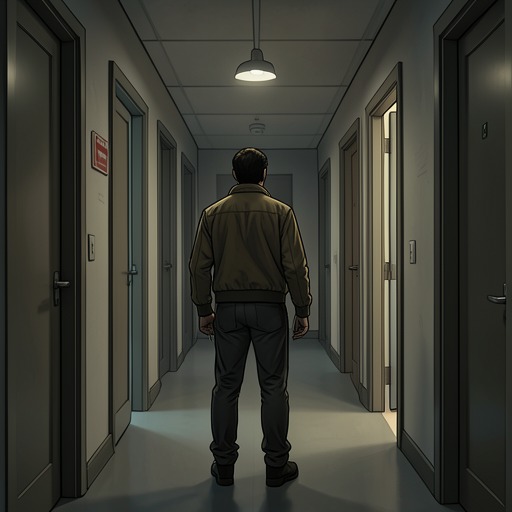
Golyadkin makes the underlying preference plainer when he tells the doctor, “I like quiet, Krestyan Ivanovitch,” and explains that in his flat there are only himself and Petrushka. He says that he goes his own way, keeps to himself, and is not dependent on anyone; he also points out that he goes for walks. His claims join solitude to autonomy: being apart from others is presented as a chosen principle, not an admission of need. At the same time, his repeated appeals to the doctor and his effort to explain himself show that he wants this independent manner to be understood and accepted by another person.
Advice and Friction with Others
Krestyan Ivanovitch responds not by affirming Golyadkin’s preferred quiet but by prescribing a change in his habits. He recommends entertainment, visits to acquaintances, cheerful company, and less hostility to drink. When Golyadkin describes a life that he considers normal, the doctor presses him to alter it radically and says that sitting at home is impossible for him. Their exchange makes Golyadkin’s isolation explicit as a point of disagreement: the doctor treats social engagement as necessary to his health, while Golyadkin defends a separate path and struggles to put that preference into words.
The same difficulty appears in his encounter with two junior register clerks at a restaurant on Nevsky Prospect. Their relations had previously been neither close nor openly hostile; both sides observed good manners without intimacy. When they greet him with surprise, Golyadkin is embarrassed but tries to answer jauntily, even attempting a friendly slap on one clerk’s shoulder. The gesture fails to produce the easy fellowship he intends. Rather than draw him into their company, the awkward exchange exposes how little shared ease exists between him and the younger men.
Golyadkin then turns to a long self-defence. He distinguishes himself from people who use roundabout methods, seek advancement by ingratiation, or intrude where they are unwelcome, and insists on directness and personal dignity. The clerks answer by laughing at him. He leaves with his hat, telling them that time will show the truth, and declares his rule: “if I fail I don't lose heart, if I succeed I persevere, and in any case I am never underhand.” His declaration of integrity is meant to answer their laughter, but it also underlines the distance between his account of himself and the response he receives.
Rejection at the Dinner and the Party
The exclusion becomes unmistakable when Golyadkin arrives for dinner and the servant tells him that he cannot be admitted because he has been ordered to stay away. Golyadkin objects that he is invited and begins to take off his coat, insisting that the servant must know him. The refusal is not merely a misunderstanding that he can settle by explaining himself: the servant repeats that the order is to refuse him. His confidence in his place at the gathering meets a boundary enforced by someone acting on instructions.
At Olsufy Ivanovitch’s gathering, Golyadkin nevertheless tries to take part. After offering congratulations, he falters over his good wishes. The guests fall silent, and he looks to Andrey Filippovitch for support; Andrey responds with indignation and turns away with Klara Olsufyevna. Golyadkin tries to explain that the matter concerns his private circumstances rather than an official incident, but Andrey rebukes him and leaves him facing the crowd without the social footing he seeks.
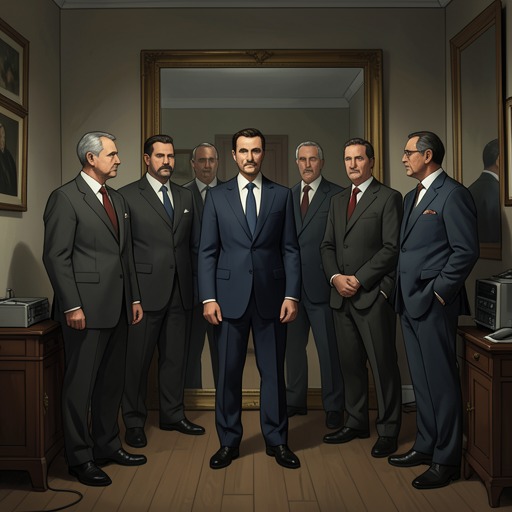
Later, as the guests attend to Klara Olsufyevna after the polka, Golyadkin approaches and tries to dance with her. The guests rush to separate them, and a circle forms around him as people shout and criticize. They guide him to the door, put on his greatcoat, and push his hat over his eyes; once outside, he stands briefly before hurrying away. The sequence turns his bid to join the gathering into a public removal. His mechanical laughter and his eventual flight mark the contrast between his efforts to remain within the social scene and the crowd’s collective decision to expel him.
The Double, Public Mockery, and Isolation
The social pattern recurs at the department through Golyadkin’s confrontation with his junior double. In front of the clerks, the younger man winks at the onlookers as if inviting them to treat the exchange as comedy. He then asks Golyadkin how he spent the night, answering a serious complaint with a question that makes the older man’s grievance itself part of the performance. The clerks are not merely present: the double’s glance recruits them as an audience.
The double’s subsequent mockery leaves Golyadkin rigid with anger and publicly exposed. He understands the incident as a betrayal by someone he had regarded the previous day as his most trustworthy friend, and believes that his reputation has been sullied and that he has been treated with contempt before witnesses. He rushes after his opponent, then stops when he sees that pursuit is useless. His conclusion that the others are conspiring together extends the observable humiliation into a wider sense of persecution.
Across these scenes, Golyadkin’s isolation is sharpened by the repeated presence of other people: the doctor who urges him to socialize, colleagues who laugh, the servant who denies him entry, party guests who remove him, and clerks made into spectators by the double. He continues to assert that he is independent and not underhand, but his attempts to defend that identity do not restore his standing. Instead, each effort ends in another encounter in which recognition is withheld or turned into ridicule, deepening the separation he claims to prefer.