His Excellency
The DoubleHis Excellency is the senior official whose favor and judgment Yakov Petrovitch Golyadkin hopes to secure, but whose responses never give Golyadkin the recognition he seeks. At the department, he presides over a scene of deference and watches the two Golyadkins occupy sharply unequal positions within it; later, he approaches the distressed clerk with an offer to look into his case. Golyadkin tries to turn that opening into a formal accusation against his double, but His Excellency does not answer him. In the final scene, he is among the assembled witnesses as Golyadkin is taken away, the official audience before whom private fear becomes a public spectacle.
Position and Public Presence
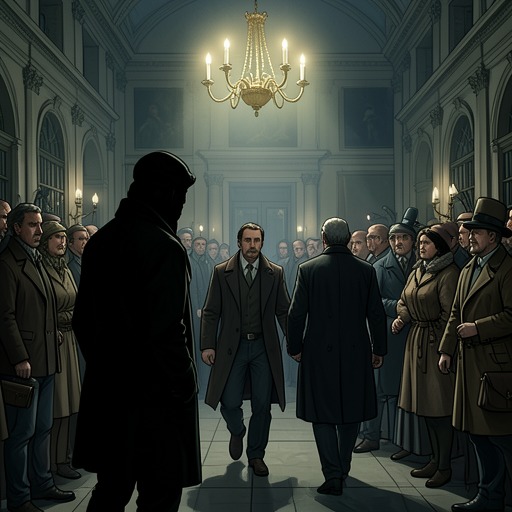
At the close of office hours, His Excellency waits at the foot of the departmental stairs for his delayed carriage, conversing with Andrey Filippovitch and two councillors. Clerks gather to watch him, and the atmosphere is shaped by their attention: some smile at his joke, while the hall-porter stands ready to open the door and bow him through. His departure is treated as a small ceremony, with the gathered officials streaming after him. The scene establishes more than rank; it shows how the department organizes itself around His Excellency’s presence and how readily its members look to him for cues.
Golyadkin watches this display from within the same crowd, but experiences it as a world from which he is excluded. His attention fixes on his junior double, who appears absorbed in His Excellency and eager to catch his notice. Golyadkin imagines that the double is winning people over and plotting with them, and considers approaching His Excellency himself to explain matters. That intention is interrupted when the carriage arrives and the departing officials separate the two men. The gap between His Excellency’s public circle and Golyadkin’s private agitation is thus staged spatially, amid the stairs, the door, and the movement of the crowd.
Golyadkin’s Appeal at the Department
Later, His Excellency turns toward Golyadkin and tells him to run along, promising to look into his case and give orders for him to be taken. His glance toward a thick-whiskered gentleman, who nods in assent, accompanies the promise. Golyadkin understands that those around him are taking him for something different from what he believes himself to be and are not seeing him in the proper light. The offer is therefore double-edged: it sounds like official attention, but its terms do not assure Golyadkin that his identity or complaint has been understood.
Golyadkin takes the opportunity to speak. He tells His Excellency that impostors should not be accepted, then calls his twin vile and vicious and points toward him. He insists that he is alluding to a well-known person, trying to make his charge legible without naming its target directly. His Excellency gives no verbal answer and rings the bell violently. As Andrey Filippovitch and the man with the cigar nod, the summons and the surrounding reactions intensify Golyadkin’s sense that the authorities are responding to a different situation than the one he is trying to describe.
The junior Golyadkin steps forward and asks permission to speak, then turns the question back on the elder: before whom is he making this explanation, and in whose room is he standing? The intervention shifts the exchange from the truth of Golyadkin’s accusation to his decorum and place in the official setting. His Excellency remains the silent center of this contest for credibility. The scene gives him no explicit verdict on the double, but its sequence—Golyadkin’s accusation, the bell, the junior’s confident interruption—leaves the elder unable to secure a hearing on his own terms.
The Final Removal
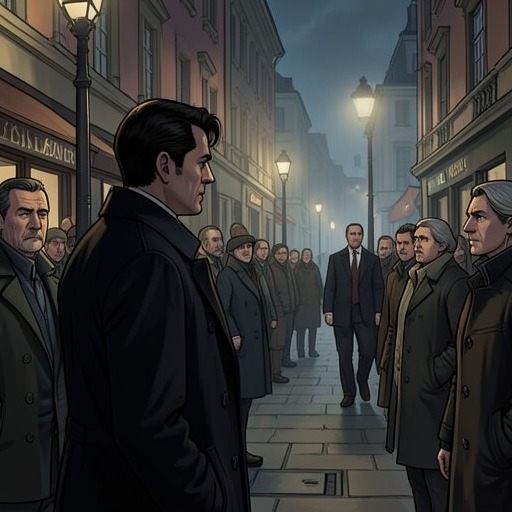
At the end, Golyadkin is brought down the brightly lit stairs with Krestyan Ivanovitch Rutenspitz. A crowd fills the staircase and watches from every side; a four-horse carriage waits at the entrance. The junior Golyadkin bounds down ahead and opens the carriage door, while Krestyan Ivanovitch gestures for the elder to get in. Olsufy Ivanovitch watches from his chair on the upper landing. The crowd’s impatience becomes audible when Golyadkin looks back, and he desperately protests that he hopes he has done nothing reprehensible or deserving of severity in his official relations.
His Excellency belongs to this final public tableau, where the earlier promise to look into Golyadkin’s case gives way to the visible fact of his removal. The ending does not supply a clear account of what His Excellency has decided or what orders have been given. Instead, authority is registered through the assembled witnesses, the carriage, and the official presence accompanying Golyadkin out. His role remains consequential precisely because his attention never becomes the understanding Golyadkin wants: the senior official is both the hoped-for judge and part of the public world before which the clerk’s identity and distress collapse into spectacle.