Imposture
The DoubleImposture in The Double is the name Yakov Petrovitch Golyadkin gives to the threat posed by his exact double: not merely a lie, but the apparent power to occupy another person’s identity, damage his standing, and leave him unable to prove which man is which. The concept gathers the novel’s central anxieties about likeness, reputation, and public recognition. Golyadkin condemns the impostor as a shameless fraud, yet repeatedly tries to reason his way into accepting the double’s place in the world; each attempted accommodation makes the danger more intimate.
Meaning and Moral Language
Golyadkin casts imposture as a violation of both moral conduct and social order. He insists that deception cannot prosper in modern times and invokes Grishka Otrepyov, who, he says, gained through imposture only by deceiving the blind and not for long. The example gives his denunciation a historical and almost judicial register: the impostor may enjoy temporary success, but fraud is supposed to end in exposure and punishment. His confident maxim, however, offers more reassurance than proof. At this point he still has not decided what to do, and his certainty about the fate of imposture coexists with uncertainty about how to confront it.
The moral stakes become personal through Golyadkin’s insistence that a person must not be treated as a rag for wiping dirty boots. His image turns injury to identity into an image of degradation: to be confused with the double is not simply to lose a name, but to be handled, used, and discarded as an object. The language also reveals how much his sense of self depends on other people recognizing distinctions that he cannot make secure by himself. He wants the mask to fall and the truth to become manifest, but waits for office hours to end before taking action, imagining that exposure will let him restore the proper order of things.
Likeness and the Double’s Appointment
The double’s exact resemblance makes Golyadkin’s charge difficult to settle. Thinking through the other man’s admission to the department, he acknowledges the case for compassion: the newcomer is poor, has suffered reverses, and reportedly possesses a satisfactory reference and good conduct. If nature has made two men alike as two drops of water, Golyadkin asks himself, should an office refuse one a position because of the resemblance? He can even imagine the likeness as a providential oddity, with department heads generously providing for twin brothers. In this version, the appointment is not fraud but kindness, and Golyadkin’s indignation begins to look ungenerous.
That charitable account quickly collapses under the pressure of what Golyadkin believes he knows about the double. He calls him playful, nimble, ingratiating, and a scoundrel, fears that he will disgrace the Golyadkin name, and imagines having to look after him and wait upon him. The sharpest danger is not simply that the newcomer may behave badly: the two men may be confused with one another. Golyadkin tries to preserve a distinction by assigning them opposing moral identities—the double can be a rascal while he remains honest, mild, and reliable in the service—but immediately fears that observers will mix them up. His defense depends on a public judgment he cannot control.
Exposure, Humiliation, and Appeal
At the department, Golyadkin tries to make that private fear an official matter. He tells Andrey Filippovitch that he is surprised nobody unmasks the impostor and scoundrel, and seeks a private conversation with His Excellency. When he finally addresses the superior, he declares that impostors cannot be accepted nowadays. His Excellency answers not with a discussion but by ringing the bell violently. Golyadkin then points toward the double, calling him vile and vicious while claiming to allude to a well-known person. The appeal makes his accusation unmistakable, but the evidence supplied here does not show the authorities accepting it; the double remains near His Excellency as Golyadkin speaks.
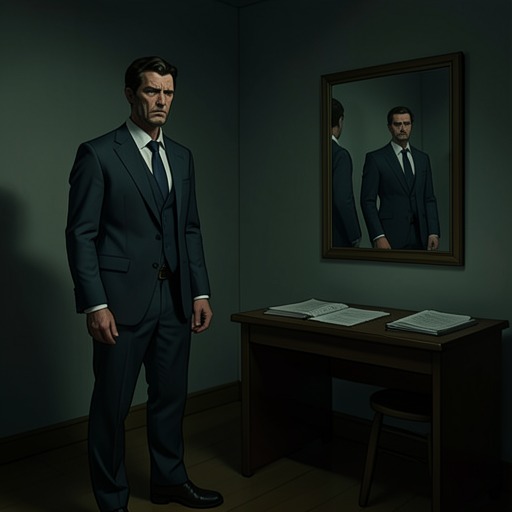
A restaurant encounter has already given the fear a concrete, degrading form. Golyadkin sees the double in a doorway he had taken for a looking-glass. The other man smiles, nods, winks, and eats the last morsel of the tenth pie, while Golyadkin recognizes the act as impersonation. He wonders whether anyone else has noticed. The scene leaves the alleged fraud suspended between spectacle and invisibility: the double performs openly before Golyadkin, yet may pass without public recognition as an offence at all.
Golyadkin pays the restaurant bill—one rouble and ten kopecks are owed—and initially tells himself that the waiter was right to demand payment, despite the man’s insolently significant grin. His effort to treat the incident as settled does not hold. On the last step outside, he stops, flushes until tears come to his eyes, stamps his foot, and rushes home. Without changing his coat or stopping for his pipe, he sits down, draws the inkstand toward him, and begins writing with a trembling hand. The shift from inward argument to written protest marks the pressure of humiliation: where he cannot make the public see the impersonation, he turns to a document of his own.
The Unstable Boundary Between Fraud and Recognition
Imposture in Golyadkin’s account is paradoxical. He insists that the double is counterfeit, yet fears precisely because the counterfeit resembles him perfectly and may be accepted where he himself is not. His imagined remedy is exposure—the mask must fall—but the episodes show how little command he has over the conditions of recognition. In the department his accusation elicits the ringing of a bell; at the restaurant the other man’s performance seems visible to him but possibly unnoticed by everyone else. The conflict is therefore not only between an original and a copy. It is between Golyadkin’s conviction about who the impostor is and a social world that gives him no assured means to make that distinction hold.
His shifting explanations deepen that instability. He can pity the poor newcomer and defend the fairness of hiring a capable clerk; he can imagine the likeness as a touching providential arrangement; then he can recoil at the double’s supposed character and fear that their reputations will merge. The same resemblance that briefly invites acceptance becomes the basis of a charge of fraud. Imposture consequently names both an alleged act by the double and Golyadkin’s unresolved struggle to keep a coherent account of himself in a world where likeness can be mistaken for identity. The more urgently he insists that one man is honest and the other a scoundrel, the more exposed his own standing becomes to the confusion he fears.