Nevsky Prospect
The DoubleNevsky Prospect is both a central thoroughfare of Petersburg and a testing ground for Yakov Petrovitch Golyadkin’s self-presentation. He enters it in a hired carriage, surveys its passers-by as if managing an audience, and returns to it for an anxious day of shopping and waiting; later, along the avenue, he encounters the figure who looks as though he has stepped out of Golyadkin’s own clothes. The street links public display to private alarm, making ordinary movement through the city feel like exposure.
Setting and Function
Nevsky Prospect appears as a busy public route into which Golyadkin’s private schemes repeatedly spill. At the outset, his light-blue hired carriage rolls there from his lodgings. He has dressed with unusual care, admiring his newish boots and bright waistcoat, and carries his pocket-book as he prepares to go out. The carriage, its crest, and his fine clothes give him the outward equipment of a man of consequence, but the street immediately makes that display vulnerable to other people’s notice.
The avenue is connected to nearby streets and commercial spaces rather than presented as an isolated landmark. Golyadkin’s carriage turns from Liteyny Street into Nevsky Prospect, where he spots two young clerks from his government department. Later, he returns to the avenue and tells his driver to stop at the bazaar; from there, he goes with Petrushka into the Arcade and then on through a succession of shops. The street thus organizes a chain of encounters and errands: it is a route through which Golyadkin tries to move confidently, but also a public space in which he can be recognized, watched, or thrown off balance.
Display and Exposure
Golyadkin’s first journey down Nevsky Prospect is marked by abrupt changes of manner. Though the weather is damp and muggy, he lowers both carriage windows and carefully scrutinizes the people outside, adopting a decorous, sedate air whenever he thinks someone is looking at him. His vigilance makes the carriage less a refuge than a viewing position from which he both watches and fears being watched.
At the turn from Liteyny Street, the appearance of his two colleagues reverses the direction of the gaze. One points him out to the other; Golyadkin imagines that his name may have been called. He retreats into the darkest corner of the carriage and does not answer. In his private justification, there is nothing strange about a man hiring a carriage when he needs one, and he dismisses the clerks as foolish youngsters. The scene sets his defensive account of himself against the public fact that he has been noticed: the more insistently he claims the right to appear, the more keenly he registers other people’s attention.
Commerce and Deferred Plans
When Golyadkin comes back to Nevsky Prospect, the avenue becomes the starting point for an extravagant succession of proposed purchases. At the bazaar he arranges to buy a dinner- and tea-service for fifteen hundred roubles, adding a cigar-case and silver shaving-set to the bargain. He asks about other goods, takes down the shop number, and promises to return or send for the items, while offering no immediate deposit. He changes his large banknotes into smaller ones at a money-changer, accepting a loss on the exchange because the fuller-looking pocket-book pleases him.
His plans expand from goods for himself to purchases that imply a much larger domestic life. At a shop selling ladies’ dress materials, he decides on costly fabric and again promises a deposit later. In other shops he bargains, leaves, returns, and orders more. At a furniture shop he commissions furnishings for six rooms and admires a fashionable dressing table for ladies’ use, yet leaves on his familiar promise to send for everything. The repeated deferral gives his activity its unstable rhythm: he behaves as though he is arranging an elaborate future, while the transactions remain largely promises.
The difference between the scale of his business and what he actually obtains becomes plain when the clock strikes three. Of all the morning’s purchases, he has in reality bought only a pair of gloves and a bottle of scent costing a rouble and a half. His bustling itinerary has produced very little material change, and by its end he is troubled by what the narration calls the stings of conscience. He is unwilling even to encounter Andrey Filippovitch or Krestyan Ivanovitch. Nevsky Prospect has carried him through a performance of abundance that ends not in possession but in apprehension and avoidance.
Waiting and Repeated Encounters
After leaving the shops, Golyadkin stops near a well-known restaurant on Nevsky Prospect, which he knows only by reputation. He goes in for a light lunch and to wait for the hour fixed for dinner, taking a small glass of vodka and settling in an armchair with a newspaper. Yet he cannot simply occupy the time. He reads only a couple of lines before standing to inspect himself in a looking-glass and smooth his appearance; he then checks whether his carriage is still at the window before returning to the paper.
When he sees that it is only a quarter past three, he orders chocolate despite having little inclination for it, partly because he considers sitting idle unsuitable. As he goes to pay, the same two junior colleagues he had seen on Liteyny Street face him again. Their relationship is neither friendly nor openly hostile: they observe good manners but have no closer intimacy. Their second appearance makes the avenue’s public scrutiny feel persistent rather than accidental. Golyadkin is again disconcerted by people whose place in his social world is formally familiar but emotionally uncertain.
The Double on the Avenue
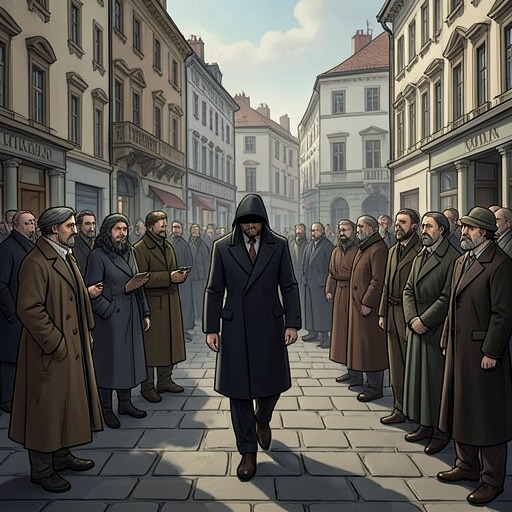
Nevsky Prospect later becomes the setting for a more radical disturbance. Golyadkin is reasoning to himself that he can remain apart from the strange likeness, let it work in the office, and take pride in being innocent and uninvolved. His self-reassurance breaks off when he sees his acquaintance from that morning walking beside him. The other man smiles, peers into his face, and seems to be seeking an opening for conversation. They walk together for about fifty paces without speaking.
Golyadkin tries to hide himself by muffling his face in his coat and pulling his hat low over his eyes. The likeness is made concrete in the clothing: his companion’s coat and hat appear to have been taken from Golyadkin himself. At last Golyadkin says that they are going different ways and insists that his companion understands him. The stranger answers deferentially, apologizes for his intrusion, and recalls that he believed Golyadkin had shown him compassion that morning. Golyadkin then invites him home, proposing that they cross to the other side of Nevsky Prospect and continue by a little back street. The movement away from the avenue’s exposed public space is also a movement toward private accommodation, though Golyadkin remains unable to comprehend what is happening to him.
Narrative Significance
Across these episodes, Nevsky Prospect binds together appearance, recognition, and unstable identity. Golyadkin uses the carriage and his carefully arranged dress to project respectability, but a pair of clerks can unsettle him simply by recognizing him. His shopping promises enlarge the image of the life he intends to inhabit, while their meagre result exposes the distance between display and possession. In the restaurant, the looking-glass and the carriage window turn waiting into repeated checks on his appearance and surroundings.
The encounter with the double intensifies that pattern. On the avenue, the likeness is not just an idea Golyadkin can dismiss in private: it walks beside him, wears clothes that seem to be his, and addresses him. His proposal to leave Nevsky Prospect by a back street registers his impulse to escape public visibility, yet he takes the stranger with him rather than ending the encounter. The street’s recurring role is therefore not simply geographical. It stages Golyadkin’s effort to control how he appears, and repeatedly makes that effort answerable to other people and to the disturbing resemblance he cannot master.