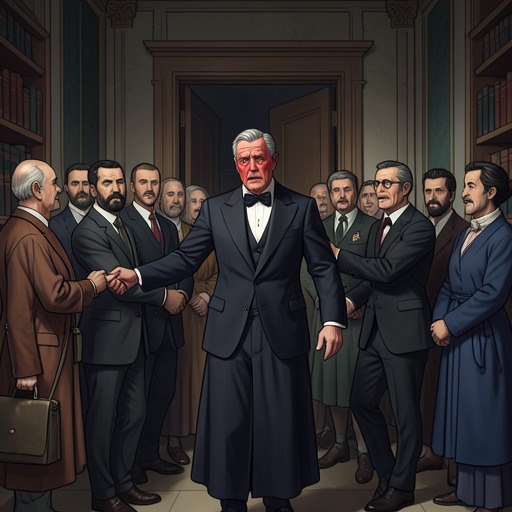
Olsufy Ivanovitch Berendyev
The DoubleOlsufy Ivanovitch Berendyev is a retired privy councillor, family patriarch, and former patron of Yakov Petrovitch Golyadkin. His household’s celebration of his daughter’s birthday displays wealth, rank, and affectionate family ceremony, while his refusal to see Golyadkin gives that same household a decisive boundary: a man who calls Olsufy his benefactor and, in a sense, father is not admitted to the family gathering. Through this contrast, Olsufy’s role is less that of a continuously present protagonist than that of a social authority whose welcome Golyadkin both claims and fails to obtain.
Identity and Household
Olsufy is described as a hale old man and a privy councillor, though long years of service have left him unable to use his legs. The narrator associates his later comfort with the rewards of that service: investments, a house, small estates, and a beautiful daughter. His position combines official distinction, material security, and family standing; the birthday celebration gathers these forms of status into a public display.
His daughter, Klara Olsufyevna, is the guest of honour at the event. The account presents her parents as deeply moved by the ceremony: Olsufy weeps and declares through his tears that His Excellency is benevolent. The scene places him within a network of official rank and patronage as well as intimate family feeling. His physical disability is noted, but the account does not make it his defining action; he remains the father and host around whom the celebration’s expressions of gratitude and affection are organized.
The Birthday Celebration
Klara’s birthday is marked by an unusually lavish dinner near Ismailovsky Bridge. The meal includes champagne, oysters, fruit, and a range of dishes, and the gathering is described as a brilliant occasion attended by people from across the government service. A ball is to follow the dinner. The abundance and formality make the celebration a spectacle of household prosperity and social connection, not simply a private family meal.
The narrator prolongs the account of the toasts in a deliberately ceremonious register. Andrey Filippovitch speaks first; the guests and Klara’s parents raise their glasses, and Olsufy becomes so overcome that he sobs. The narration dwells on the raised glasses, tears, and dignified public speeches, framing the gathering as a pageant of virtue and gratitude. Its expansive treatment of ceremony also establishes the social world that Golyadkin hopes to re-enter: recognition is performed before witnesses and distributed according to rank, kinship, and accepted manners.
Olsufy’s emotional response belongs to a scene where public dignity and feeling coexist. The narrator describes him as a hale old man and privy councillor, then shows him weeping like a child while praising His Excellency. That contrast makes his vulnerability visible without removing his authority as host. The celebration’s warmth is real within the account, but it does not extend equally to every person who approaches the household.
Former Patron and Failed Access
Golyadkin tells Krestyan Ivanovitch Rutenspitz that Olsufy has been his benefactor for as long as he can remember and has, in a sense, been a father to him. He invokes that history while addressing the butler at Olsufy’s home, insisting that the household had been mistaken to say that Olsufy was shutting his door against him during a solemn family celebration. Golyadkin expects this appeal to his past relationship to persuade the household and, ultimately, to produce an embrace from Olsufy.
The actual response is categorical. When Golyadkin tries to enter, the servant says there are orders not to admit him. Olsufy’s old butler, Gerasimitch, comes out and confirms that the master cannot see him, politely but firmly telling him that the request is impossible. The scene therefore sets Golyadkin’s asserted intimacy against the household’s explicit refusal. The available account establishes that Olsufy will not receive him on this occasion; it does not explain the order’s origins or detail the earlier history of their patronage.
Later, with the guests listening, Golyadkin repeats the claim that Olsufy has been a benefactor and almost a father. He presents the refusal as cruelly mistaken and looks around as if expecting the assembled company to recognize the force of his appeal. The episode makes Olsufy consequential even in his absence: his supposed paternal bond is the basis of Golyadkin’s argument, while the household’s exclusion makes clear that the bond does not secure him admission.
Narrative Significance
Olsufy’s portrayal turns on the gap between an abundant, affectionate household and the person kept outside its celebration. The birthday scene emphasizes family devotion, official esteem, and material prosperity; the encounter at the door shows that hospitality remains controlled by household authority. The contrast gives the refusal greater force than a simple denial of entry: Golyadkin appeals to a relationship he understands as enduring, but the people acting for Olsufy treat access as closed.
The formal celebration also provides a setting in which social standing is continually displayed and acknowledged through toasts, guests, and deference. Golyadkin’s claim to Olsufy’s paternal regard is therefore not merely private; he makes it before witnesses, hoping that public recognition will confirm his place. Olsufy, meanwhile, appears both as a tearful father at the center of family ceremony and as the master whose household bars Golyadkin from seeing him. That juxtaposition leaves the former patron’s generosity and the present exclusion side by side, without resolving their history.