The restaurant pie impersonation
The DoubleThe restaurant pie impersonation is a brief but decisive episode in which the original Golyadkin discovers his double apparently taking his place in an ordinary public transaction. A disputed bill for eleven pies becomes more than a comic misunderstanding: the double’s visible presence confirms Golyadkin’s fear of being impersonated, while the crowd and the waiter’s demand turn that fear into public humiliation. Golyadkin pays, escapes, and returns home to write in a state of inward agitation.
Causes and Setting
After lamenting that his double might disgrace his name and be mistaken for him, Golyadkin runs on without attending to where he is going. He comes to himself on Nevsky Prospect after colliding at full speed with a passer-by. The collision forces him to look around; he realizes he is near the restaurant where he had sat before the dinner party at Olsufy Ivanovitch’s house.
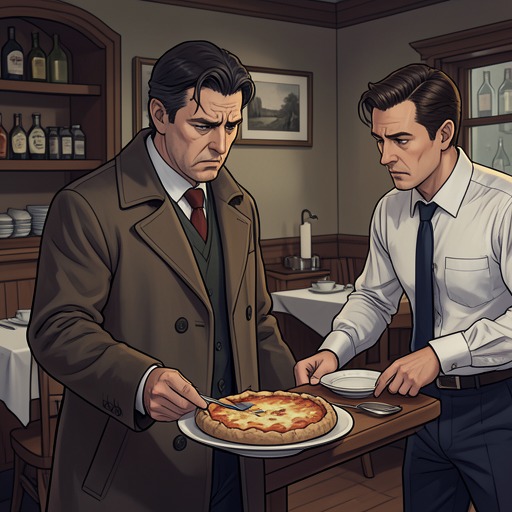
Golyadkin remembers that he has not dined and has no dinner invitation to rely on. He hurries upstairs to eat something quickly, disregarding the restaurant’s high prices because he wants to avoid delay. The setting is busy and public: customers crowd around a counter laden with food, and the waiter is occupied serving, collecting money, and making change. Golyadkin waits his turn, takes a savoury pie, retreats to a corner with his back to the company, and eats. He then returns his plate and places a ten-kopeck coin on the counter, believing he has paid for one pie.
The Disputed Bill
The waiter tells Golyadkin that he has eaten eleven pies. Golyadkin objects that he took only one, but the man insists that he counted them and demands payment. With people gathering around, Golyadkin is petrified and reaches for a silver rouble, prepared to pay the full amount rather than prolong the confrontation. He tries to make the accusation seem manageable by reasoning that a hungry man might eat eleven pies and that there is nothing astonishing or laughable in doing so.
The discrepancy becomes legible to Golyadkin when something seems to stab him and he raises his eyes. The doorway to the next room, which he had taken for a looking-glass, contains another Golyadkin: not the original, but the new one. The double stands facing him, apparently in excellent spirits. He smiles, nods, winks, shuffles his feet, and seems poised to disappear into the adjoining room and escape by a back way. In his hand is the last morsel of the tenth pie; before the original Golyadkin’s eyes, he puts it in his mouth and smacks his lips.
Recognition and Humiliation
The doorway’s apparent mirror gives the discovery its uncanny force: what Golyadkin had treated as a reflection proves, in his recognition, to be the double himself. The double’s gestures make the scene seem like a performance of confident evasion, while the remaining morsel connects him to the waiter’s count. Golyadkin concludes that the double has impersonated him. He is also unsure whether the other customers notice the double at all, leaving him alone with the knowledge that the episode’s public consequences have attached to his own account.
Golyadkin throws down his rouble as though it burns his fingers and forces his way out of the crowd. He does not stop to challenge the double or explain what he has seen. Instead, he consoles himself that no one has been completely compromised and that the waiter was, in the narrow matter of payment, right: one rouble and ten kopecks were owed. His attempt to frame the incident as satisfactorily settled does not last. On the last step down, he stops as though shot, flushes until tears come to his eyes, and feels the insult to his dignity.
Aftermath and Significance
After standing still for half a minute, Golyadkin stamps his foot, leaps from the step into the street, and rushes home, breathless and unaware of fatigue. He does not change out of his coat, as he usually would at home, or pause to take his pipe. Instead, he sits on the sofa, draws the inkstand toward him, takes up a pen, and begins a letter with a trembling hand. The episode therefore carries its consequences directly from the counter to the page: payment ends the immediate dispute, but the humiliation prompts a new written response.
The incident compresses Golyadkin’s larger fear into an especially concrete form. His double does not merely resemble him; the original is made answerable for what the other appears to have eaten. The waiter’s confident count, the crowd, and the rouble make the confusion socially consequential, while the double’s conspicuous act in the doorway remains uncertain to Golyadkin as a spectacle witnessed by others. The scene’s grotesque humor and humiliation coexist: eleven pies are treated as a bill to be paid, yet the tenth pie’s final morsel becomes the visible trace of an identity stolen in public. Golyadkin can settle the account, but not the injury to his sense of self.