The scandal at Olsufy Ivanovich’s ball
The DoubleThe scandal at Olsufy Ivanovich’s ball is the public rupture around which Yakov Petrovitch Golyadkin’s later sense of disgrace gathers. He enters the company hoping to behave properly and retain a place among its guests, but a failed address to Klara Olsufyevna turns him into the focus of a silent, watching crowd. The scene’s force lies not only in his breach of decorum but in the gap between his efforts to manage appearances and the increasingly hostile attention he cannot control.
The attempt to appear properly
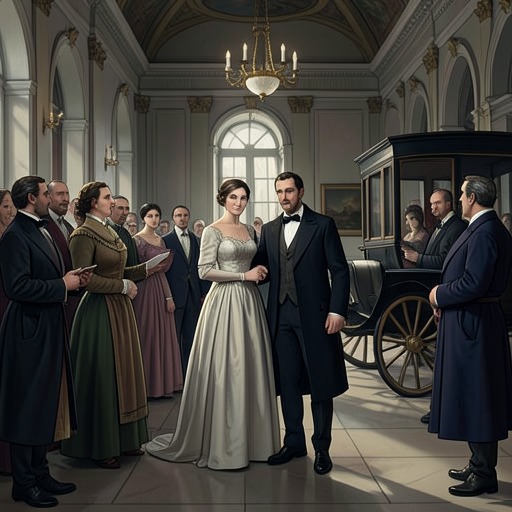
At the ball, Golyadkin pushes through the guests until he finds himself face to face with Klara Olsufyevna. He congratulates her and begins offering good wishes. The congratulations come out successfully; then he stammers, blushes, and loses his composure. As he looks up, he finds the company still and silent, with laughter nearby. His imploring glance turns to Andrey Filippovitch, whose response leaves him feeling more thoroughly crushed rather than supported.
The social failure is followed by an attempt to explain it away. Golyadkin tells Andrey Filippovitch that the matter concerns his domestic circumstances and private life, not an official incident. Andrey rebukes him, gives Klara his arm, and turns away. Golyadkin insists that he has nothing to be ashamed of, but the explanation cannot restore his standing: the room’s attention has already fixed on him, and he can find no footing in the crowd.
Retreat under the guests’ gaze
The company makes way as Golyadkin passes between two rows of curious spectators. He wishes he could return to the back passage without having committed a breach of propriety, but that escape is no longer available. Instead, he tries to reach a corner where he can stand modestly apart, avoid attracting attention, and still win his host’s favourable notice. His desire to be unnoticed is thus joined to a contrary wish to be recognized as an acceptable guest.
In the corner, he leans on the backs of two chairs and tries to look confidently at the guests grouped around Olsufy Ivanovitch. He tells a tall lieutenant that the chairs are reserved for Klara and Princess Tchevtchehanov. The lieutenant does not answer and turns away with a smile Golyadkin reads as threatening. An important councillor looks him over coldly; Golyadkin falls silent and decides to show that he is all right and like everyone else. Each attempted repair of his social performance instead meets a fresh refusal of recognition.
A pattern of humiliation
The ball’s later significance is made explicit when Golyadkin waits in Olsufy Ivanovitch’s yard during another night of snow and damp. He considers the back-entry corner where he had once waited for two hours, but now regards it as a marked place, with precautions likely taken since the scandal at the last ball. Even his imagined return to that shelter is obstructed by the memory of the public disgrace. He also waits for a signal from Klara, treating the episode as though it might still unfold according to a familiar romantic plot, while recognizing that the Petersburg night makes a pink ribbon at a window impractical.
The scandal also frames later scenes of exclusion. At the government office, Golyadkin approaches colleagues with whom he used to get on well, but receives curt greetings, avoided handshakes, turned backs, and the insulting curiosity of a group of junior clerks. The appearance of Golyadkin junior among them makes the rejection more crushing. The narrative’s reminder of the ball connects private humiliation to a widening social pattern: the office, like the party, becomes an audience before which Golyadkin tries and fails to secure ordinary acceptance.
Repetition and removal
At the Excellency’s gathering, the earlier scandal returns as a point of comparison. Golyadkin thinks that what is happening is just as it was at Olsufy Ivanovitch’s. Two lackeys and his twin lead him toward the hall doors; the twin snatches up his greatcoat and flings it over his head as a joke. The lackeys snigger while Golyadkin struggles free and goes out, followed by his double. The public scene thus recurs in a more forceful form, with the double participating in the expulsion and turning the greatcoat—an ordinary article of dress—into an instrument of ridicule.
The ball is consequently more than a single lapse in etiquette. Its sequence of failed speech, hostile attention, attempted retreat, and rejection supplies a template for Golyadkin’s later encounters. What he hopes will be a modest corner or a declaration that he is like everyone else cannot undo the spectacle; instead, each fresh audience recalls and extends the first humiliation.