Yakov Petrovitch Golyadkin
The DoubleYakov Petrovitch Golyadkin is a government clerk whose struggle to preserve his name and standing becomes inseparable from his conflict with Yakov Petrovitch Golyadkin junior, the double who takes his place in the eyes of others. Golyadkin’s defining contradiction is that he claims a firm, dignified self while seeking recognition from people and institutions that repeatedly refuse to confirm it. His letters, protests, and gestures of reconciliation are attempts to make that self legible; each instead exposes how little control he has over the story told about him.
Identity and the defense of dignity
Golyadkin understands himself as an honourable man who should not be treated as disposable. When he imagines yielding to his double, he draws a hard line: “I am not a rag.” The repeated declaration is both a protest and a measure of his vulnerability. He knows that he may be unable to prevent others from humiliating him, yet insists that even a defenceless, metaphorically filthy rag would retain feelings and dignity. His self-respect therefore persists less as power than as a claim he cannot stop making.
That claim is complicated by his wish to be forgiven and welcomed. Golyadkin can imagine a reconciliation in which his double admits fault, yields, and becomes his friend; he even regrets standing up for his rights when doing so brings further trouble. But he cannot accept being treated as a rag. He moves between accommodation and protest, hoping that the other man will restore the friendship while insisting that he must not surrender his honour. The tension does not resolve into a stable strategy: every effort to defend himself risks provoking the very rejection he fears.
Letters, interpretation, and the pursuit of control
Writing offers Golyadkin a way to address a crisis that he cannot manage face to face. He drafts a letter beginning “Dear Sir Yakov Petrovitch!” and reassures himself that its tone is courteous but firm, and that he is fully within his rights. The formal address and carefully judged politeness suggest an effort to turn personal conflict into a matter that can be stated, reasoned through, and answered. Yet the letter’s composed manner stands against the confusion and distress that govern his response to events.
A letter from Vahramyev, a former friend and fellow clerk, disrupts that fragile sense of control. Vahramyev says that he will carry out the commission of delivering a letter, identifies the intended recipient only indirectly, and reports that the person is lodging with Karolina Ivanovna. He also announces that he is breaking off his connection with Golyadkin, accuses him of losing his dignity and reputation, and demands two roubles for a razor sold seven months earlier. The mixture of practical business, accusation, and social rejection gives Golyadkin no single problem to answer. He sits motionless, then tries to rise and cannot; the letter seems to illuminate the fog surrounding him without giving him the strength to act.
Golyadkin responds by writing to Nestor Ignatyevitch. He interprets the letter as an insult aimed at him, believes calumny has spread, and frames his reply as a defense of honour and good name. Even the old two-rouble debt becomes part of a moral accounting: he describes repayment as a sacred duty. The exchange shows his characteristic reliance on written explanation, but also the limits of that method. He reads hostile implications into indirect language, answers accusation with formal rhetoric, and hopes that a letter dispatched at daybreak will let him get ahead of those he imagines are plotting against him.
The double and the struggle over public identity
The conflict becomes material when Golyadkin junior takes the official document that Golyadkin senior is handling. The younger man has promised to scratch out a blot with a penknife, presenting his intervention as an act of sympathy. Instead, after overpowering Golyadkin in a brief struggle, he takes the document, rolls it up, and hurries into the Director’s room beside Andrey Filippovitch. Golyadkin remains holding the penknife, apparently ready to make the promised correction. The small object sharpens the reversal: the instrument meant to repair the paper is left in the hands of the man who has lost control of it.
The work is completed on time and exceeds His Excellency’s expectations. Golyadkin learns that the official was pleased and had thanked the junior, while Andrey Filippovitch refuses to hear Golyadkin’s protest, calling it a private matter and saying he has no time. The outcome is not merely a quarrel between look-alikes: the double receives public credit for the work, while the original cannot make his claim heard by the authority whose approval matters. Golyadkin’s effort to establish his identity meets an institution that responds to the completed document and the successful clerk before it responds to his account of what happened.
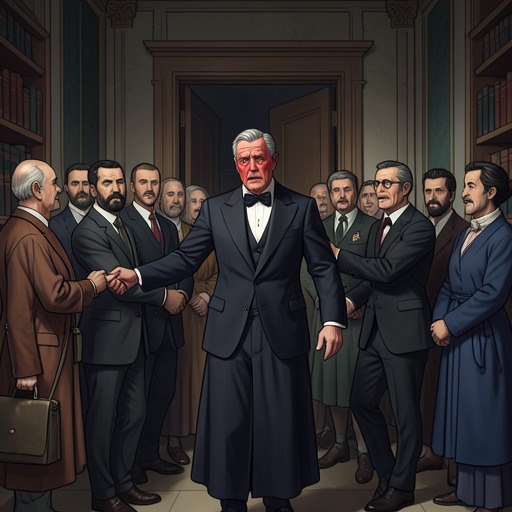
A later encounter among the clerks repeats the same struggle in social form. Golyadkin junior greets the group with practiced familiarity, shaking hands, slapping shoulders, embracing one colleague, and explaining how he came to be employed by His Excellency. When he unexpectedly holds out his hand to Golyadkin senior, the latter takes it eagerly and presses it warmly, moved by a gesture that could have opened the way to reconciliation. The double tears his hand away, behaves as though the contact has polluted him, wipes his fingers, and makes sure the surrounding clerks see the insult. For a moment their disapproval appears to turn against the junior, but his next witticism destroys Golyadkin’s remaining hope. In public, even a gesture Golyadkin receives as reconciliation can be recast as another occasion for his humiliation.
The double’s impersonation also appears in a restaurant, where Golyadkin is told that he has eaten eleven pies and must pay. He is ready to hand over a silver rouble rather than prolong the scene, trying to make an implausible accusation harmless by accepting it. Then he recognizes the man standing in the next-room doorway, a figure he had taken for a looking-glass reflection: it is Golyadkin junior, eating the last piece of the tenth pie before his eyes. The junior has impersonated him, yet Golyadkin’s bewildered question of whether anyone else notices the double shows that recognition is not shared. The scene turns the problem of identity into a public accounting: the pies are counted, the payment demanded, but the person who ate them is not the one being charged.
Removal and the unresolved ending
The loss of professional standing is followed by a concrete instruction. An attendant brings Golyadkin an official envelope signed by Andrey Filippovitch, directing him to hand over the business in his charge to Ivan Semyonovitch. When Golyadkin enters his flat, he finds Petrushka gathering his belongings into a heap, apparently preparing to leave for Karolina Ivanovna’s flat and take the place of Yevstafy. The official notice and the servant’s impending departure make his isolation practical as well as emotional: the office is reallocating his work, and his household is beginning to empty around him.
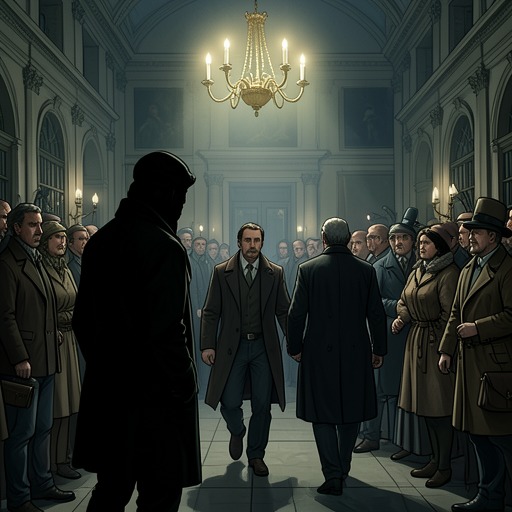
At His Excellency’s gathering, Golyadkin makes one last direct appeal. He calls the double an impostor and a vile, vicious man, pointing him out while speaking with terror. His Excellency does not answer and rings violently for the bell. The difference between Golyadkin’s accusation and the official response is decisive: his words do not initiate an inquiry into the double but summon the procedure that will remove him. The man who has tried to make his identity undeniable is instead treated as a disturbance to be handled.
On the brightly lit stairs, a crowd watches as Golyadkin is brought out with Krestyan Ivanovitch. A carriage waits with four horses; Golyadkin junior opens its door, and Olsufy Ivanovitch watches from his chair on the landing. Surrounded by expectant eyes and a murmur of impatience, Golyadkin desperately asks whether he has done anything reprehensible that could justify severity or public attention concerning his official relations. He then says that he entrusts his fate to Krestyan Ivanovitch. Andrey Filippovitch and Krestyan Ivanovitch help him into the carriage, while the double assists from behind; the door slams, the horses start, and the crowd pursues the vehicle with hostile shouts disguised as good wishes.
Golyadkin’s ending provides no vindication and no clear account of what will happen to him next. It completes the movement from private self-defense to public dispossession: his letters fail to secure understanding, his work is credited to his double, his official business is transferred, and his final appeal gives way to surrendering himself to the man who takes him away. The repeated insistence that he is not a rag makes the removal especially stark. His claim to dignity survives in his words, but the last scene shows him surrounded, watched, and carried off under the authority of others.