Yakov Petrovitch Golyadkin junior
The DoubleYakov Petrovitch Golyadkin junior is the protagonist’s uncanny double and his most intimate public rival. Where the senior Golyadkin anxiously tries to preserve his dignity, the junior moves through the same rooms with easy charm, ingratiates himself with witnesses, and turns apparent fellowship into rejection. His repeated appearances make the conflict at once a contest for social standing and a crisis in the protagonist’s grasp of what is real.
Identity and Introduction
The junior is presented as another Mr. Golyadkin, not merely a colleague who shares a name. In a restaurant, the senior initially takes a doorway for a looking-glass; there, directly behind a waiter, he sees the other Golyadkin facing him. The junior smiles, nods, winks, and eats the last morsel of the tenth pie, revealing himself as the person who has impersonated the senior and left him to face the bill for eleven pies. The discovery gives a concrete, comic shape to the double’s threat: he can occupy the senior’s identity in public, while the senior is left to explain the consequences.
The narrative repeatedly defines the junior through performance. He is nimble, smiling, fawning, and quick with a word or gesture that makes others feel noticed. In the government office he works a group of clerks with handshakes, a shoulder slap, an arm around one man, an explanation to another, and a kiss for a particularly intimate friend. The speed and variety of these gestures contrast with the senior’s hesitant attempts to greet the same company. The junior’s social fluency is not simply a private trait: it is the means by which he makes a place for himself in a room.
A Rival in Public
The junior’s advantage is established before the office confrontation. At closing time he gets his overcoat ahead of the senior, having, as the senior sees it, whispered to and ingratiated himself with the attendants. Once dressed, he looks back ironically at his counterpart and makes a conspicuous circuit among the clerks, speaking and smiling to each in turn before darting downstairs. The senior pursues and catches him by the collar at the final step, appealing to their friendly relations of the previous day. The gesture exposes the asymmetry between them: the senior treats their connection as a bond that should constrain the junior, while the junior’s conduct has already turned their shared identity into an advantage he can use.
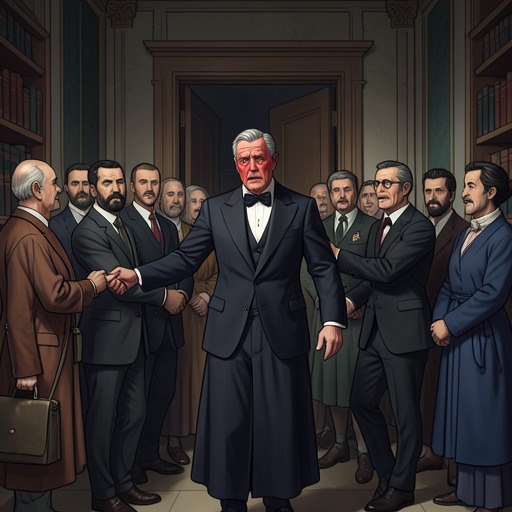
When the senior returns to the office at dusk, his colleagues greet him coldly. Some give only a brief greeting, some turn away, and some of the youngest clerks gather around him with insulting curiosity. The junior then appears among them, as sprightly and ingratiating as ever, and repeats the pattern of winning people over. The narrator notes that the scene happens as it had in the senior’s dream, but now it unfolds before the assembled clerks. The junior even holds out his hand to the senior, apparently without noticing him; the senior eagerly and warmly takes it, perhaps moved by the unexpected offer or by his own defenselessness. The junior then pulls away, acts as though the hand were polluted, spits aside, and wipes his fingers with a handkerchief while ensuring that the others see. What looked for an instant like reconciliation becomes a staged repudiation before witnesses.
Impersonation and Public Shame
The restaurant episode makes the junior’s method unmistakable. When a waiter demands payment for eleven pies, the senior tries to accept the charge rather than prolong the scene. He then recognizes his double in the doorway he had mistaken for a mirror. The junior has the last piece of the tenth pie in his hand and eats it in front of him, smiling and winking as though he might slip away by another route. The senior understands that he has been impersonated, throws down a rouble, and escapes without looking back. Even while identifying the junior as the culprit, he tells himself that at least no one has been completely compromised and concedes that the waiter was right to charge what was owed. His account of the incident is therefore divided: he recognizes the deception but still tries to contain its social consequences by accepting the bill and minimizing the offense.
The junior’s performance gains force because the senior’s public self is so precarious. At the ball, the senior has already become the object of an abruptly hushed and watching crowd after approaching Klara Olsufyevna and stumbling through his congratulations and wishes. Andrey Filippovitch rebukes him, and the senior retreats to a corner, trying to look like an unconcerned spectator. Later, at the office, the junior’s casual ease with the clerks turns that isolation into a contrast the whole group can observe. Across these scenes, the junior’s conduct does not merely defeat the senior in private; it helps make the senior’s loss of standing visible to an audience.
The Final Confrontation
The junior’s role reaches its most consequential form when the senior attempts to accuse him before His Excellency. The senior calls his counterpart vile and vicious and points him out, while the assembled officials react to the accusation. Before the senior can establish his case, the junior steps forward and asks permission to speak, sounding resolute and entirely convinced of his right to address the room. The exchange reprises the larger pattern: the senior’s attempt to expose the double becomes another public contest in which the junior can claim composure and command of the situation.
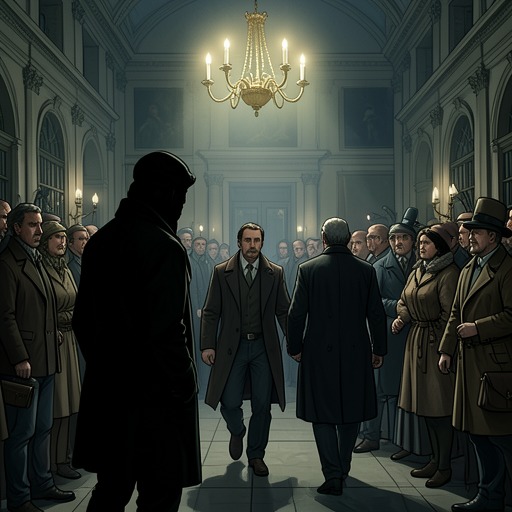
At the novel’s removal scene, the junior is still beside the senior, but now in the role of guide and apparent accomplice to the authorities’ intervention. Krestyan Ivanovitch Rutenspitz enters, takes the senior’s hand, and leads him toward the door. The junior whispers the doctor’s name and credentials into the senior’s ear, then takes a candle and goes ahead to show the way. The party and the crowd follow; people repeat reassurances that the doctor is an old acquaintance. Outside, a carriage waits with four horses, and the junior opens its door. The senior is helped inside as the brightly lit staircase remains crowded with onlookers, including Olsufy Ivanovitch. The double who once turned a handshake into an insult now directs the final passage out of the house, accompanying the senior’s departure with an appearance of helpfulness that does not erase the humiliations that preceded it.
Narrative Role and Significance
The junior is defined less through an independent history than through the repeated scenes in which he mirrors, displaces, and outperforms the senior. His greeting to the clerks echoes an earlier dream; his presence in the restaurant transforms a mistaken reflection into an embodied double; his cheerful sociability contrasts with the senior’s increasingly unsuccessful efforts to appear normal. The story preserves the senior’s uncertainty about the junior’s status even as it makes the double’s actions vivid: he is shown eating, greeting, shaming, speaking before officials, and leading the way with a candle, while the senior struggles to explain what those acts mean.
That tension gives the junior’s social charm its darker significance. He succeeds not by openly declaring himself an enemy in every encounter, but by moving easily among other people and shaping what they witness. A handshake can become an occasion for rejection; a public accusation can be answered by the junior’s calm intervention; a removal can be presented as a familiar, orderly escort. His role therefore binds the novel’s double motif to its scenes of scrutiny and exclusion. The senior’s fear is not only that another man resembles him, but that this other self can occupy his place before the very people whose recognition he cannot secure.