
Louisa’s Australian Women’s Journal
The Drover's WifeThis thread follows Louisa Clintoff from the reformist world of London to her effort to give women in the high country a public voice, culminating in her decision to record Molly Johnson’s story.
increasing Bearing strength in each event
 decreasing
Bearing strength in each eventdecreasingA Reformist Inheritance
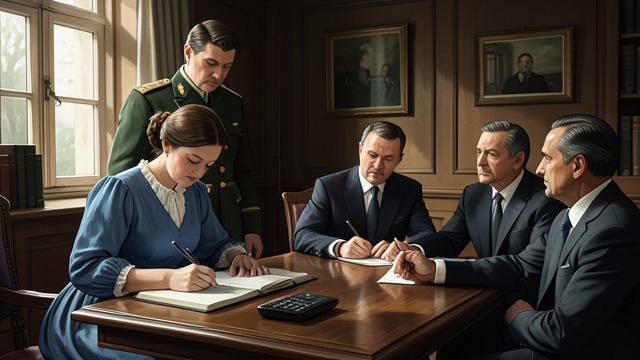
A Politics Learned at Home
Family and loss
Louisa Clintoff grows up among the arguments, printing work, and political commitments of her parents, Dawn and Reginald Lorens. Their newspaper gives her an early model of writing as public intervention, especially on women’s education, legal rights, and economic independence.
The death of her sister Hannah Lorens, who was unsafe in her marriage, sharpens that inheritance into purpose. Louisa and her mother treat silence around violence against women as a social failure, not a private inconvenience.
A project of her own
As the family prepares to leave London for Australia, Louisa plans a monthly women’s journal called The Dawn. She intends it to combine difficult subjects such as childbirth, economics, and battered wives with poetry and practical domestic writing.
She brings a mimeograph, wax paper, and ink, determined to establish the publication in the Snowy Mountains. The plan links her political convictions to a concrete undertaking, but she has yet to learn how little access she has to the lives of the isolated women she hopes to represent.
A New Country
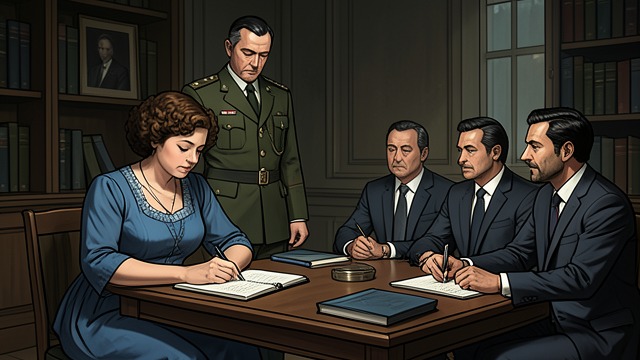
Carrying the Project Abroad
Leaving London
Louisa leaves London with Nathanael Clintoff and their young son, Samuel Adrian Clintoff, during a global economic depression. The family’s move is both a personal adventure and a wager on a new life: Nathanael hopes to escape desk duties in the British Army, while Louisa hopes to build a women’s journal in the Australian high country.
The journey begins with excitement, but the family’s passage is not effortless. Their carriage is attacked on the way to Portsmouth, and Nathanael fights off the thieves before they continue to the ship.
From ideal to landscape
The sea voyage ends safely in Melbourne, but the family soon encounters the physical demands of travel inland. Louisa studies provisions and routes, while trying to imagine how her work might reach women far from the cities.
Her ambition travels with her, yet the distance between political plans and the realities of isolated settlement is already growing. The journal will have to be made in a place where access to people, supplies, and communication cannot be assumed.
A Network in Melbourne
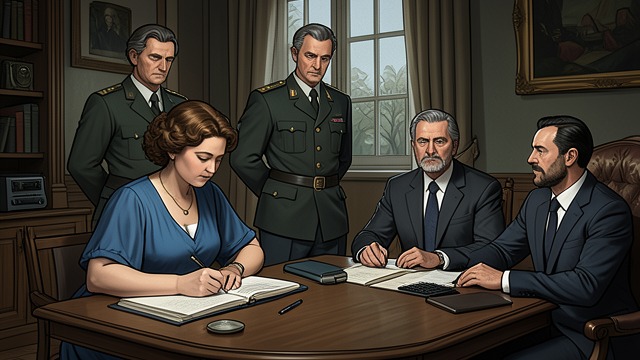
Finding Allies
Reform among the elite
During the family’s stop in Melbourne, Louisa attends a formal ball and meets Rosa Morgan Turner. Their conversation moves past the ceremony to women’s political rights, the women’s suffrage movement, and the possibility of cooperation across distance.
Louisa invites Rosa to contribute a report from Adelaide to her planned journal. Rosa accepts, giving Louisa an early contributor and evidence that the publication might connect women beyond one isolated district.
The limits of welcome
Louisa also encounters the divide between public language about advancement and the exclusion of Aboriginal people. She learns that the Australian Natives Association uses “natives” to mean Australian-born white men, not the First Peoples of the continent.
The discovery complicates her reformist optimism. Her ambition to speak for women must contend with the prejudices of the society around her, and with the fact that women’s political progress does not automatically challenge racial exclusion.
First Publication
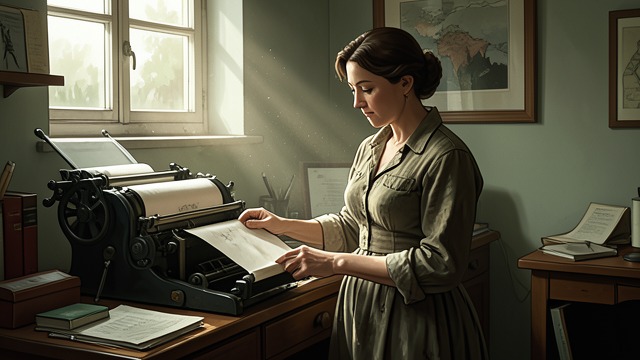
Printing in the High Country
A first issue
Once settled in Everton, Louisa uses the printing equipment she brought from London to produce the first issue of The Dawn. She proudly identifies herself as the town’s first published female writer, turning a private plan into a public act.
Her opening subject is battered wives and whether violence is treated as a husband’s right. The choice reflects her sister’s death and her conviction that abuse must be discussed as a social and legal question.
A difficult audience
Louisa wants to build a women’s group and meet local women, but her early contact with Molly Johnson makes clear how little she understands of Molly’s circumstances. Molly’s guarded response is not an invitation to the kind of easy friendship Louisa imagines, and Louisa’s assumptions about rural life remain untested.
The journal is therefore both an achievement and an unfinished method. Louisa has made a platform, but she must learn to listen before the platform can carry another woman’s account faithfully.
Witnessing Molly’s Story
From Advocacy to Listening
A story behind bars
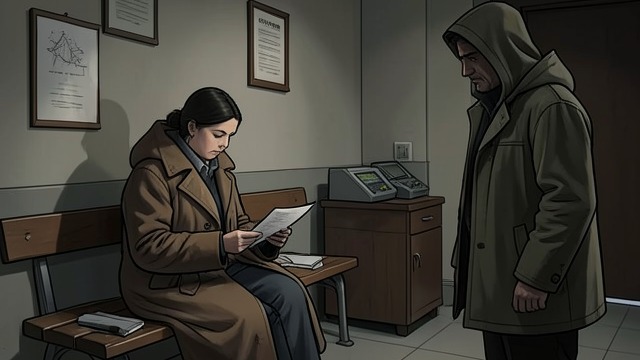
After Molly is imprisoned and sentenced to death, Louisa brings her food, clothes, and a copy of The Dawn. She hopes the journal’s article on battered wives will help Molly recognize that others care about her case, but Molly points out that Louisa writes from the outside and that the article lets her hear Louisa, not herself.
The rebuke changes the encounter. Louisa sets aside the impulse to explain her intentions and asks whether she may hear Molly’s own story.
A record beyond the verdict
Molly agrees to speak for her children, asking that her crime not overshadow their knowledge of her love. Louisa’s role shifts from reformer addressing women in general to listener recording one woman’s particular experience.
At the execution, Louisa and two other women protest publicly for battered wives and women’s rights. The protest cannot save Molly, but the story Louisa records resists the official judgment’s reduction of Molly to a criminal and carries her testimony into the future.
Before the 1893 departure from London
The 1893 voyage from London to Melbourne
The Clintoffs’ first week in Melbourne, 1893
After Louisa settles in Everton, before the full-moon crisis
The days before Molly’s execution in winter 1893
