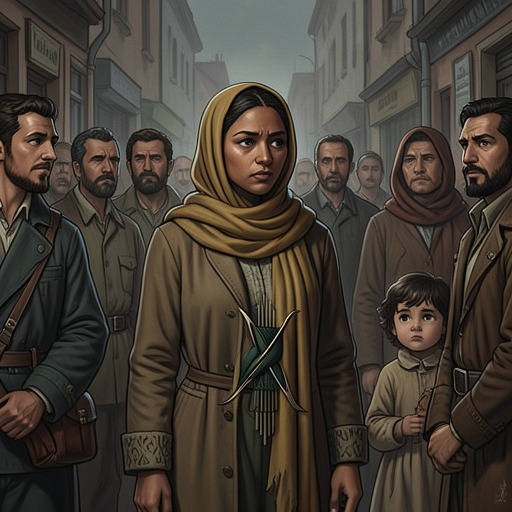
“Whitest gin around”
The Drover's Wife“Whitest gin around” is the district’s racist label for Black Mary, Molly Johnson’s mother. Its apparent reference to fair skin does not free her from racial classification: the phrase makes her body a subject of white gossip and marks her as Aboriginal despite her complexion. As the story passes from Ginny May to Yadaka and then into the public proceedings against Molly, the label links private family history to colonial judgments about identity, parenthood, and who may keep children.
The Label and Black Mary
Yadaka tells Molly that Ginny May kept alive the story of her sister’s great love for a man described as having the “wrong” skin. He identifies the woman as Black Mary, whom people in the district called “Whitest gin around.” According to the account he shares, she had red hair and fair skin, but pronounced Ngarigo features; she worked as a cook for drovers, one of whom was Molly’s father, Jock Stewart.
The expression compresses contradictory judgments into a single nickname. “Whitest” points to Black Mary’s complexion, while “gin” racializes her as an Aboriginal woman. The qualification does not undo the classification; it makes her appearance part of the gossip by which the district names and measures her. The story also locates the label within a family history that Molly has not known: Black Mary was her mother, and Jock Stewart was her father.
From Family Story to Public Testimony
The phrase returns when Miss Shirley speaks about Molly’s parentage in the presence of Judge Eisenmangher. She repeats the account of a fair-skinned woman with freckles and red hair called Black Mary, and of Jock Stewart pursuing her. Her manner is openly disapproving of the relationship. Although Father McGuinness cautions that the account is hearsay, Miss Shirley continues, presenting the family’s mixed heritage as a matter of public judgment.
The change in setting matters. A story passed on through Ginny May reaches Molly privately through Yadaka, who names her mother and explains the family connection. Later, Miss Shirley recasts related talk before a judge, where it can inform official action. The expression thus travels from local nickname to evidence-like social shorthand: repetition gives it public force without making the underlying story impartial or well-established.
Racial Classification and the Children
Miss Shirley turns the story of Black Mary into an argument about Molly’s children, calling them “Octaroon” and urging that they need urgent help. The judge then signs an authorization for their removal, framed as being for their safety. The sequence connects the label’s racial logic to a concrete consequence: Molly’s ancestry is invoked not simply to describe her, but to cast her children as objects of intervention.
At Molly’s trial, the Crown’s closing statement similarly makes her mixed heritage central to its account of her actions. It presents her hostility toward the white men she killed as generational, arising from what she learned about her ancestry and her mother’s experience, and alleges that Yadaka encouraged revenge. The trial is heard by an all-male jury; Nate recognizes its bias, while Danny—the only witness to Molly’s truth—is absent. In this setting, the family story becomes a prosecution narrative, not a neutral explanation of Molly’s life.
Significance
The phrase’s recurrence reveals how racial naming operates across different levels of power. District gossip labels Black Mary; the family story gives Molly knowledge of her parentage; and public authorities use racial categories to question the children’s place with their mother. Fair skin does not protect Black Mary from being racialized, nor does Molly’s appearance prevent others from making her heritage a public charge.
“Whitest gin around” therefore carries more than a description of appearance. It preserves a fragment of family history while showing how that history is distorted and put to use by a society that treats ancestry as grounds for stigma and state intervention. The same story that helps Molly understand where she comes from becomes part of the case used against her and the threat to her children.