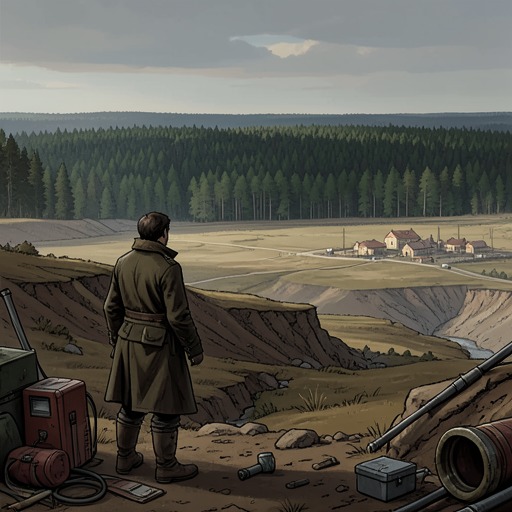
1849 Bingera Massacre
The Drover's WifeThe 1849 Bingera massacre is a turning point in Robert Parsen’s life and a concentrated account of frontier reprisal: at thirteen, he joined Gregory Blaxland in leading a vigilante party against sleeping Gin Gin people. The attack does not settle the violence that preceded it. Instead, it converts personal grief into an enduring racial vendetta, while exposing the self-justifying logic by which colonial retaliation expands beyond its claimed cause.
Background and motive
Two years before the massacre, Parsen’s family had moved to Maryborough with other colonial entrepreneurs seeking to establish a pastoral station. There Parsen witnessed an attack on the local Ginginbarra clan in which twenty-eight squatters were killed; his mother was among the casualties. Yet her death did not fit the simple account of revenge that Parsen would later maintain: she had been caught in crossfire and killed by a bullet from her own side. The discrepancy between the actual circumstances and his continuing blame of Aboriginal people is central to the event’s moral and narrative force.
Parsen’s family history had already linked colonial advancement to violence. His great-grandfather, an English convict transported to Australia on the First Fleet, had won his freedom and acquired land after killing three Aboriginal people during an attack on a captain. That inheritance forms a grim background to Parsen’s own choices, but the massacre is not presented as an inevitable consequence of ancestry. It is a specific act of reprisal, undertaken by a young man who has learned to treat violence as both a means of action and a reason to harden himself against grief.
The attack at Bingera
In 1849, thirteen-year-old Parsen and twenty-one-year-old Gregory Blaxland headed a vigilante party of about fifty squatters and station hands. They went to Bingera and ambushed a group of roughly one hundred sleeping Gin Gin people. The party chose its opportunity deliberately: Parsen advised waiting until after a major gathering, when the people would be sleeping more soundly and waking later. Asked how he knew, he said he had slept out and seen it himself. His confident reply presents the attack not as a sudden clash but as an operation planned around knowledge of the intended victims’ circumstances.
Parsen had learned to handle a gun early and was a capable marksman despite his age. During the assault, he shot many people, including those trying to escape through the Burnett River. The violence was indiscriminate. The imbalance between the assembled party and the sleeping group, and the attackers’ deliberate choice of timing, make the event a massacre rather than a fair confrontation. The narrative places Parsen’s youth beside the brutality of his actions without using his age to excuse them.
Revenge and its aftermath
Parsen’s stated justification was that Aboriginal people had killed first and that the attack therefore followed from their violence. The story undercuts that rationale through the account of his mother’s death: she had been killed by a bullet from her own side, not by the people against whom he directed his vendetta. The revenge thus rests on a racialized attribution of collective guilt, not on the circumstances of the loss he invokes.
After the massacre, Parsen’s ruthlessness became fixed, and his hostility toward Aboriginal people was described as beyond repair. He continued to carry a vendetta over his mother’s death despite knowing that she had been caught in crossfire. He also cried for the last time during the episode, declaring that the violence would not have happened if Aboriginal people had not killed first. His response marks a personal change: grief is not resolved but shut down, and a claim of retaliation becomes the lasting principle through which he interprets violence.
The massacre belongs to a broader cycle rather than standing alone. The preceding attack on the Ginginbarra clan and the reprisal at Bingera are distinct events, but Parsen’s reasoning binds them into a sequence in which one act of violence is made to authorize another. The narrative’s attention to the mother’s accidental death interrupts that sequence’s apparent logic: the supposed cause of Parsen’s revenge does not support the blame he assigns.
Later echoes: classification and removal
The novel returns to the consequences of colonial power in a different form when Miss Shirley invokes Molly Johnson’s Aboriginal ancestry and calls Molly’s children octaroons before Judge Eisenmangher. The judge signs an authorization for their removal, framed as being for their safety. Danny hears the classification and fears separation from his mother; when he later tells Molly what Miss Shirley said, the word awakens Molly’s memory of an earlier threat to send her away as a child because of her mixed ancestry. She understands that the same racial classification now puts her own children at risk.
Molly responds by binding Miss Shirley and Father McGuinness, taking food and blankets for the children, and burning the signed order. The scene is not the same event as the Bingera massacre, but its proximity in the novel’s account of racial power sharpens the contrast between forms of coercion: the earlier vigilante attack enacts violence directly, while the later threat operates through official language, classification, and a judge’s signature. In both, Aboriginal lives and kinship are subjected to decisions made by colonial actors; in the later scene, Molly’s resistance prevents the authorized separation from taking effect.
Narrative significance
The massacre establishes Parsen as more than a skilled drover with a violent disposition. It shows the formative event through which he converts personal loss into a durable racial grievance and learns to present retaliation as justice. The revelation that his mother was killed by a shot from her own side makes that conversion especially consequential: the story distinguishes the fact of his grief from the explanation he uses to sustain his hatred.
The episode also places private memory within a history of collective violence. Parsen remembers his mother, but his response falls upon a sleeping group and extends far beyond the circumstances of her death. The later child-removal episode echoes the same unequal authority in a bureaucratic register, where racial labels become grounds for separating children from their mother. Together, these episodes show how violence can persist both as armed reprisal and as an official claim to decide which families may remain together.