Daniel Johnson
The Drover's WifeDaniel Johnson, called Danny through most of the novel, is Molly Johnson’s eldest child, a twelve-year-old who has been pushed into adult responsibility by isolation, poverty, and danger. He helps keep his mother and siblings safe, but the novel also insists on the cost of that role: Danny witnesses events no child should have to bear. As an adult, he returns to those years through a notebook of sketches, poems, and memories, preserving knowledge that time and society threatened to erase.
Identity and Background
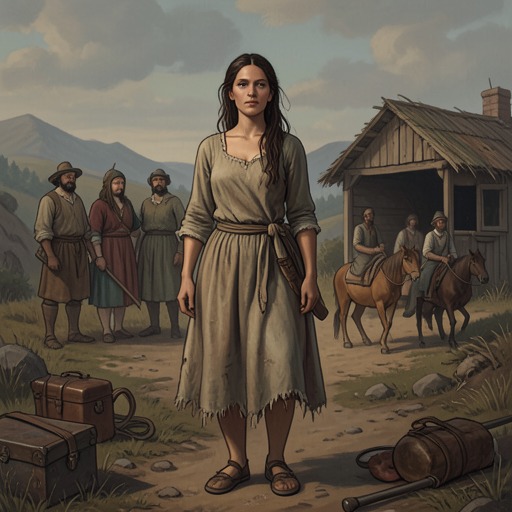
Danny is the eldest of Molly’s four children, with another baby expected at the beginning of the family’s story. His father, Joe Johnson, spends long periods away droving livestock, leaving Molly and the children to manage life in the bush. At twelve, Danny is already described as the household’s dependable young man, alert to threats ranging from hunger and floodwaters to intruders and dangerous animals. His maturity is practical rather than chosen: family survival makes demands on him before he has reached adulthood.
The family’s poverty is visible in the small details of their routine. On their Sunday walks, the children wear their best clothes, which are little more than everyday rags; the boys’ shirts are pressed, Delphi’s hair is set, and Joe Junior and Henry James still fit their worn boots. Danny goes barefoot. Molly expects him to inherit his father’s boots in winter, a promised object that links his growing body to a future she is reluctant to accept.
Molly knows that Danny may have to leave for droving work the following year. He has turned twelve nearly two months earlier, and she can endure the thought of his eventual departure, but does not want it to come. The pressure is financial as well as familial: the economic depression has battered the sheep industry, and the latest drive has involved fifteen thousand sheep brought down from Queensland. Joe’s recurring work away from home has been the family’s established pattern for nearly eight years, but his absence leaves Danny’s mother increasingly reliant on him.
Childhood Responsibilities and Danger
Danny’s role as protector is tested during a sudden flood. As the water rises around the boulders where the children are gathered, Molly orders Joe Junior and Henry James onto the bank and realizes Danny is missing. He is clinging to a boulder in the flood, holding Delphi’s rag doll in his mouth while debris caught between rocks helps keep him from being swept away. A massive boulder is moving downstream toward him. Molly calls for him to hold on and plunges into the current, but she is swept under. The scene reverses their usual positions: Danny is the child in immediate danger, while Molly must risk herself to reach him.
Later, when Molly sends the children to town in a wagon, her instructions make Danny’s responsibilities explicit. She asks him to ensure that his younger siblings behave, trade meat for fresh vegetables, choose a donkey or horse but not a worn-out one, and remember other supplies because ammunition is low. She puts the list in his shirt pocket. The errands are not merely a child’s trip; they require judgment, negotiation, and care for the household’s practical needs.
Molly also tells Danny to get cakes and sweets from Miss Shirley’s and then return straight home because she will need his help. The detail recalls her own childhood, when her father would leave her with Miss Shirley while he went droving and hoped sweets might ease the separation. The parallel gives Danny’s errand an inherited shape: the child who is sent away briefly is also the child his mother needs beside her.
Family, Racial Classification, and Separation
Danny’s care for his siblings becomes especially significant when Miss Shirley invokes racial classification to argue that Molly’s children require intervention. In a hearing before Judge Eisenmangher, Miss Shirley calls the children “Octaroon” and pleads that they need urgent help. The judge signs an authorization for their removal. Danny is present when the decision is made; his fear is not abstract, because he understands that the order could separate the children from their mother and home.
After returning to Molly, Danny tells her that Miss Shirley called them octaroons and asks what the word means. His question exposes the immediate danger in language that adults have turned into administrative power. Molly recognizes the term from her own childhood: when she was eight, she overheard Miss Shirley discussing a plan to send her away because of her mixed heritage. The earlier threat against Molly thus returns through Danny and his siblings, making the children’s vulnerability part of a family history rather than an isolated dispute.
The order’s apparent language of protection conceals its consequence: the state authorizes the children’s removal from their mother. Molly responds by tying up Miss Shirley and Father McGuinness, taking the authorization, and throwing it into the fire. She then gathers blankets and food for the children. Danny has helped alert her to the meaning of the classification, and his younger siblings are with him as the family prepares to leave. The episode places his loyalty to his mother and siblings against a legal process that treats their heritage as grounds for separating them.
Memory, Writing, and the Adult Danny
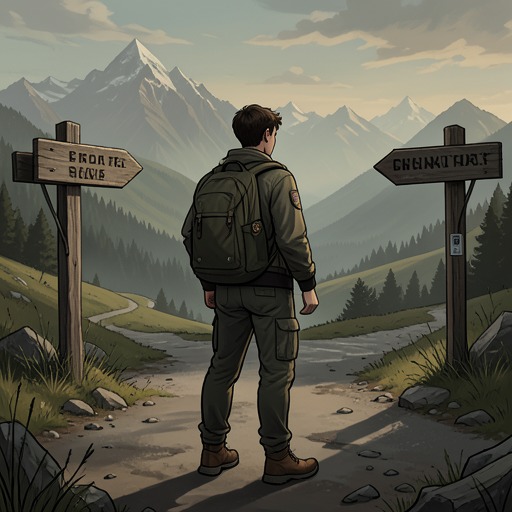
Sixteen years later, Daniel is thirty-two and sits alone on the verandah of a newly renovated homestead, reading a tatty notebook by lantern light. The notebook contains sketches, poems, and memories. He has written down what happened from the moment that drove him and his siblings into the mountains to be with their people, as well as what he learned during the four years they spent there. The account stresses both the depth of that knowledge and its limits: it was ancient knowledge, and there was only so much others could share with them. Time and society were against its transmission.
A drawing of a full moon leads Daniel back to the moment that inspired one of his poems. He has represented the moon’s unusually large halo with multiple rings, connecting a remembered sign in the sky with the unrest that followed. Louisa had suggested that writing might help him ease pain, hurt, and loss, and had made clear that the poem did not need to be shown to anyone. The notebook therefore serves not only as a record of events but also as a private means of carrying grief.
The adult Daniel’s act of writing gives form to the novel’s concern with cultural continuity. His notebook gathers personal memory, poems, and sketches around knowledge that could not be fully passed on, while his recollection of the four years with his siblings preserves a period whose lessons exceed what he can write down. The child once charged with getting his family safely through immediate dangers becomes the adult witness who records what happened and what was learned, resisting a second kind of loss: the disappearance of experience from memory.
Narrative and Historical Significance
Danny’s story links intimate family survival with the larger pressures of colonial authority and racial classification. As a child, he sees his family’s life threatened by hardship, flood, and a removal order made in the name of the children’s welfare. His presence at the hearing and his later question to Molly show how public judgments enter a child’s understanding of home and belonging. The novel’s focus on him does not make childhood a refuge from history; it shows that the consequences of adult decisions reach children directly.
His movement from barefoot boy to adult keeper of a notebook also creates a structural bridge between action and remembrance. The novel first places Danny inside the family’s emergencies, where his responsibilities are immediate and practical; the later frame returns to him as a man arranging those experiences into sketches and poems. His record cannot restore everything that was lost or shared only briefly, but it preserves the family’s passage through those years and makes memory itself part of survival.