Danny Johnson–Yadaka relationship
The Drover's WifeThe Danny Johnson–Yadaka relationship is a formative friendship between a boy living under danger at home and a wanted Aboriginal man who becomes his trusted teacher. Through shared work, spear practice, conversation, and the telling and performing of stories, Yadaka offers Danny both practical guidance and a connection to Aboriginal family and culture. Yadaka’s death makes that bond a lasting source of grief and purpose: Danny helps his family reach the cave Yadaka had described, remembers him as a great man, and later carries their story into Ngarigo cultural practice.
First Encounters and the Growth of Trust
Yadaka sees in Danny a boy of about the same age as his eldest son. Danny, in turn, is curious about the black man but wary, and keeps his distance even as the two share the surroundings of the bush. Their relationship begins without instant intimacy: Danny says he is not allowed to talk to strangers, and Yadaka leaves him room to decide whether to remain. When Danny stays, Yadaka recognizes the trust in that choice. Their early silence and guardedness gradually give way to ease.
Small acts make their growing connection concrete. Danny prepares tea at a bush fire, carefully lifting the billycan from the coals and settling the leaves. Yadaka does not force conversation; the two sit and drink together until Danny begins to talk about his recent birthday. Danny’s willingness to speak grows from the sense that Yadaka will listen. The boy’s loyalty to his mother is especially visible to Yadaka, who likes both Danny’s spirit and his devotion to her.
The relationship also takes shape through shared responsibilities. When Yadaka places a small homemade wooden cross in the ground, Danny stops him and insists that the task belongs to him. The gesture shows Danny asserting his own role rather than simply accepting care, while Yadaka’s presence makes room for that claim. Their connection is not only one of adult instruction and child dependence; Danny is eager to contribute and to be treated as capable.
Teaching, Work, and Men’s Responsibilities
Yadaka’s teaching combines practical skill with an account of responsibility. He tells Danny that caring for his mother, brothers, and sister is only part of what he must learn; his household jobs form another part. The lesson frames growing up not as status alone, but as obligations to family and community.
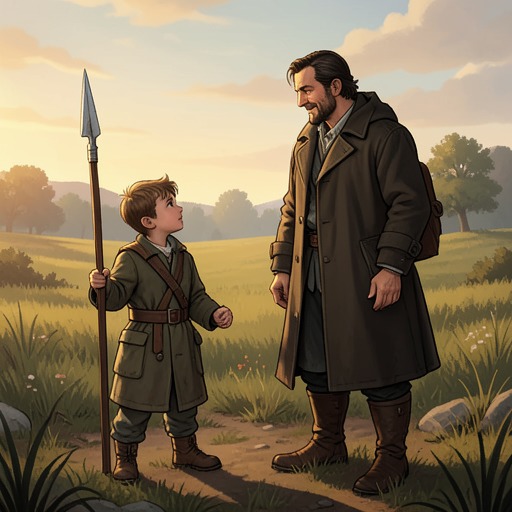
Spear practice turns that teaching into action. Yadaka demonstrates a throw, sending the spear into the ground well ahead of them, then shows Danny how to hold and cast it. Danny’s first attempt goes poorly, but Yadaka encourages him to try again. On the next attempts Danny’s technique improves, and Yadaka congratulates him with a gentle hand on his shoulder. Danny responds with visible pride and excitement. The two then work together at a fallen tree, each taking one end of the saw. Instruction and labor sit side by side: Yadaka teaches, but Danny participates as a willing partner.
Their lessons also include cultural expression. When Danny describes the bullock, Yadaka joins the activity by imitating it in an Aboriginal dance. Molly is startled by his sudden movement, but Danny is energized by the exchange and continues with greater involvement. The scene makes their bond a channel for embodied teaching, not merely conversation: Yadaka’s movement gives Danny a way to see culture enacted and to join in.
Danny looks forward to returning to learn spear-throwing and what he calls his men’s business. Yadaka has promised to teach him, including taking him on his first kill with the spear. He also proposes a walk with Danny and his sister toward the widening Snowy, where wildflowers should be blooming. These plans place instruction within a wider promise of shared time and family inclusion. For Danny, the bond means not only learning a skill but having a trusted adult with whom he can share secrets and feel safe.
Friendship, Attachment, and Separation
Danny privately wishes he could tell Yadaka how much he means to him. He regards him as more than his own father in the sense of trust and companionship: Yadaka is a friend who can hear his secrets and ease his burden. Danny imagines that Yadaka would know how to make things right and that, with him present, his mother and younger brothers could be safe and play freely. That hope is sharpened by the contrast with the long period in which home has not felt safe to Danny.
The prospect of Yadaka’s departure makes the boy’s reliance on him painful. Danny anticipates that the safety he has begun to feel will disappear when Yadaka leaves. When Molly calls him from the shanty, he tries to hide his emotion, rubbing his nose and sniffing, but turns back and throws his arms around Yadaka. The embrace gives physical form to what Danny has been unable to say. Their closeness is affectionate, but it is also shaped by the uncertainty of a fugitive’s life and the danger that surrounds them.
That danger is already present in Molly’s concern that Yadaka leave. She fears that if he goes to town seeking a reward, troopers may come to her doorstep, and she does not want that risk. Yadaka himself names the racial basis of his vulnerability, saying that his only crime is existing while black. Their friendship therefore develops under intersecting pressures: Danny is a child in an unsafe household, Molly is trying to protect her family, and Yadaka is exposed to colonial authority as a wanted Aboriginal man.
Yadaka’s Death and Danny’s Resolve
The relationship is violently broken when Danny witnesses the aftermath of Yadaka’s killing. He hides at the base of a snow gum, frightened and hoping his mother will comply with the men confronting her. He recognizes Yadaka’s legs behind a log and fears that his friend is already dead. The sight overturns the trust and future the two had been building: the man who had taught Danny to act with care and responsibility has been taken from him by men who regard Aboriginal life as expendable.
Later, at midnight beneath a full moon, Danny stands in the yard looking at Yadaka hanging from the snow gum. The image fixes the loss in the landscape and in the boy’s memory. Danny’s grief is joined to anger when he recognizes John McPharlen, one of the men associated with Yadaka’s death and the assault on his mother. Holding the spear beside him, Danny promises that when he is old enough he will return and make McPharlen pay, for both Molly and Yadaka. The promise shows how Yadaka’s influence persists, even as Danny’s grief is redirected into a vow of retaliation.
Yadaka’s teaching also supplies a practical legacy. He had told Molly how to reach his cave, hoping she and her family would join him. After his death, Danny recounts those directions as the family travels by sulky through the dark back street. The cave offers them a chance to survive together and to encounter their extended Aboriginal family. Danny’s role in guiding them makes him a carrier of Yadaka’s knowledge: the relationship continues through remembered instruction that becomes a means of escape and family preservation.
Cultural Memory and Continuing Kinship
In the later family story, Danny continues to remember and retell the account of Yadaka acting out the bullock. The memory brings him a smile, followed by a brief sadness that his wife alone understands. Yadaka is remembered not only as Danny’s friend and teacher but as a great man, father, and warrior. That later tenderness holds grief alongside gratitude rather than allowing the death to erase the relationship’s living lessons.
Danny’s story travels beyond the immediate family. He tells it to the Ngarigo, who incorporate it into an ancient practice of mimicry and dance, developing it through song and movement. The family takes pride that the story honors Molly’s bravery and recognizes her plight, bringing her into the clan. For Danny and his siblings, its communal performance is a way to remember their mother and to let the clan share in her story. The relationship with Yadaka thus becomes part of a larger process of belonging: what he taught and enacted with Danny helps a family history enter collective cultural memory.
That continuity extends to a later generation. Danny and his brothers value the opportunity to carry forward a culture from their Aboriginal family, and Danny takes particular pride in the knowledge they hold. At a later gathering for his eldest son Mirribi’s twelfth birthday, the family anticipates the final stage of the boy’s men’s-business ceremony, learned by Danny and his brothers in the high country with their Ngarigo family. The account connects Yadaka’s early teaching to a wider chain of transmission, while distinguishing the specific ceremony’s later teachers and family setting. In the final family play, Danny embraces his children as they perform the bullock story. Yadaka is no longer present, but the story’s enactment keeps his influence within the family’s shared practice.