Ginny May
The Drover's WifeGinny May is an Aboriginal medicine woman, birth attendant, and keeper of family memory whose influence reaches across two generations. She assists Molly Johnson through births and illness, watches over Molly’s children from a distance, and adopts Yadaka so that she can entrust him with a story forbidden in her own clan. Her care is both practical and historical: she helps sustain lives in the present while ensuring that a suppressed account of love and kinship will not disappear.
Identity and Introduction
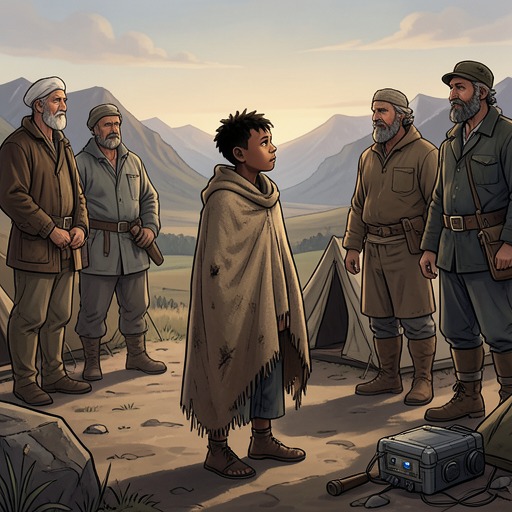
Ginny May is introduced through Yadaka’s account of his escape and arrival at a gathering of nations, tribes, and clans. At twenty-five, after repeated failed attempts to escape captivity, Yadaka finally makes his way north through the mountains and reaches the gathering. The elders consider his request to stay, and Ginny May, then in her early sixties, takes a particular interest in him. He is accepted into the community and adopted by her; she asks him to call her Njadjan, meaning mother. Yadaka initially does not understand her reason for choosing him, but he is grateful for the new relationship.
The novel does not give Ginny May an extended direct presence. Readers know her chiefly through Yadaka’s recollections and Molly’s memories, so her character is assembled across different relationships: she is an adoptive mother to Yadaka, a sister in the history she entrusts to him, and a familiar source of care to Molly and Molly’s children. This indirect introduction suits her role as a figure whose influence persists even when she is absent from the scene.
Care for Molly and Her Children
Ginny May’s care for Molly begins long before Molly meets Yadaka. When Danny is about eight, he sees an older Aboriginal woman hanging back as a group passes across the Johnson property. Molly brings Joe Junior and Henry James forward to show them to her. The woman nods and smiles proudly before continuing on her way. Molly explains that the woman helped at the boys’ births and regards them as her babies too, in a way. The encounter is quiet and carefully bounded: the woman keeps her distance, but her attention establishes an enduring connection with the children.
Ginny May’s assistance extends beyond those two births. Molly remembers that she helped when Molly’s father died and was present for three of Molly’s six births: Baby Jack, Joe Junior, and Henry James. She was also there after one of Molly’s four miscarriages, when Molly was in a dangerous condition, and nursed her back to health. After helping, she would clench her fist, blow through it, speak briefly in language, and leave. Molly remembers not only the care itself but its limited, recurring form: Ginny May arrived when needed, attended to the immediate crisis, and then returned to her own path. Molly’s memory of missing that care gives the visits an emotional weight beyond the practical help they provided.
Ginny May is also associated with Molly’s more recent birth experience. Yadaka says that their medicine woman spoke of Molly and of two births. Molly identifies Joe Junior and Henry James, recognizing the reference to the children Ginny May helped deliver. In this way, her knowledge of Molly’s family is carried into the present through Yadaka, who can recognize the connection even before Molly understands their shared history.
Adoption and Storykeeping
Ginny May’s adoption of Yadaka gives her a way to preserve a story she is not permitted to share with others in her clan. He eventually learns that the account concerns treachery, broken lore, and forbidden love, and that it is regarded as bad luck or a no-good story. By making him her son, she chooses someone to whom she can pass the history and makes him responsible for keeping it alive. Yadaka understands the adoption not simply as refuge after his escape but as a relationship carrying an obligation across time.
The story concerns Ginny May’s sister and her love for a man described as having the wrong skin. Ginny May had repeatedly told it to her youngest son, Bulburai, but he showed no interest and knew the relationship was forbidden by King Jimmy. When Yadaka asked why she kept telling him the story, she answered, “Someone needs to know”. The account’s transmission is selective and vulnerable: it has been rejected by one listener and is constrained by the rules surrounding it, yet Ginny May refuses to let it vanish. Yadaka becomes its chosen recipient, and later he recognizes that the story concerns Molly.
Relationships and Revelation
Yadaka’s bond with Ginny May shapes how he understands his encounters with Molly. After learning enough of Molly’s family history to identify her, he tells her that Ginny May is his adopted mother. He then reveals that, on the night Molly was born, Ginny May held her while her father grieved over her dead mother. This disclosure makes Ginny May the link between Molly’s earliest family history and Yadaka’s present-day relationship with her. Molly had known her as the older woman who appeared at times of need; she had not known the wider history that connected the woman to Yadaka or to her own mother.
Ginny May’s story also changes the meaning of Molly’s ancestry. Yadaka explains that Ginny May kept alive the account of her sister’s love for a man of different skin, repeating it despite its forbidden status. In the story’s structure, the revelation does not come from Ginny May speaking directly to Molly; it reaches her through Yadaka, the person Ginny May adopted to preserve it. Her act of storykeeping thus joins two acts of care: attending to Molly as a child and ensuring that Molly’s origins can eventually be named.
Narrative Role and Significance
Ginny May’s character brings together caregiving, kinship, and cultural memory without making them interchangeable. Her work as a birth attendant and nurse concerns immediate survival, especially in a setting where Molly’s pregnancies and recoveries are perilous. Her adoption of Yadaka, by contrast, creates a durable channel for a history that the clan’s rules have made difficult to tell. In both roles, she acts through relationships: she cares for children not born to her, and she entrusts a story to a son she has chosen.
The novel also places her care within a world of racialized suspicion and danger. Molly knows that Aboriginal people nearby are arrested, imprisoned, or driven away, and that white people have unofficial permission to shoot them on sight. Against that threat, Ginny May’s visits to the Johnson property are acts of sustained attention, even when they remain discreet and distant. Later, Miss Shirley’s racial classification of Molly’s children as “Octaroon” helps prompt the authorization to remove them, while the Crown’s case against Molly invokes her mixed heritage and the history Yadaka has revealed. Ginny May is not present in those proceedings, but the memories and story she preserved expose how private family history is drawn into colonial systems of classification and control.
Her importance is therefore measured less by the number of scenes she occupies than by what continues because of her actions. Molly remembers the woman who helped her through births and illness; Yadaka carries the story she entrusted to him; and the revelation of that story gives Molly a new account of her own family. Ginny May’s care reaches the body, the household, and the past, while her insistence that someone must know makes remembrance itself a form of responsibility.