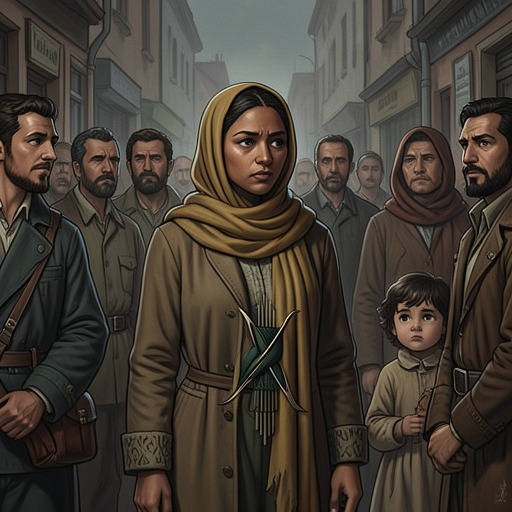
Interracial love taboo
The Drover's WifeThe Interracial love taboo is a rule against a relationship between an Indigenous person and a white person, remembered in the novel as both a violation of community law and a love that later generations are forbidden to discuss openly. Its consequences extend beyond the couple at the story’s center: the taboo shapes who may keep a family history, how Molly Johnson understands her ancestry, and how racial classification puts her children at risk.
Prohibition and the Colonial Setting
The story of the taboo is rooted in an encounter between communities with different relationships to the high country. When the Edwards party arrives in Ngarigo Country in the early 1820s, King Jimmy, the Ngarigo elder, shows the newcomers hidden tracks through the mountains. The account initially describes contact and curiosity; later, the growing arrival of settlers, the seizure and fencing of land, and the removal of Ngarigo people from their homelands transform the conditions in which relationships across those boundaries could occur. Colonial authorities permit Indigenous people to be shot or dispersed, while settlers discuss managing them. The taboo therefore appears within a wider conflict over authority, belonging, and survival, rather than as an isolated private rule.
A Love Preserved as a Forbidden Story
Ginny May adopts Yadaka partly so she can entrust him with a story her clan considers unlucky or unsuitable to tell. It concerns treachery, broken law, and forbidden love: her sister loved a man of different skin. King Jimmy had forbidden the relationship, and Ginny May’s son Bulburai showed no interest in hearing the account. Ginny May nevertheless repeats it to Yadaka, making him responsible for keeping it alive. Her choice turns adoption into a form of cultural and familial transmission: the story survives because someone outside the immediate line of inheritance is selected to listen and remember.
Yadaka later tells Molly about the history, linking it to rumors surrounding Black Mary. He explains that Ginny May repeatedly told the story of her sister’s great love to her youngest son, despite his disinterest and the prohibition. Ginny May’s reason was that someone needed to know. The story’s repeated telling does not erase the original restriction; it preserves the history of a love that the community had judged impermissible and that white society also treated as something to conceal.
Molly Johnson and the Inherited Consequences
The old story changes Molly’s understanding of her own family history. Yadaka presents it as connected to Black Mary and to the claim that Charles Edwards was her father. Molly is overwhelmed by the revelation and immediately worries about what her children will face. Her concern is sharpened by the racial stigma already attached to her identity and by the threat that officials may use her children’s ancestry to justify removing them from her care.
That threat becomes official when Miss Shirley calls the children Octaroons and asks Judge Eisenmangher to intervene. The judge signs an authorization for their removal. In this episode, ancestry is not merely a private secret: it is turned into a bureaucratic classification with direct consequences for the family. The novel thus places the taboo beside colonial authority over kinship, showing how a relationship that was forbidden in the past can continue to shape the lives and legal vulnerability of descendants.
Story, Kinship, and Cultural Continuance
Yadaka’s inheritance of Ginny May’s story contrasts with the wider forces that have separated Ngarigo people from Country and restricted their movement. He gives Molly directions to his winter cave and describes it as a place where she can find food, shelter, and, in spring, her people. The invitation offers a possible connection to family and community, though the text does not resolve it as a simple escape from danger.
In the later family gathering, Danny and his brothers carry forward a men’s-business ceremony learned in the high country with their Ngarigo family. They recognize that modern life threatens the continuation of practices and knowledge, and take pride in preserving them. This ending places inherited stories and cultural teaching alongside the forbidden-love narrative: both depend on people choosing to receive and pass on knowledge. The taboo remains a mark of conflict and constraint, but the act of remembering prevents the history it tried to suppress from disappearing.