John McPharlen
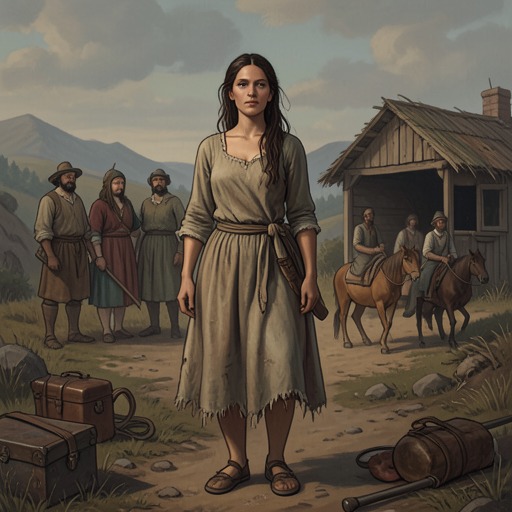
The Drover's WifeJohn McPharlen’s life links childhood abuse, dependence on Robert Parsen, and violence against others. First introduced as a young stockman travelling with Parsen, he later joins the attack on Molly Johnson and sexually assaults her. When Molly encounters him again while leaving Everton, she kills him. His trajectory makes him both a product of cruelty and an agent of further harm.
Childhood and Parsen’s Intervention
McPharlen’s childhood is described through deprivation and abuse. His mother was neglectful and violent, and local people mistook his withdrawal and stutter for a mental impairment. He was rarely fed or bathed and had no dependable protection. When he was ten, Parsen found him offering himself to an adult in exchange for money. Parsen stopped the encounter, intervened when McPharlen’s mother turned on him, gathered clothes for the boy, and took him along wherever he went.
That intervention became the defining relationship of McPharlen’s life. He and Parsen remained together; over time, McPharlen stuttered less, bathed more regularly, and was no longer troubled by the nightmares described from his childhood. He looked up to Parsen and would do anything for him. The account presents real care and improvement, but not an escape from dependence: McPharlen’s loyalty to the man who rescued him becomes part of the way he moves through the world.
Stockman and Parsen’s Companion
As an adult, McPharlen works as the youngest of the stockmen travelling with Parsen, helping manage sheep with dogs and hand signals. His appearance is repeatedly characterized by rotten teeth and an unsettling manner. Early in the journey, he taunts Parsen about a lamb the older man is carrying, joking that it will probably become food rather than find a home. The moment displays McPharlen’s coarse humour alongside Parsen’s willingness to care for the vulnerable animal.
McPharlen’s closeness to Parsen also shapes his conduct in town. The two are regulars in the lock-up at sale time, and Nate Clintoff recalls that they were once detained for their own safety after drinking and handling a gun recklessly. At the boxing tent, McPharlen appears beside Parsen as one of the stockmen preparing to fight Aboriginal performers. These scenes place him within a rough, male social world where intimidation and racial hierarchy are treated as ordinary features of public life.
Prejudice and the Attack on Molly Johnson
McPharlen’s conduct reflects the racial hierarchy that structures the frontier society around him. When Yadaka, an Aboriginal man wanted by the authorities, explains that his offence is simply being Black, the account places McPharlen’s later hostility within a landscape where Aboriginal people have been arrested, imprisoned, driven away, or left exposed to unofficial permission for whites to shoot them. McPharlen voices that prejudice openly: after the Edwards family is murdered, he insists that no white man could have killed a white woman and children, and blames an Aboriginal man instead. His certainty rests not on evidence but on the racial assumption that Aboriginal people are inherently suspect.
That same contempt becomes action at Molly Johnson’s homestead. After Parsen orders Yadaka restrained, McPharlen binds the injured man’s legs and asks how many he will make, treating the prospect of violence against him as a matter of payment. He then recognizes the worn boot Molly is wearing as Joe Johnson’s, a small detail that hints at the concealed circumstances surrounding Joe’s absence. While Danny watches from concealment, McPharlen and Parsen assault Molly; McPharlen sexually assaults her, and Danny flees, unable to bear witnessing it. The scene makes McPharlen’s violence an immediate cause of lasting trauma for Molly and Danny, and places it alongside the wider racialized violence directed at Yadaka.
Molly’s Killing of McPharlen
When Molly and Danny leave Everton, they pass the Stanlow Inn, where Molly recognizes McPharlen. Danny recognizes him too: he is the man who assaulted his mother and one of the men involved in Yadaka’s hanging. The encounter brings the earlier violence into the present of their escape. Danny’s hand tightens around the spear beside him, while Molly’s response is to confront McPharlen herself.
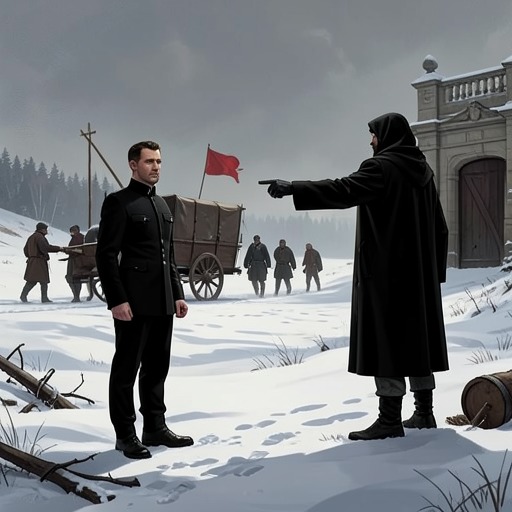
Later, McPharlen encounters Molly alone outside the inn. He reacts with contempt, wipes at her tears, and grabs her jaw. Molly stands her ground, and the narration frames the confrontation as an act of reclaiming agency from someone who had hurt and frightened her. She castrates him; he collapses and dies as snow begins to fall. The killing is a direct consequence of his prior assault and renewed aggression, but it also exposes Molly to the law’s judgment: she is subsequently tried in a biased all-male court, where Miss Shirley invokes the children’s mixed heritage and the prosecution presents Molly’s actions as racially motivated revenge.
Character Significance
McPharlen’s history connects harm suffered in childhood with harm inflicted in adulthood, without making the former an excuse for the latter. Parsen’s intervention rescues him from neglect and gives him a lasting attachment, yet McPharlen’s loyalty coexists with racist speech, participation in violence against Yadaka, and the assault on Molly. His return at the Stanlow Inn turns him into the point where Molly’s private trauma, Danny’s memory, and the colonial violence surrounding Yadaka converge. His death ends his role in their escape, while its legal aftermath helps shape the fatal case against Molly.
Character Significance
McPharlen’s history connects harm suffered in childhood with harm inflicted in adulthood, without making the former an excuse for the latter. Parsen’s intervention rescues him from neglect and gives him a lasting attachment, yet McPharlen’s loyalty coexists with racist speech, participation in violence against Yadaka, and the assault on Molly. His return at the Stanlow Inn brings Molly’s private trauma, Danny’s memory, and the colonial violence directed at Yadaka into one confrontation. His death ends his role in their escape, but its consequences continue: the Crown presents Molly’s killing as racially motivated revenge, invoking her mixed heritage and alleging that Yadaka encouraged her. McPharlen’s violence thus remains consequential beyond his own death, becoming part of the prosecution’s case against the woman he had harmed.