Judge Eisenmangher’s child removal papers
The Drover's WifeJudge Eisenmangher’s child removal papers are the instrument by which a claim of racial classification becomes an immediate threat to separate Molly Johnson’s children from their mother. Miss Shirley presents the children as needing intervention because they are supposedly “octaroons”; the judge signs the authorization, and Molly later burns it as she escapes with her family. The paper’s power lies not in any account of the children’s needs, but in the authority it gives others to define their identity and decide where they belong.
Classification and Authorization
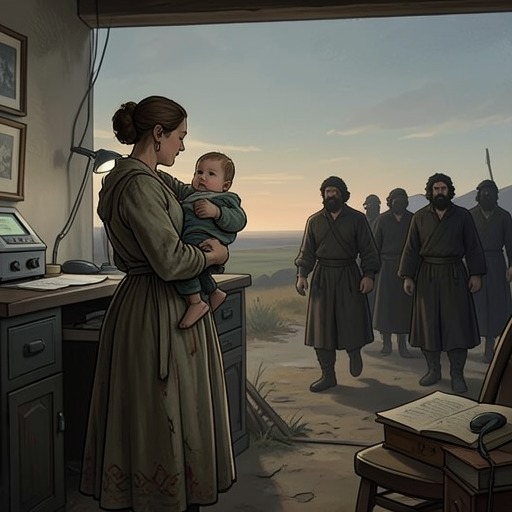
Miss Shirley introduces the children’s classification during a discussion of Molly’s suspected connection to Yadaka. She calls the children “Octaroon,” presents them as urgently in need of help, and appeals to Judge Eisenmangher. The judge finishes writing, signs the note, folds it, and hands it to her, authorizing the children’s removal “For their safety.” That official language casts separation as protection, even as the scene shows how little the process depends on the children’s own wishes or their mother’s account.
The label carries a history for Molly. When Danny tells her that Miss Shirley called them octaroons, Molly recalls hearing a similar classification as a child. Miss Shirley had discussed sending Molly away as a mixed-heritage child, arguing that she should be removed from her father’s care and that calling her a quadroon would secure her transfer. Molly recognizes that the word used against her children can likewise make them targets for removal. The old threat is not merely remembered: the signed paper shows that a racial category has again become an administrative decision.
From Paper to Flight
The authorization changes the family’s immediate circumstances. Once Molly understands what the classification means, she becomes determined to act as a mother defending her children. At the McGuinnesses’ cottage, she ties up Miss Shirley and Father McGuinness, takes the paper with her, and makes clear that she rejects their claim to know what is best for her children. The encounter is consequential but bounded: she leaves the two adults alive and turns to the practical work of getting the children away.
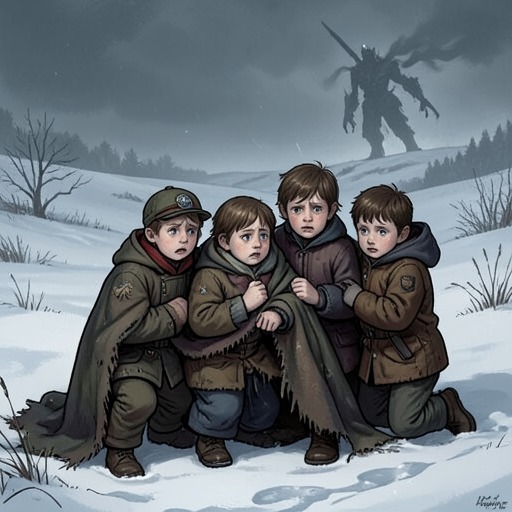
Molly burns the document in the fireplace. Its words—“octaroons,” “removal necessary,” and “permission granted”—and Judge Eisenmangher’s signature disappear in the flames. Destroying the paper does not erase the authority that produced it, but it prevents this particular authorization from accompanying the family as Molly sets out to flee. She gathers blankets and food, distributes the blankets among the children, and brings them to the wagon. Their fear at the night’s disruption and at seeing their mother’s battered face makes the consequences of the order tangible: the children have been pulled into flight because an official document made their separation possible.
Kinship, Authority, and Significance
The papers bring two ideas of care into direct conflict. The judge’s stated rationale is the children’s safety, while Miss Shirley’s appeal depends on classifying them by ancestry and claiming that this label calls for intervention. Molly’s response rests on her lived relationship with her children: Danny has already affirmed that she is a good mother who loves them, and Molly insists that they have a home with her. The order does not weigh those bonds on their own terms; it makes the classification decisive.
That conflict sits within the novel’s wider depiction of colonial authority. The evidence describes Indigenous people being driven from their homelands, restricted in their movements, and subjected to official or unofficial power to disperse them. In this context, the removal paper’s language of safety cannot be separated from the power to determine which families may remain together. Molly’s act of burning it is an immediate refusal of that power, not proof that the threat has been permanently overcome. Later, at Molly’s trial, the Crown invokes Miss Shirley’s declaration of Molly’s mixed heritage as part of its account of her supposed motive, showing that racial classification remains consequential even after the physical paper has been destroyed.