King Jimmy
The Drover's WifeKing Jimmy, the leading elder of the Ngarigo, first appears as an authority figure trying to interpret and manage contact with the Edwards settlers. He shows them the hidden routes of the high country and hopes they might learn from Ngarigo knowledge, but the newcomers’ presence soon becomes part of a history of violence and dispossession. His authority is tested not only by that colonial intrusion but also by the consequences of Charles Edwards’s assault on a young Ngarigo woman, the birth of their daughter Waraganj, and Waraganj’s eventual departure from her clan.
Elder and guide to the high country
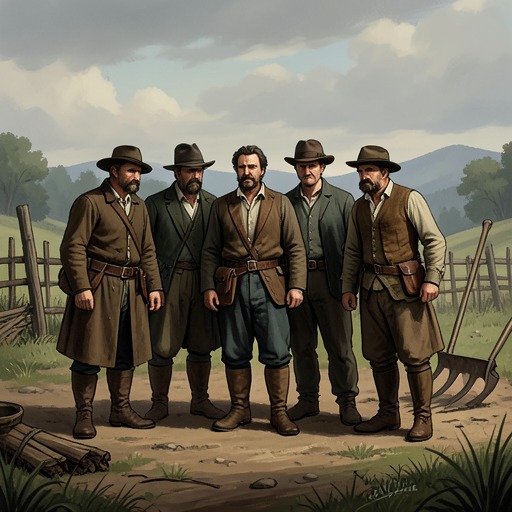
In the early 1820s, Charles Edwards, his son Neville and other white men came to the high country looking for land to graze livestock. King Jimmy, named by troopers who had passed through the nearby outpost of Cresthill, was the Ngarigo head elder they encountered. Charles’s agreeable manner and gift-giving won the elder’s confidence, and King Jimmy showed the settlers hidden tracks that would have been difficult for outsiders to find. His welcome was an act of practical knowledge-sharing, but it also placed the newcomers in contact with a Country to which the Ngarigo already had ancient ties.
The first meeting is framed through sharply different understandings. The settlers admired the landscape as a place to graze sheep, while the Ngarigo understood it through songlines and the plants that had sustained them for generations. The two groups mistook one another’s agreement for shared understanding; in retrospect, that mismatch marks the beginning of the area’s destruction. King Jimmy nevertheless hoped the newcomers could be educated in Ngarigo knowledge of the land, sky and clans. Most Ngarigo men were less hopeful and wanted the visitors to leave after looking around. The elder’s openness thus exists alongside a community’s caution, rather than representing unanimous consent to settlement.
Violence and Waraganj’s birth
That fragile encounter is overturned when the white men assault Ngarigo women. A young warrior reports what happened to his wife, and the Ngarigo hold council and decide to confront the settlers and seek punishment. By then, the men have already left. The episode makes clear that the newcomers’ access to the country, initially enabled by King Jimmy’s guidance, does not produce mutual understanding or reciprocal obligation. Instead, the failure to hold the perpetrators accountable leaves the community to face the consequences of violence without the settlers present.
Charles Edwards is also responsible for the assault on a young Aboriginal woman, about fourteen years old and, unbeknownst to him, King Jimmy’s youngest promised wife. She becomes pregnant and gives birth to Waraganj, whose pale skin and fine features make her mixed ancestry visible. King Jimmy initially wants the newborn killed, fearing she may be a bad omen and questioning whether she can belong to the clan. He also suspects that the young woman did not willingly go with Charles, in light of what the community has learned about the other assaults. His response places the child’s survival in immediate danger, even as his recognition of the mother’s likely lack of consent complicates the idea that he simply blames her.
Waraganj’s mother leaves her newborn beneath the tree where she gave birth, asking the ancestors to protect her. When the child survives the night, she is named for the snow gum beneath which she was born. Some of the Ngarigo women, especially King Jimmy’s other wives, oppose the mother and child’s place in the community. They are banished to its outskirts. The mother returns after a few years, pregnant with King Jimmy’s child, and the clan accepts her and two-year-old Waraganj back. The sequence shows the limits of the welcome: Waraganj is restored to the clan, but her belonging remains contested by the circumstances of her birth.
Clan authority and Waraganj’s departure
Sixteen winters later, Waraganj is promised to a man from a coastal clan and is due to leave for his country. Instead, she runs away from her clan, her mother and younger siblings, and the protection her extended family could provide. Her departure is a rejection of the expected journey and of the obligations arranged for her, though the account also emphasizes her longstanding sense of being an outsider. Her mother and siblings love her; others in the clan attribute her rebelliousness to her mixed ancestry, while women’s taunts and the attention of young warriors sharpen her separation from the community.
King Jimmy’s response is to send warriors after her, but they do not search far because it is dangerous. He declares that she is not worth the trouble, blames her for her mother’s later death, and says she will face consequences if she returns. The threat comes after Waraganj’s mother dies three days after her daughter leaves, found beneath an old snow gum. Waraganj does not know of her mother’s heartbreak or death when she escapes. King Jimmy’s judgment closes off a possible return to family protection and intensifies the rupture between an elder’s authority and a young woman’s decision to leave.
Colonial pressure and the limits of welcome
The wider conditions around King Jimmy’s leadership are changing rapidly. White settlers take land, fence it and drive Aboriginal people from their homelands, restricting the seasonal movement on which Ngarigo life depends. Colonial authorities permit the shooting or dispersal of Aboriginal people, and Charles Edwards participates in district meetings that discuss developing Cresthill into a town. He supports the proposal while insisting that Aboriginal people must be managed. The meetings are sanctioned and their decisions quickly applied, placing King Jimmy’s community under pressure from a political order that treats their presence on their own Country as an obstacle to settlement.
Against that history, King Jimmy’s early effort to teach the newcomers the ways of the land is both an act of leadership and a measure of what the encounter destroys. The same people who receive Ngarigo guidance go on to claim the country for grazing and settlement; the knowledge shared does not secure respect for Ngarigo authority. King Jimmy’s story also gives personal form to the consequences of colonial violence: his young promised wife is assaulted, her child’s belonging becomes contested, and that child ultimately leaves the clan. His role is neither simply that of a welcoming guide nor solely that of a punitive elder. The narrative places his choices within the mounting pressure of dispossession, while showing how colonial violence enters family and clan life across generations.