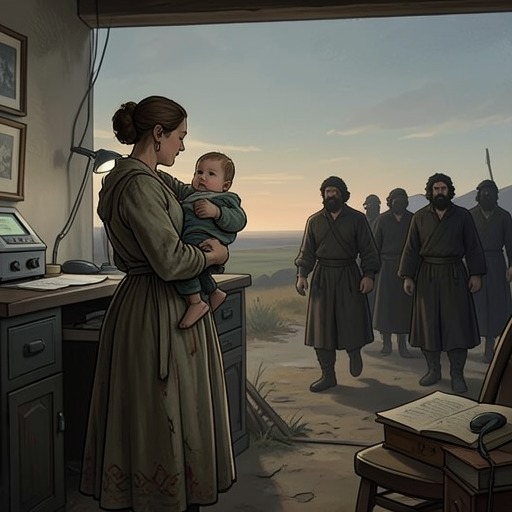
Mary dies in childbirth
The Drover's WifeMary dies in childbirth before the main action of the novel, but her death is not merely a piece of family background: it is the fact that connects Molly Johnson to an Aboriginal maternal line and makes her later identity legible. The circumstances of Mary’s death are recovered through Yadaka’s account of what Ginny May kept alive, turning a private loss into knowledge with consequences for Molly and her children.
Identity and Circumstances
Mary is Molly Johnson’s mother. She dies giving birth to Molly, leaving Molly without a maternal relationship she can remember. As an adult, Molly tells Yadaka plainly that she did not know her mother and that Mary died during her birth. She describes a small family history shaped by absence: before her children, she had only her father, Jock Stewart.
That absence has affected Molly’s life beyond grief for a person she never knew. Her father warned Joe Johnson that she had grown up without female influence and might need to learn what he considered women’s ways. Molly understands the consequence of that warning through her violent marriage: the knowledge Joe imposed on her was not maternal care, but abuse. The novel thus places Mary’s death at the start of a chain in which the loss of a mother leaves Molly vulnerable to others’ definitions of womanhood.
The Birth and Its Witnesses
The novel does not stage Mary’s death as a scene. It reaches it through recollection and testimony, particularly the story Yadaka has received from his adoptive mother, Ginny May. He tells Molly that on the night she was born, Ginny May held her while her father cried over Mary’s body. The account gives the death a specific human setting: Jock is grieving, the newborn Molly is in Ginny May’s arms, and the woman who will later become Molly’s mother in the biological sense is already absent from her life.
Ginny May’s presence at the birth also creates the line by which the story travels. She is Yadaka’s adoptive mother and Mary’s sister, and she preserves the history of Mary’s love for a man of a different skin. Through her, the birth and death remain known beyond the immediate family. The novel presents this knowledge as something carried forward rather than formally recorded: Yadaka can repeat what Ginny May told him because she kept the story alive.
The Revelation of Molly’s Ancestry
While Yadaka is staying with Molly, their exchange about family leads him to recognize the pattern in her history. Molly’s statement that her mother died giving birth supplies the final piece he needs. He connects it with what he knows about Ginny May and tells Molly that Ginny May held her as a newborn. He then identifies Mary as a woman of Ngarigo ancestry, remembered locally as Black Mary, and explains that her relationship with Jock was real but had to remain private because others would not accept it.
The revelation changes the meaning of Mary’s death in the story. Molly had known the fact of her mother’s death without knowing the mother’s identity or the history that surrounded her birth. Yadaka’s account makes clear that Mary was not simply a missing parent: she was an Aboriginal woman whose relationship with Jock crossed a racial boundary enforced by the surrounding society. Molly initially rejects the news and orders Yadaka away, but his account is grounded in the story Ginny May entrusted to him, not in a claim that Molly already recognizes.
Consequences Across Generations
Mary’s death leaves Molly without the mother who might have transmitted her ancestry directly. That break in family knowledge helps explain why Molly does not know her own maternal identity until Yadaka visits her. The story reaches her through another generation and another household: Ginny May remembers, Yadaka carries the account, and Molly is finally confronted with it.
The revelation also bears on the danger facing Molly’s children. Miss Shirley later invokes the children’s mixed heritage to urge their removal, and the court authorizes that removal in the name of their safety. At Molly’s trial, the Crown uses her newly disclosed heritage and Mary’s history to frame Molly’s actions as generational hatred, while the only witness who could speak to Molly’s truth, Danny, is absent. Mary’s death is therefore connected not only to Molly’s private sense of family but also to the racial classifications that threaten the next generation.
Narrative Significance
Mary’s death is a recalled event whose significance grows as its story is retold. Early in the novel, Molly’s lack of a mother is part of her personal history; later, Yadaka’s knowledge reveals that the silence around Mary also concealed Molly’s Aboriginal ancestry. The frame of Daniel Johnson reading an old notebook years afterward emphasizes how much of the family’s experience depends on remembering and preserving what could not be safely or openly known at the time.
The episode also links bodily vulnerability to the novel’s wider conditions of isolation and unequal power. Mary dies in childbirth, and the account provides no scene of medical assistance or further explanation of the circumstances. What it does show is the human aftermath: Jock’s grief, Ginny May holding the infant, and a daughter growing up without her mother. By making those facts the basis of a later revelation, the novel presents family memory as both an inheritance and a means of restoring a history that racial prejudice had obscured.