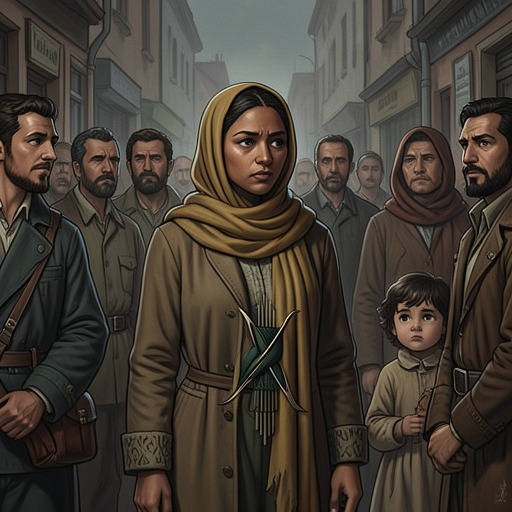
Mixed heritage and racial stigma
The Drover's WifeMixed heritage and racial stigma are central to how the novel links racial classification with family vulnerability and colonial power. In Everton, gossip about Molly Johnson’s ancestry becomes an administrative judgment about her children: the label applied to them helps turn a family’s kinship into grounds for its forced separation. The threat is personal and immediate, but it is also part of a wider regime in which Aboriginal people face imprisonment, displacement, and officially tolerated violence.
Ancestry Made into Public Gossip
The novel presents Molly’s ancestry first through other people’s talk, not through a settled public account of her identity. Miss Shirley recalls hearing about a fair-skinned woman with freckles and red hair called Black Mary, and about Molly’s father, Jock Stewart, pursuing her. She frames their relationship as disgraceful and describes Molly as among the district’s first people of mixed ancestry. Her account also connects Black Mary’s first encounter with white people to the Edwards family, before Miss Shirley announces that Charles Edwards was Black Mary’s father.
That claim is presented as hearsay, not established fact. Father McGuinness immediately challenges Miss Shirley for having no evidence, but her story continues to circulate in the room where Judge Eisenmangher is present. The distinction matters: the novel shows how an unverified account can acquire practical force when a socially influential speaker delivers it before a legal authority. Miss Shirley’s certainty and appetite for an audience do not make the allegation reliable, but they help make it consequential.
The family story also reaches Molly through the memories and testimony of others. In an earlier scene, she recalls that her father would not give a sober confession, while Miss Shirley tells the judge that she believes the stories to be true. The novel therefore keeps the ancestry claim within a chain of recollection, rumor, and inference rather than presenting it as an uncontested documentary record. Its immediate power arises less from proof than from the racial hierarchy that allows white officials to act on such claims.
Classification and the Removal Threat
Miss Shirley turns the disputed ancestry into an argument about the children. She condemns relationships across racial lines as a source of confusion and says there was only one child of such a union before predicting that others would follow. Then she applies the racialized term “octaroon” to Molly’s children and tells the judge that they need urgent help. The word does more than describe them: in her speech, it makes their ancestry the basis for treating them as a problem to be managed by white authorities.
Danny overhears the discussion and understands that the conversation concerns his mother. Judge Eisenmangher signs a letter authorizing the children’s removal “for their safety.” The language of protection conceals the force of the decision: neither Molly nor the children are shown participating in the judgment, and Danny’s immediate response is fear that his family will be separated. He thinks of his mother’s care and love, and of the expectation that the children will return home to her the next day. The official document turns Miss Shirley’s racial argument into a direct threat to that family bond.
The order also makes clear how classification operates institutionally. Miss Shirley supplies a label and a claim of danger; the judge’s signature gives them legal consequence. The novel does not present the order as a neutral response to demonstrated harm. Instead, it sets the language of children’s safety against the children’s own attachment to their mother and the care she provides, revealing the distance between bureaucratic paternalism and lived family knowledge.
Molly’s Recognition and Resistance
When Danny later tells Molly that Miss Shirley called the children “octaroons,” Molly recognizes the word’s danger through an earlier memory. As a child, she had heard Miss Shirley discuss sending her away as a mixed-heritage child, describing separation as a way to protect or cleanse her. The remembered conversation links the present order to a prior threat directed at Molly herself. What once seemed like an episode of adult talk becomes intelligible as a pattern: racial classification can be used to justify removing a child from family care.
Yadaka’s explanation gives Molly another way to understand her place within that pattern. When he asks her to come with him, she questions what it would mean to become Black. He tells her that she already is, and connects Ginny May’s presence in her life to a family and community relationship. His words challenge the idea that identity is determined by white gossip or official naming alone. They also offer belonging through kinship, rather than the shame and separation attached to the racial labels used in Everton.
Molly’s resistance becomes concrete when she finds the children’s removal paper. After binding Miss Shirley and Father McGuinness, she throws the document into the fire. The paper’s operative terms—“octaroons,” removal, and permission—are consumed, along with the judge’s signature. She takes blankets and food for the children and prepares to leave with them. Destroying the order cannot erase the racial system that produced it, but it interrupts this particular attempt to make that system’s classification govern her family.
Racial Power Beyond the Household
The threat to Molly’s children sits alongside the persecution Yadaka describes. When she worries that his presence may bring troopers to her home in pursuit of a reward, he answers that his only crime is existing while Black. Molly understands the conditions behind his statement: Aboriginal people are blamed, arrested, imprisoned, or “dispersed,” and white people have unofficial permission to shoot any Black person on sight. His fugitive status is thus shown against a wider violence that racializes existence itself as a danger to be punished.
The authorities’ response to Molly’s circumstances also exposes the uneven distribution of agency. Nate Clintoff’s discussion with Spencer Leslie establishes that a check on Molly’s welfare may be delayed by two days, and that the troopers would then regard their responsibility as over. Later, Nate regrets his role in the legal process but acknowledges that he took an oath to uphold the law. The trial has an all-male jury; Miss Shirley’s declaration of Molly’s mixed heritage enters the Crown’s argument, while Danny—the only witness to Molly’s truth—is absent. These details show how gender, racialization, poverty, and legal powerlessness compound one another rather than operating as separate disadvantages.
At the trial, the Crown casts Molly’s actions as the product of inherited racial hatred, tying them to her ancestry and to what she learned from Yadaka. The framing makes her background evidence against her, rather than attending to the circumstances that shaped her actions. Nate recognizes the hearing as biased, but his recognition does not undo its outcome. The novel’s account of racial stigma therefore extends from rumor to classification, from classification to legal authorization, and from legal argument to a judgment made without the testimony that might have changed how Molly’s story was understood.
Family, Identity, and the Novel’s Historical Ground
The novel distinguishes its fictional events from the author’s account of the history that informs them. In the author’s note, Leah Purcell explains that she wanted to understand her Aboriginality after government policies had prevented her mother and grandparents from passing on their culture. Research and listening to elders’ oral stories helped her fill gaps in family and community history. That reflection places the novel’s concern with interrupted transmission and imposed identity in conversation with the author’s own account, without making Molly’s fictional family a documentary counterpart to it.
Within the story, the children’s threatened removal makes the stakes of identity inseparable from care and belonging. Miss Shirley’s vocabulary presents mixed heritage as a defect requiring intervention; Molly and Yadaka instead locate family in protection, kinship, and the possibility of connection with Molly’s people. The contrast does not resolve the novel’s racial conflict through a change of official opinion. Rather, it shows how a family can recognize an imposed category, understand the danger attached to it, and resist its immediate consequences—even while the institutions that gave the category force remain in place.