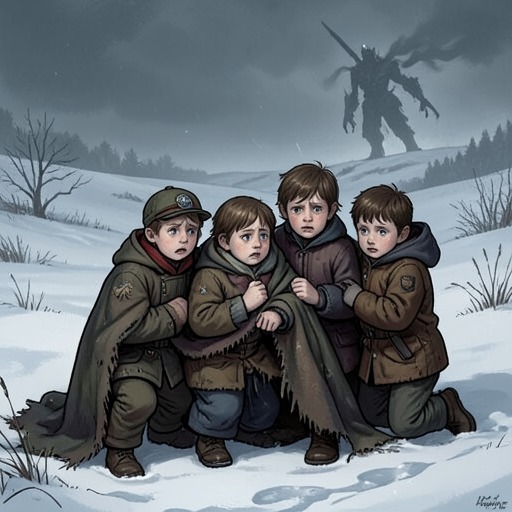
Molly Johnson escapes with her children
The Drover's WifeMolly Johnson escapes with her children from Everton after learning that a judge has authorized their removal. Rather than submit to an order grounded in racial classification, she frees her family from the immediate threat, burns the document, and leads them toward the cave Yadaka described. Her escape is both an urgent act of maternal protection and a movement toward a wider family: the children may survive together and begin to understand their Ngarigo identity and kinship.
The removal order and its threat
The escape is precipitated by an official decision made in Molly’s absence. Miss Shirley tells Judge Eisenmangher that Black Mary’s father was Charles Edwards, claims that Molly is harboring a wanted man, and calls Molly’s children “Octaroon.” She presents the children as needing urgent help; the judge signs a letter authorizing their removal “For their safety.” The language of protection thus supplies the rationale for separating them from their mother, without evidence in this scene that the children themselves have been consulted or that their family’s wishes matter.
Danny hears the decision and fears that he and his siblings will be taken away from their mother. When he returns to Molly, he tells her what Miss Shirley called them and asks what the term means. The word recalls Molly’s own childhood: at eight, she overheard Miss Shirley discussing how a child of mixed heritage could be sent away, and how a racial label could be used to secure that outcome. Molly recognizes that the classification now threatens her children just as it once marked her for removal. Yadaka’s account of her family history has also helped the past make sense of the present.
Molly confronts those who authorized the threat
Molly goes to the McGuinnesses’ stone cottage and adjoining church. A lamp still glows behind a closed curtain, but inside, Miss Shirley and Father McGuinness are bound and gagged in their nightclothes. Furniture has been knocked out of place and a glass vase broken, evidence of resistance during the encounter. Molly has a piece of paper in her mouth while tying the rope, and she begins by acknowledging that the two have been good to her children over the years. Gratitude does not soften her response to their decision: she condemns Miss Shirley for presuming to know what is best for her family.
The paper is the judge’s removal authorization. Molly puts it in front of Miss Shirley, then throws it into the fire. Its words—“octaroons,” “removal necessary,” and “permission granted”—and Judge Eisenmangher’s signature are consumed together. Molly takes blankets and food from the dining table and leaves. She does not kill the two people she has restrained; Miss Shirley’s fear gives way to relief that their lives have been spared. The escape therefore answers the threat directly while stopping short of fatal retaliation against its immediate agents.
Protecting the children on the road
Molly’s children wait in a wagon in the backyard. They have been woken by raised voices and the sounds of furniture being knocked over; Danny has already urged his brothers and sister to dress and gather blankets and pillows. Molly distributes the blankets and food, then takes a moment with the children, hugging and kissing them and tracing a hand over each face. Danny watches the tenderness of her care, while the younger children remain frightened and do not understand what has happened. The escape is not simply a departure: Molly must reassure and equip a family abruptly pulled from sleep and confronted with the possibility of separation.
At the first sign of snow, Molly says they must leave, promising that the next day they can build a snowman and make snow cakes. She tucks Delphi’s rag doll beneath the blanket around her daughter and tells the boys to stay warm, quiet, and out of sight. Danny is to cover himself with a blanket and, if anyone stops them, pretend to be ill with influenza; the other children must not make a sound. Molly covers them with a horse blanket so that they appear to be provisions rather than children. These measures make concealment, rather than speed or open confrontation, the means by which the family can get out of town.
The route to Yadaka’s cave
Molly takes the reins and asks Danny to repeat the directions Yadaka had given her. They travel in a horse-drawn sulky down a dark back street, then must pass through Everton because that is the route out of town. Molly keeps the wagon quiet as they move along the main street. Danny gives the route in landmarks: head northeast, keep right at the Great Waterhole, turn left at a bald patch, and continue to three boulders resembling giant emu eggs. The directions turn Yadaka’s promise of refuge into a practical destination the family can attempt to reach.
The cave is described as a place with supplies and, in spring, people. Molly tells Danny that he should identify her as Black Mary so that those waiting there will know who he is bringing. When he asks who they are, she tells him they are “our people, Danny. Family.” Her answer marks a change in the meaning of the journey: the children are not merely being moved away from danger but are being taken toward kin and a community that can recognize them. The prospect is uncertain, and the conditions may be difficult, but the possibility of remaining together and learning who they are gives the escape its forward-looking purpose.
Flight, family, and colonial power
The episode joins an individual act of rescue to a wider conflict over who has the authority to define and care for Aboriginal and mixed-heritage children. Miss Shirley’s racial label makes family separation appear administratively legitimate; Judge Eisenmangher’s signature converts that claim into an order. Molly responds by destroying the document and taking her children beyond the immediate reach of the decision. The scene presents official language as an instrument of coercion, while showing the consequences through Danny’s fear and Molly’s urgent preparations rather than through abstract legal debate.
The escape also makes the family’s movement a counterpoint to imposed removal. Molly’s children travel under blankets, hidden from those who might stop them, but their intended destination is not isolation: it is a cave associated with Yadaka, supplies, and the return of people in spring. Molly’s instructions about the name Black Mary and her recognition of the cave’s community as family connect her children’s immediate safety to cultural belonging. Her physical distress becomes apparent after the wagon sets off, but the scene closes on the family’s chosen direction and a measure of hope, not on a confirmed arrival. The escape offers a chance to survive together and reconnect with kin; it does not establish what awaits them there.