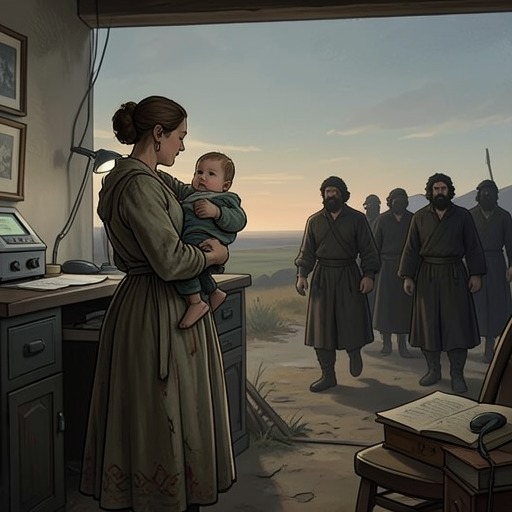
Molly Johnson—Jock Stewart Father-Daughter Relationship
The Drover's WifeMolly Johnson’s relationship with Jock Stewart, her father, joins affection to preparation for hardship: he teaches her to make do, to tell stories, and to provide for herself, while expressing love through songs and small acts of care rather than conventional tenderness. His death and the marriage he arranges for her shape the life she builds afterward, including her determination to give her own children the love and security she lacked.
Identity and Early Bond
Molly’s memories of her childhood with Jock are marked by movement and resourcefulness. He worked at various jobs, and the two walked to wherever work could be found. On the road they met people, sometimes caught rides in passing wagons or a peddler’s cart, and exchanged stories. Jock controlled how much of their own history they disclosed, and Molly remembers him as an expert at spinning yarns and keeping them going. Their travels taught her to listen closely and distinguish truth from invention, skills she later uses to protect her household.
Jock also shaped Molly’s early connection to the land and to the people around them. When she was a child, he and Molly were hiding in scrub when a woman from a passing Aboriginal group stopped after Jock whistled. The woman later returned and washed Molly at the river with sud made from wattle leaves. Molly recalls loving the foaming leaves and believing the experience was magic. The memory links her father’s childhood world to knowledge and care passed to her by an Aboriginal woman, although Molly’s recollection of that encounter remains partial.
How Jock Expresses Love
Molly does not remember Jock as a conventionally demonstrative father. At church, when she was about ten and staying with Miss Shirley and Father McGuinness, she watched mothers touch their children with visible affection. She sometimes took Miss Shirley’s arm and placed it around her own shoulder. She wondered whether Jock was proud of her and her later life, and whether he could have given her the maternal love she hoped to provide her own children.
Instead, Molly learned to recognize Jock’s care in gestures particular to their difficult circumstances. When food was scarce, he let her eat first and gave her the freshest bread; sometimes he turned dry bread into toast, taking care not to burn it. These small provisions stand beside his songs as evidence of affection. When drunk, Jock sang beautifully, sometimes breaking down in tears as he sang, and Molly cried with him. His repertoire included the lament “Black, black, black is the colour of my true love’s hair.” Molly wondered whether he was singing of her mother, since her own hair was blond-brown with a reddish tinge, but the memory does not settle whom the song commemorates.
Lessons in Self-Reliance
Jock’s care also took the form of preparing Molly to survive without him. By the age of seven, she had learned to hunt, kill, skin, gut, cut, and cook an animal. He explained that he wanted her to be able to feed herself if he died. The lesson was demanding, but it gave Molly practical competence that mattered throughout her isolated life. She later cooked kangaroo stew and damper for Joe when he brought a stove to the shanty, drawing on skills her father had taught her.
Their shared storytelling and travel supplied another kind of preparation. Jock showed Molly how a story could be shaped, what to reveal, and how to keep a listener engaged. As an adult, she walks with her children and makes up yarns with them; those outings become occasions for questions about her life and for sharing what she knows and does not know. She recognizes the practice as something learned from her father, while also using it to create openness with her children that she had not always experienced as a child.
Death and the Marriage He Arranges
As Jock was dying, he arranged Molly’s marriage to Joe Johnson, a man he had known when Joe drove cattle with him. Molly recalls being sixteen and Joe about thirty-six when she married; she was already three months pregnant when Joe left on their first drove together. She describes the match as one of convenience. Jock hoped marriage would give her social standing and the children she desired, partly because he knew she disliked being alone and wanted a family of her own.
Jock died while Molly was pregnant. Molly buried him with help from the same Aboriginal woman she remembered from childhood, whose grieving response frightened her somewhat but also brought beauty and comfort. His death left Molly without the person who had taught her how to manage practical hardship, just as she entered marriage and motherhood. Their bond therefore persists less as a continuing presence than as a set of skills, memories, and stories she carries forward.
Inheritance and Narrative Significance
Molly’s father-daughter relationship helps explain the contrast between the care she remembers receiving and the care she tries to give. She hopes Jock would be proud that she has made a home for her children and given them the love of a mother she herself missed. She calls Danny her angel and tries to shield him, while acknowledging that protection has limits. Her remembered tenderness for him echoes Jock’s quiet acts of provision, but she makes maternal affection more explicit than she experienced from her father.
The inheritance is not simple comfort. Jock’s lessons prepare Molly to act independently, while his arranged marriage places her within a life she describes as difficult and emotionally austere. His yarns become a model for both intimacy and concealment: Molly uses storytelling to share family history with her children, but she also relies on her ability to keep a story going when she fears scrutiny. The relationship thus links affection, survival, and guarded self-presentation across generations, without resolving the questions Molly still has about her mother or about what her father felt but did not say.