Molly Johnson’s execution
The Drover's WifeMolly Johnson’s execution makes the conflict between legal authority and lived survival public and irreversible. Sentenced for the deaths of John McPharlen, Trooper Spencer Leslie, and her husband Joe Johnson, Molly approaches the gallows barefoot, refusing the shoes offered to her. As Louisa Clintoff and two other women protest the law’s failure to protect battered wives, Molly turns her thoughts toward her children and the mountains she calls home. Her death closes the legal case against her, but the scene insists that conviction does not settle the question of justice.
The sentence and its grounds
At the execution, Judge Eisenmangher reads the formal sentence: Molly is to be hanged by the neck until dead. He names the three deaths for which she has been convicted: John McPharlen, Trooper Spencer Leslie, and Joe Johnson. The charge places those killings together under a single legal judgment, although the story gives them different circumstances. Nate Clintoff recognizes that Joe’s death might be understood as self-defence, but regards the killing of Trooper Leslie, who had been performing his duty, as the decisive factor in the death penalty.
The trial has already been shaped by assumptions about Molly’s ancestry and by the absence of testimony that could establish her account. Miss Shirley identifies Molly as having mixed Aboriginal heritage and claims that Molly’s hostility toward white men was inherited and encouraged by Yadaka, whom she calls a wanted murderer. The case’s closing argument thus recasts violence and family history as evidence of racialized, generational hatred. Nate regards the hearing as biased, but says he could do nothing to change its outcome. Danny, the only witness to Molly’s truth, is missing.
That outcome is foreshadowed by a wider pattern of vulnerability. Molly has described a world in which Aboriginal people are arrested, imprisoned, or driven away, and in which white people have unofficial permission to shoot them on sight. When Miss Shirley classifies Molly’s children as “Octaroon” and urges their removal, Judge Eisenmangher authorizes it in the language of their safety. At the gallows, therefore, the judgment against Molly stands beside an attempt to separate her children from her: legal power has reached both mother and family, while their own account has little standing within it.
The gallows and the public protest
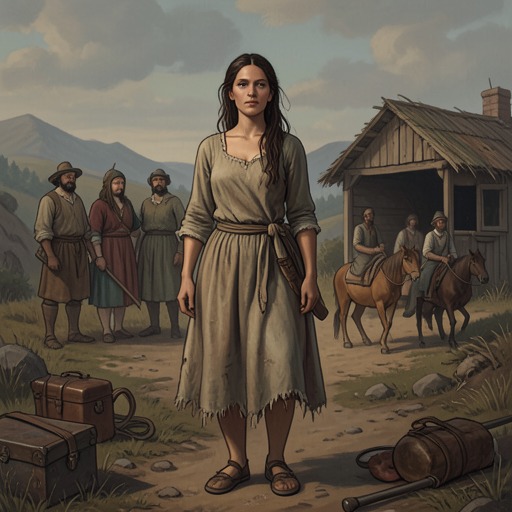
Molly’s final approach is deliberate. She told Louisa that she would not wear shoes; the choice is tied to her wish to honour her mother and to feel alive through her final steps. Nate steadies her when she falters near the rope. A trooper places the noose around her neck, while Nate steps aside, distressed and unable to look at her. The execution is carried out in public, before a crowd of stern male faces, and the formal reading of the sentence makes the state’s claim over her life explicit.
Louisa reaches the crowd with two other women, one of them Elpida Sava. They reveal messages written in charcoal on aprons: “Hear her! Battered wives are powerless! Legislate women’s rights now!” Holding hands, they step forward despite the disapproval of men in the crowd. Their protest connects Molly’s fate to Louisa’s effort to secure legislation for battered wives. Nate is moved by his wife’s courage, but remains in his appointed role as Everton’s peacekeeper. The public scene gives the women a visible voice without granting them the power to halt the sentence.
Molly and Louisa exchange a subtle nod, a silent recognition between them. That gesture is the scene’s counterpoint to the written charges: the law names Molly’s crimes, while the women name the powerlessness that helped shape her circumstances. Louisa’s protest cannot save Molly, and Nate cannot turn his sympathy into intervention. The gap between what they understand and what they can change is made visible on the platform.
Molly’s last thoughts and the children
As she waits, Molly recalls her father’s song, “And still I hope that the time will come when you and I will be as one.” She searches the crowd and imagines Delphi holding up a daisy-chain necklace, then Joe Junior and Henry James laughing and playing in the snow. These images turn the execution scene away from the official account of three murders and toward the family life Molly fears leaving behind.
Danny appears in her vision beside a snow gum. He signals to her with the gesture she taught him, blowing through his fist and opening his fingers; the breath and words are carried to her by a crow. Molly understands herself not simply as a drover’s wife but as a Ngarigo woman, and imagines Danny turning to go with confidence that he and the others are safe. Her hope of being remembered rests not on vindication by the court but on her children’s knowledge of her love and on their continued journey.
The ending does not confirm that the children have reached safety. In the mountains, they are exhausted and dangerously cold: Joe Junior helps Henry James up, while Danny carries Delphi, whose condition is uncertain. The contrast between Molly’s hope and the children’s immediate peril makes the separation unfinished rather than resolved. Her imagined reunion offers emotional assurance, but the narrative leaves the family’s physical survival uncertain.
Law, responsibility, and memory
Nate’s position reveals the execution’s moral division. He has lost sleep over his decision, wondering whether he should have overlooked Molly’s crime, yet he believes the evidence against her—especially in Trooper Leslie’s death—requires him to uphold the law. At the gallows he again wishes he had let her go to her children, but cannot reconcile that desire with his official duty. His final nod authorizes the trooper to proceed; it does not erase his distress or his recognition that the process has been biased.
The execution also marks the limits of the protection available to Molly as a mother and as a woman who has endured abuse. Louisa’s appeal for legislation is explicitly aimed at preventing other battered wives from facing the same powerlessness, but Nate believes reform will come too late to help Molly. Molly, for her part, has told him that her children will receive all the help and love they need. The scene sets that promise against the removal order and the children’s exposure in the mountains, showing how maternal care persists even when institutions threaten to sever the family.
In its final movement, the novel places the crow above the gallows as Molly gives her soul to its wings. Her last imagined words and gestures preserve a bond with Danny, while the mountains remain the image of home and belonging. The execution ends Molly’s life under the law’s authority, but the narrative refuses to let the sentence be the sole account of who she was: mother, survivor, and Ngarigo woman, remembered through her children and through the protest of those who witnessed her death.